Power is most of the answer
The MLS carries two separate entries for the same building: Workshop, and Workshop w/Electric. It is close to the only meaningful distinction the record makes about an outbuilding, and it turns out to be the one that matters.
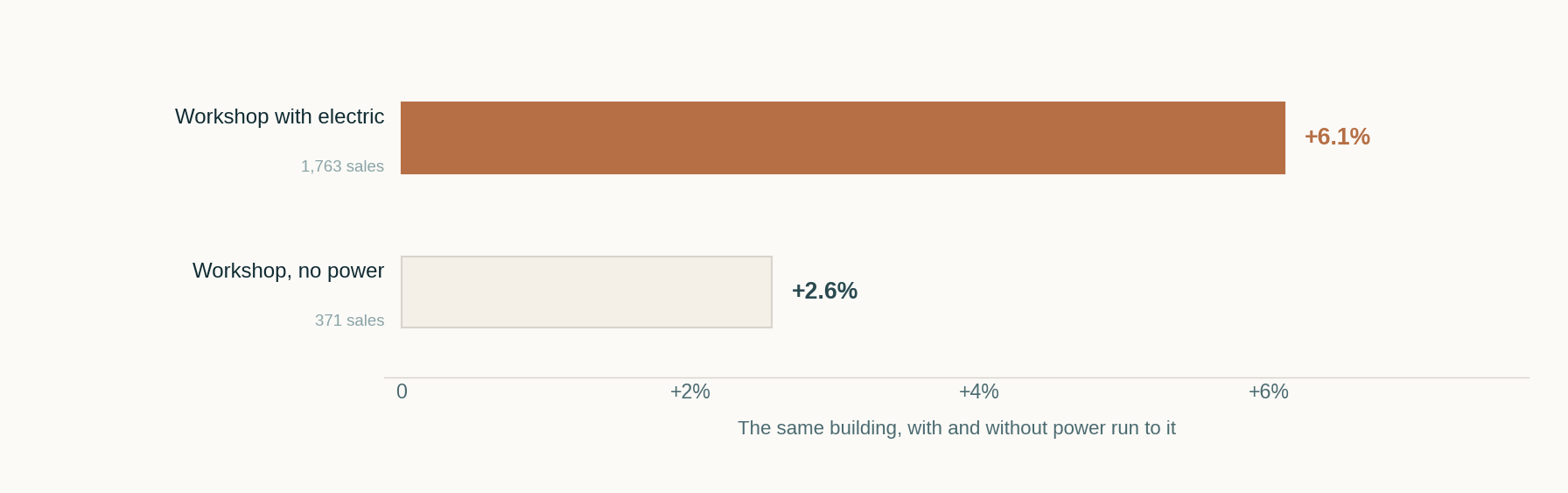
A shop without power is a large shed. You can store things in it. You cannot work in it after dark, run a compressor, charge anything, weld, or heat it in January. The market prices that difference at roughly three and a half points, which on the median shop property is about $18,000.
Trenching a circuit out to an existing building and setting a subpanel is a few thousand dollars in most cases. There is nothing else in this body of research where the ratio between what a thing costs and what it returns is anywhere near that favourable.
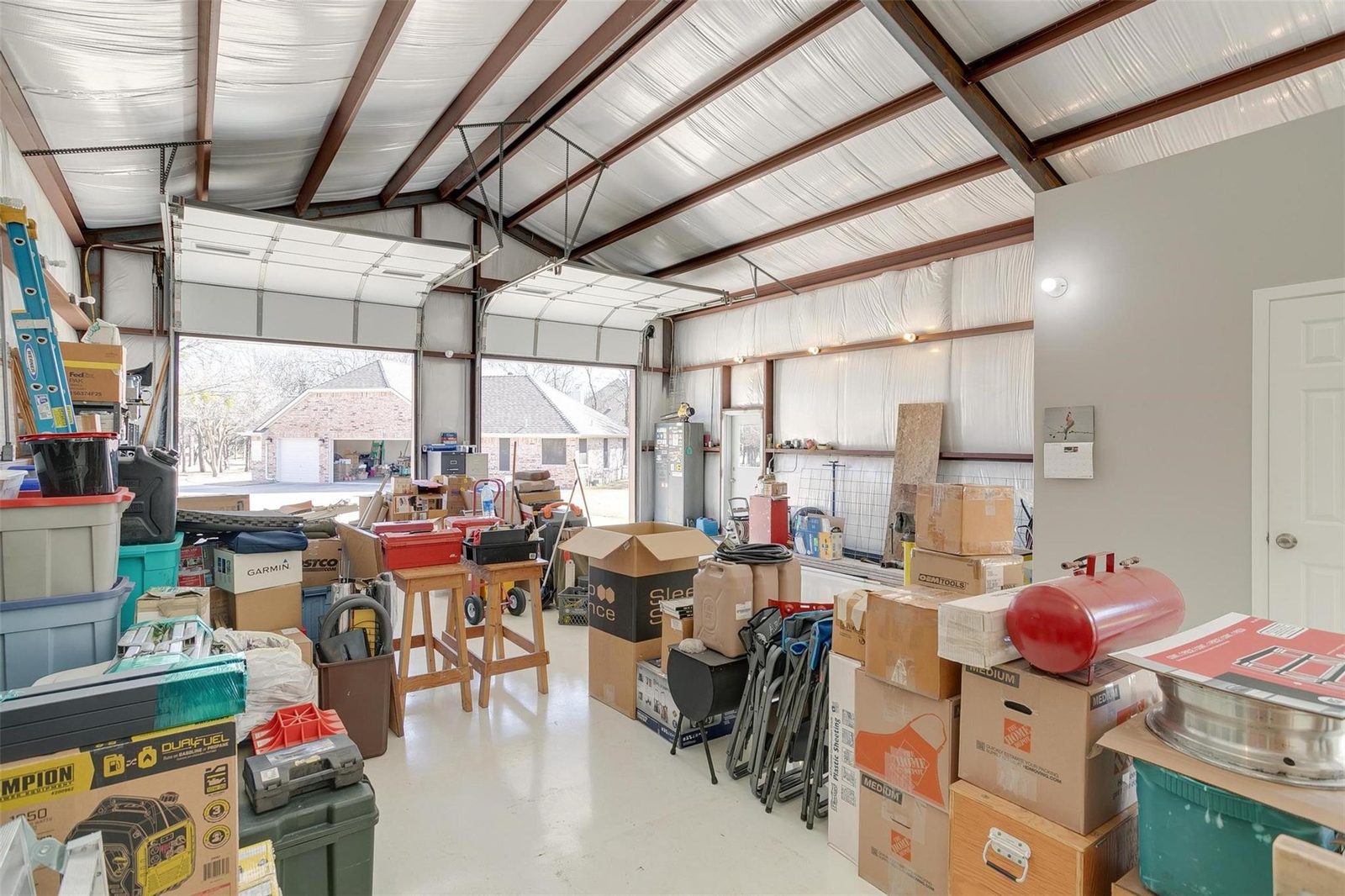
If the shop has power and the listing says only “Workshop,” the field is costing you money. If it does not have power and a circuit can be run before listing, the arithmetic is unusually clear.
And scale is the rest of it
A workshop can be a 400 square foot metal box or four thousand square feet of conditioned space with a fourteen-foot roll-up door. The MLS records both as Workshop. There is no field for the size of an outbuilding — Building Area Total is populated on zero of 89,302 records.
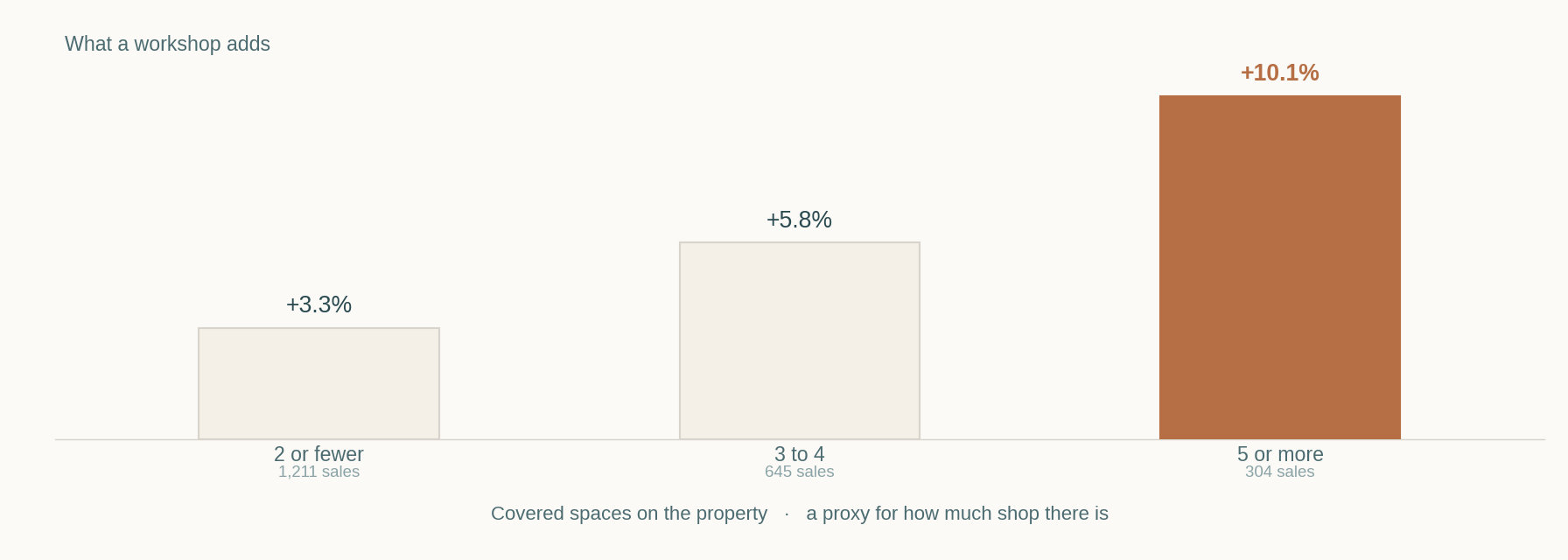
Two indirect measures get at it. The first is how many covered spaces the property reports:
The second is how many separate structures the listing names. A property with one outbuilding of record carries +2.6%. Four or more carries +8.0%:
| Structures listed | Sales | Workshop adds | 95% interval |
|---|---|---|---|
| 1 | 638 | +2.6% | +0.9 to +4.4% |
| 2 | 525 | +3.4% | +1.4 to +5.4% |
| 3 | 409 | +4.9% | +2.4 to +7.4% |
| 4 or more | 567 | +8.0% | +5.7 to +10.3% |
Both measures climb steadily, and they are measuring the same underlying thing: how much building is out there. I have appraised a property in Parker County with five separate shops totalling roughly ten thousand square feet. It sits in the top row of both tables, and calling what it has a “workshop” in the same breath as a 24×24 slab with a roll-up door is the central problem with any single number on this page.
So treat the pooled 5.7% as the midpoint of a range running from about 2.6% to 10%, not as an adjustment.
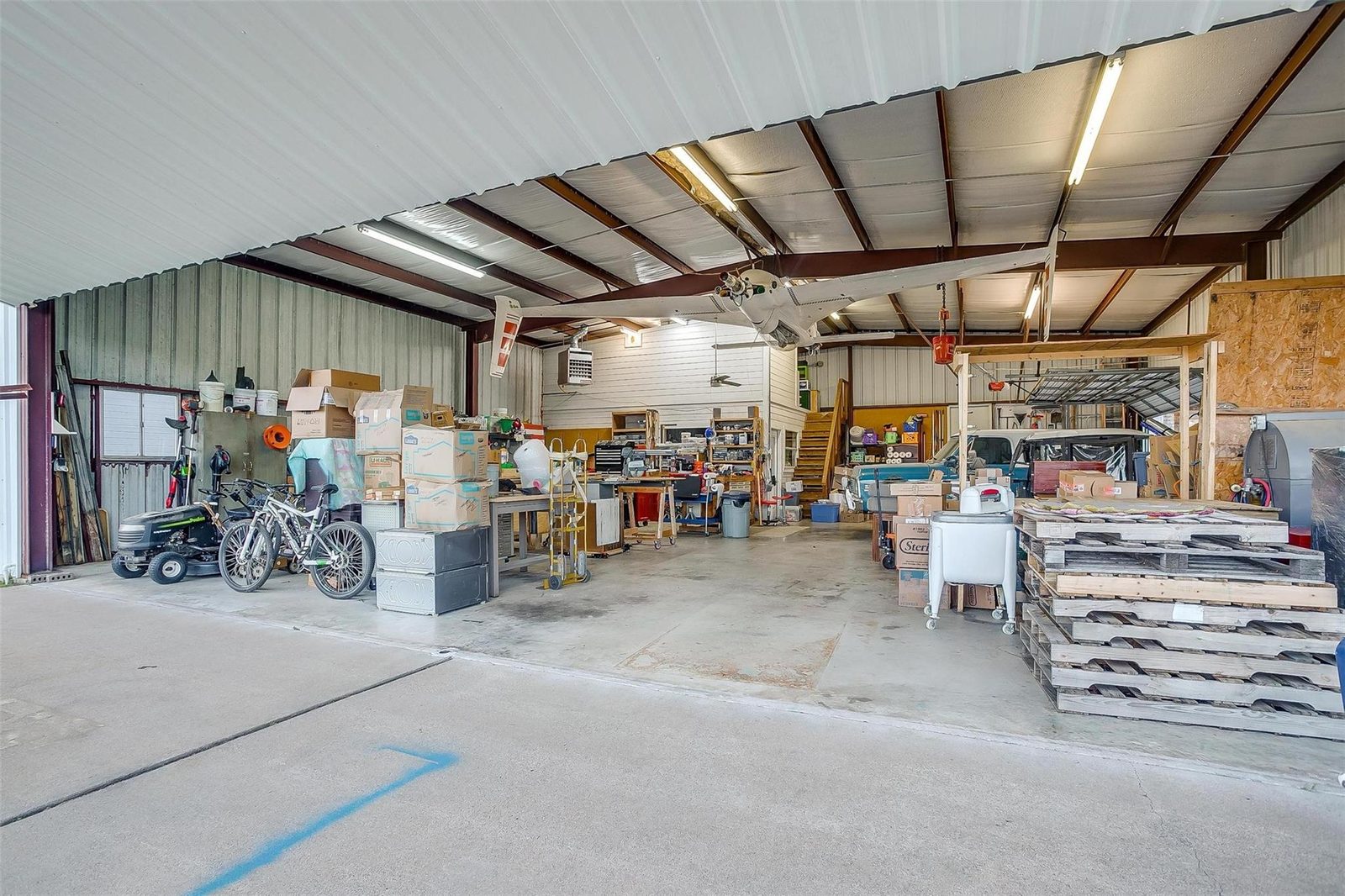
One more proxy points the same way. Shops with an accessory unit of record — a finished room, an office, an apartment over the bays — add 9.0% against 4.3% for those without. Eave height is not recorded anywhere, but a taller building is what makes a second level possible, and the buildings that demonstrably have one carry roughly double the premium. The door gives a second route at the same question, below.
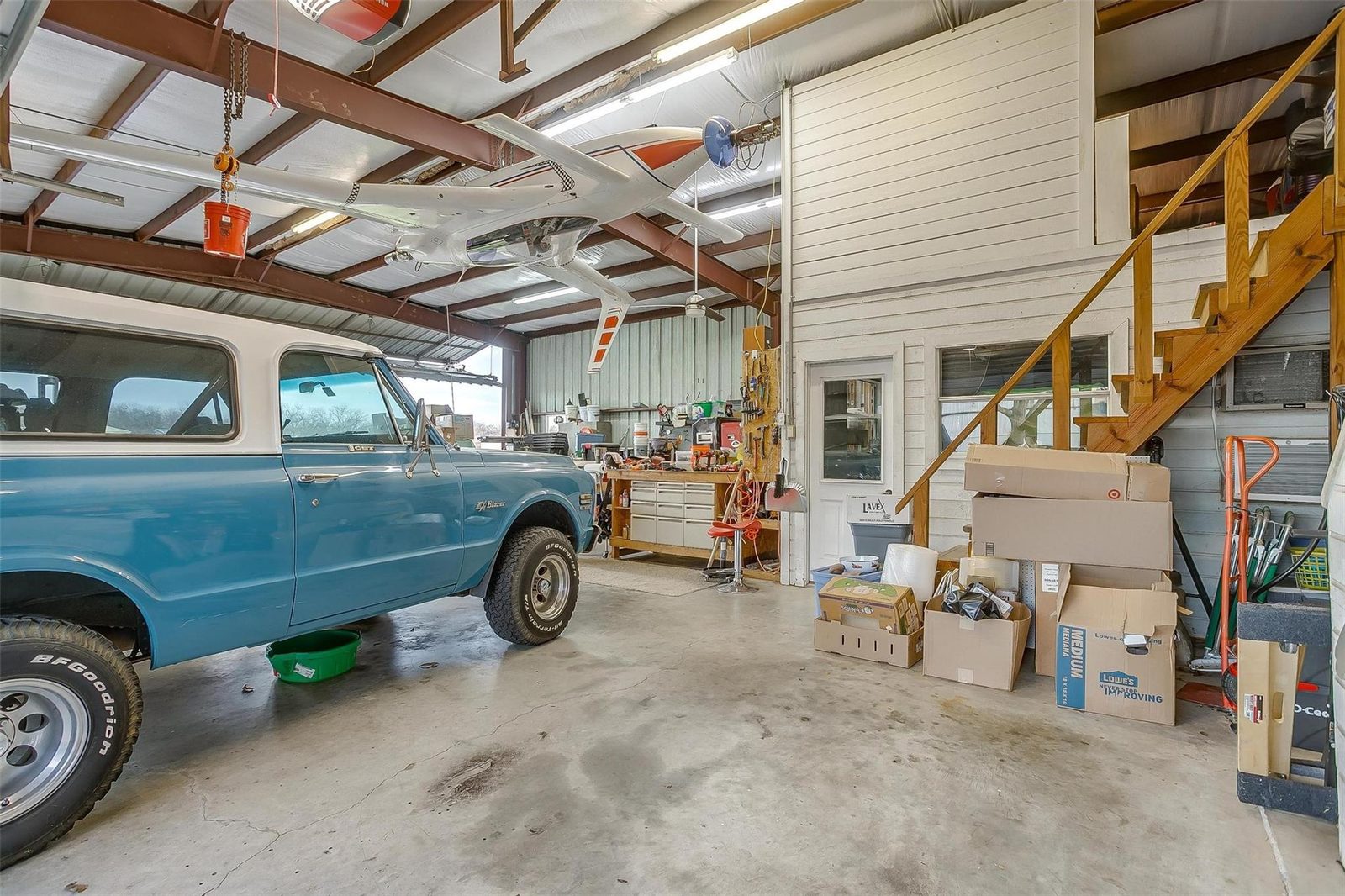
The door is the other half of it
Eave height is not recorded anywhere, so it cannot be measured directly. But height is mostly a means to an end: a taller building takes a taller roll-up door, and a taller door takes a motorhome, a gooseneck, a boat on a tandem trailer or a commercial truck.
That is recorded, in the parking-features field, and it sorts into a clean gradient.
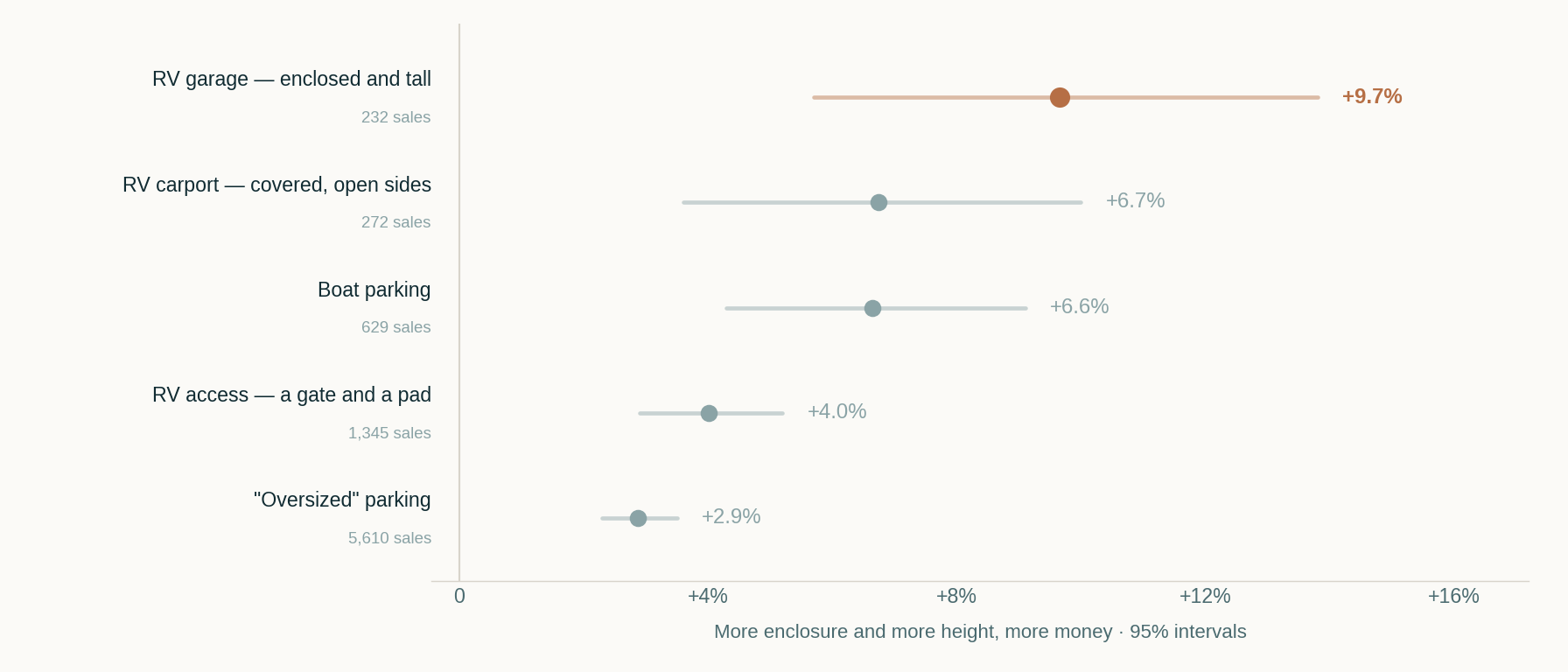
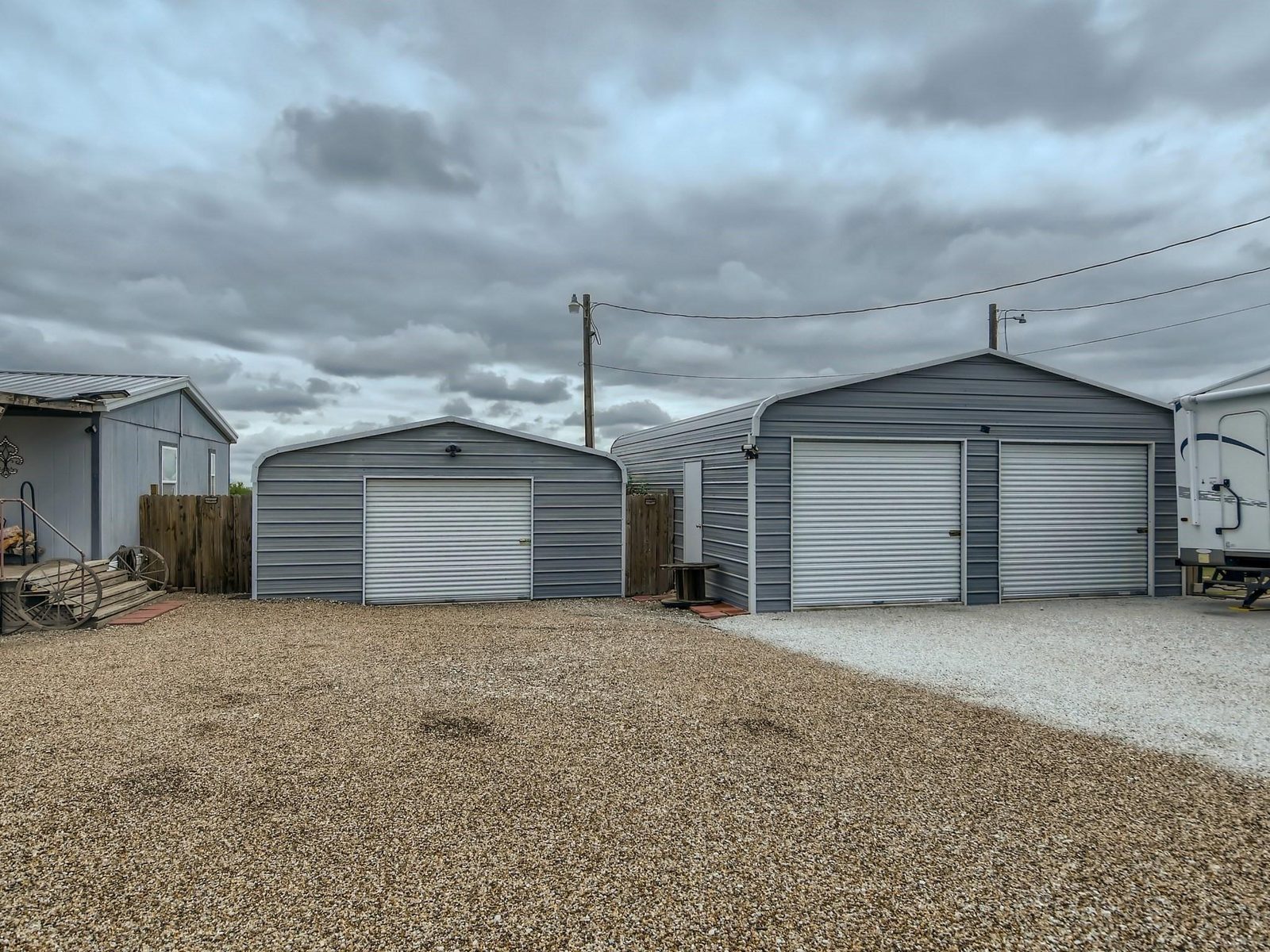
An RV garage — enclosed, and necessarily tall — adds 9.7%, the highest figure of any parking feature in the data and higher than a workshop, a barn or a second garage. An RV carport, covered but open-sided, adds 6.7%. A gate and a slab to park on adds 4.0%. Generic “oversized” parking adds 2.9%.
The same thing shows up when you split the workshops themselves:
| Workshop | Sales | Adds | 95% interval |
|---|---|---|---|
| No big-vehicle capability of record | 1,350 | +3.5% | +2.2 to +4.7% |
| With big-vehicle capability | 814 | +8.2% | +6.4 to +10.1% |
More than double, for the same word in the same field.
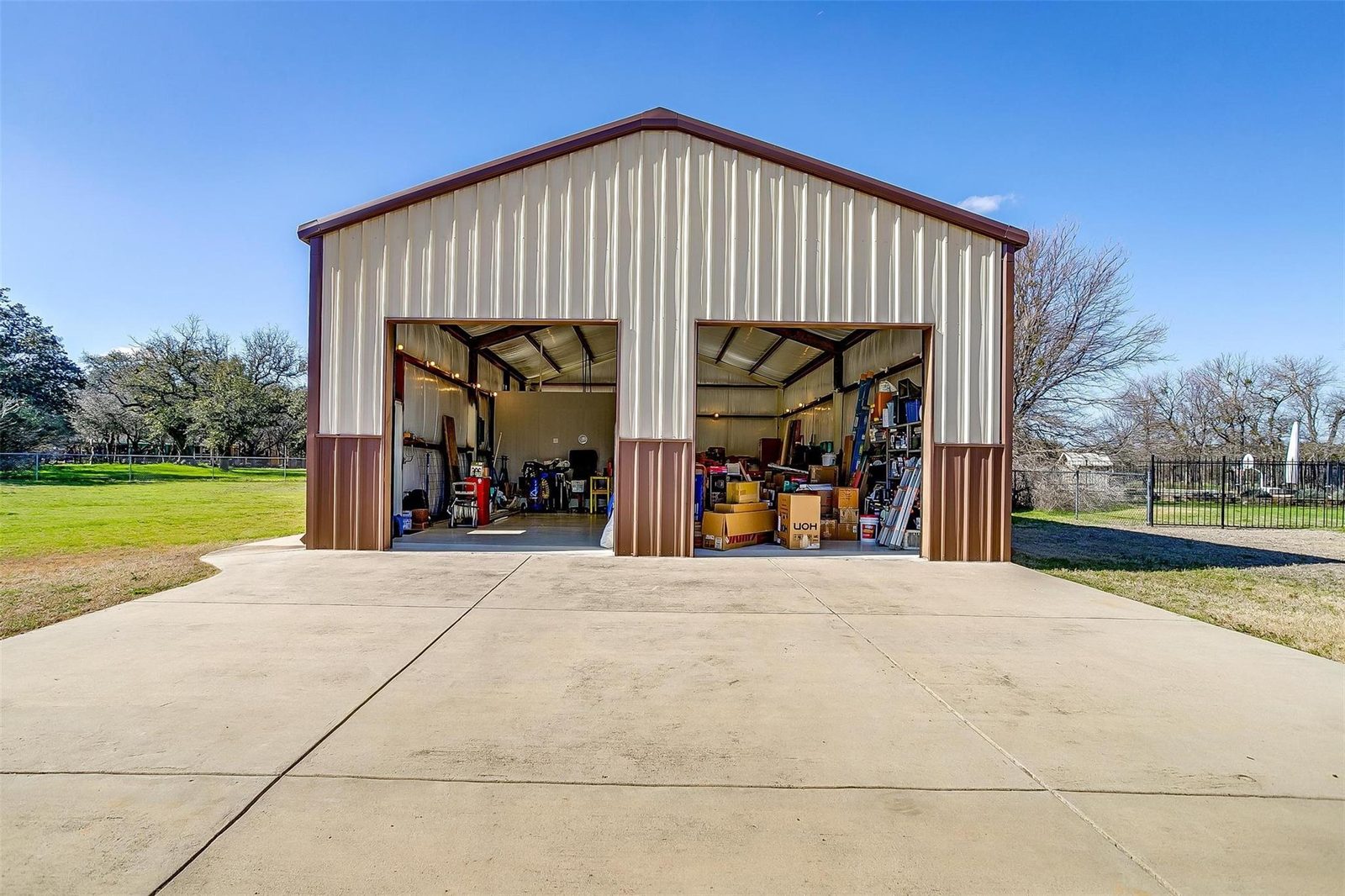
People who own motorhomes and commercial trucks tend to have more money, and their shops tend to sit on better properties. So is this measuring the door, or the owner?
Restrict the comparison to genuinely ordinary properties — lots under an acre, in subdivisions where the median house sells for under $500,000 — and the gap survives almost unchanged: +3.2% for a plain shop against +7.9% for one that takes a large vehicle. An average house in an average neighbourhood with a tall shop is worth materially more than the same house with a standard one.
Which makes height a design decision rather than a detail. The incremental cost of a fourteen-foot eave over a ten-foot one at the framing stage is small. Retrofitting it later is not a job at all — it is a new building.
Why it rewards acreage
| Lot size | Sales | Workshop adds | 95% interval |
|---|---|---|---|
| Under a quarter acre | 490 | +3.4% | +1.7 to +5.2% |
| A quarter acre to an acre | 574 | +5.5% | +2.8 to +8.1% |
| One to five acres | 839 | +7.9% | +6.4 to +9.4% |
| Five acres and up | 82 | +8.8% | +1.1 to +17.0% |
A shop on a tenth of an acre is storage. A shop on five acres is frequently why the buyer wanted five acres. The building has not changed; what has changed is whether the property can support the use the building implies — equipment, trailers, livestock, a business run from home, room to work outside it.
This is the opposite of how a guest house behaves. Accessory units contribute about the same on a suburban lot as on acreage, because what they do for a buyer is the same either way. A shop is only as useful as the ground around it.
Everything else in the yard
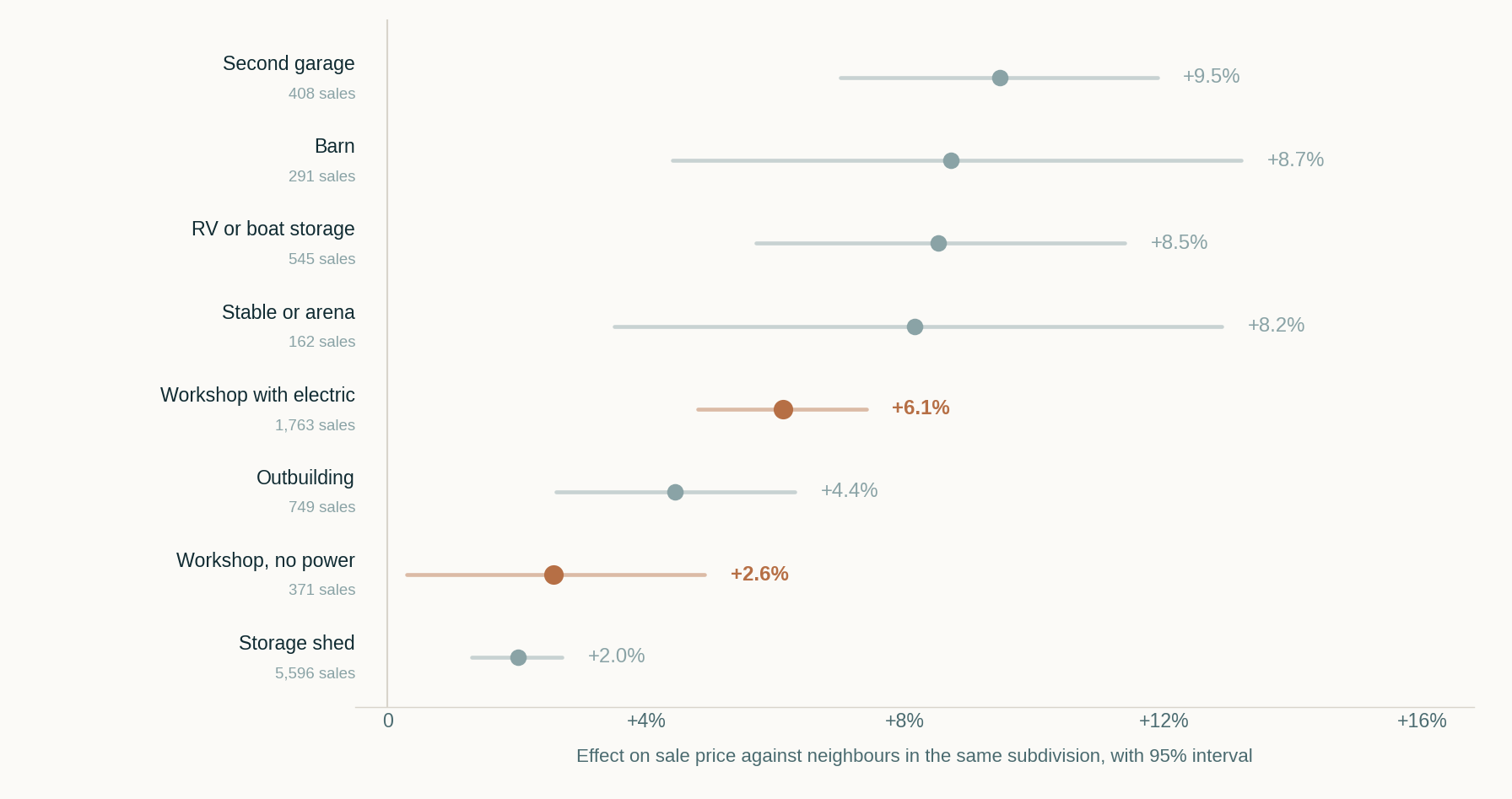
Two results here are worth pausing on.
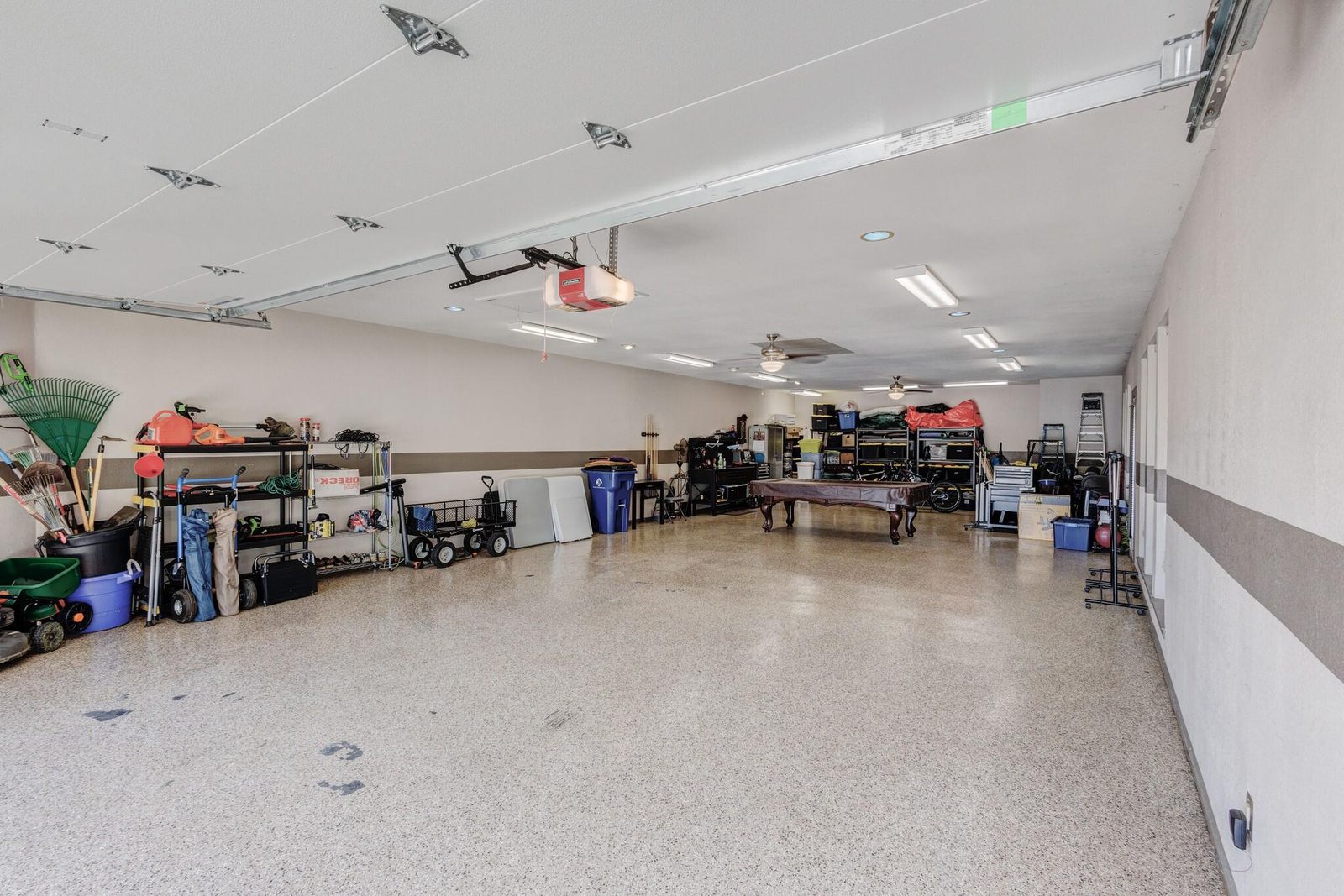
A second garage outperforms a barn. +9.5% against +8.7%, and the second garage rests on a larger sample. That is a suburban feature beating an acreage one, which is not what most people would guess. A second garage is usually attached or near the house, finished, powered, and immediately usable by an ordinary buyer. A barn is none of those things for most of the market.
A storage shed adds 2.0% on 5,596 sales — the largest sample in this entire body of research, and essentially the same figure as a workshop with no power. Which is the clearest possible statement of what the market is actually paying for. It is not the structure. It is whether the structure can be used.
Where a shop pays, and where everyone already has one
| County | Share of sales with a shop | Workshop adds | 95% interval |
|---|---|---|---|
| Parker | 9.5% | +7.6% | +5.2 to +10.0% |
| Johnson | 4.7% | +7.0% | +4.2 to +9.8% |
| Tarrant | 1.8% | +4.9% | +3.2 to +6.5% |
| Hood | 6.3% | +2.8% | −3.3 to +9.3% |
| Wise | 14.3% | −1.9% | −5.4 to +1.7% |
Parker County is the best market for a shop in North Texas, and it is not close: 9.5% of sales have one and they carry a 7.6% premium.
Wise County is the instructive one. It has the highest share of properties with a shop of any county here — 14.3% — and no measurable premium at all. When a feature is close to standard, having one stops being a reason to pay more; not having one starts being a reason to pay less. Same inversion that happens with swimming pools above $1.2 million.
Hood County does not separate from zero either, on 185 sales. Both are worth knowing before anyone quotes a countywide figure at you.
Against what one costs
A turnkey 30×40 metal building in the DFW area — kit, erection, slab, basic doors — runs roughly $42,000 to $60,000, against $38,000 to $55,000 in North and West Texas and $48,000 to $68,000 on the Gulf Coast. Shell-only installation runs about $25 to $45 per square foot.
One local cost is specific to this market. On Dallas-area black clay a thickened slab with turn-down footings runs $6 to $9 per square foot, against $4 to $6 on sandy or limestone soil. On a 40×60 that is $18,000 to $30,000 of foundation before the building goes up — the same expansive-clay problem that adds ten to twenty-five thousand to a swimming pool here.
Against that, a powered shop adds about $32,400 on the median house that has one. So a modest 30×40 returns somewhere around half to three quarters of what it costs, which is better than a guest house and comparable to a swimming pool — at a fraction of either one's build cost in absolute terms.
What nobody publishes per square foot: insulation, electrical rough-in, roll-up doors by size or height, plumbing, or heating and cooling. Those are quoted per job, and the ranges are wide enough that a published average would be worse than no number at all. Price them from bids, not from an article.
Handling one in a report
Establish power first. It is the single largest recorded distinction between one shop and another, and it is worth more than double. The MLS separates Workshop from Workshop w/Electric; use it, and verify it on inspection rather than trusting the entry.
Measure the building. No field records outbuilding area, so if size is not in the report it is not in the analysis. A 600 square foot shop and a 3,000 square foot shop are the same word in every comparable you pull.
Measure the door. Width and height decide what can physically go in the building, and the data says the market prices that heavily — a shop that takes a large vehicle carries more than double one that does not. Record the opening dimensions and the eave height; neither is in the MLS and both move the number.
Note the rest of what makes it usable. Slab thickness, insulation, climate control, plumbing, three-phase service, and whether there is finished space inside. None of it is recorded and all of it is priced.
Do not carry a figure across county lines. Parker at 7.6% and Wise at nothing are forty miles apart.
And bracket on the whole improvement set, not the shop alone. The premium climbs with the number of structures, so a property with a shop, a barn and RV cover is not three separate adjustments added together.
What this does not say
Size, finish and quality are invisible. This is the central limitation and it is a large one. A 400 square foot uninsulated box with a single roll-up door and a four-thousand-foot conditioned shop with fourteen-foot doors and a finished office record identically. The proxies above — covered spaces, structure count — get at scale indirectly, and imperfectly.
Nor are most of the things that decide how usable a shop is. Roll-up door dimensions, eave height, slab specification, insulation, plumbing, heating and cooling appear nowhere in the record. The big-vehicle finding above uses parking-features entries as a proxy for a door large enough to admit one; it is an inference about height, not a measurement of it.
Properties where the shop is the improvement are not handled well. On an airpark lot or a shop-with-quarters, the conventional house may be small or absent, and a model controlling for living area will misread that badly. Only 20 sales here list an aircraft hangar and 35 pair a workshop with a house under 1,000 square feet — too few to analyse and too few to exclude with confidence.
Residual quality is not controlled. Properties with substantial outbuildings differ from their neighbours in ways beyond living area and lot size. Some part of every figure here is the kind of property rather than the building on it.
And a shop takes slightly longer to sell — a median 34 days to contract against 31. Worth more, to fewer buyers.
Terrence Bilodeau is a Certified Residential Appraiser (TX-1360232) and a Texas real estate broker. Clearfork Appraisals provides private-client appraisals in Fort Worth and across Tarrant, Parker, Johnson and Hood counties. This article is a general market study. It is not an appraisal and not a valuation opinion about any specific property.
Common questions
How much does a workshop add to a home's value?
About 5.7% of the sale price overall, but that average conceals a wide range. A workshop with electrical service adds 6.1% (95% interval +4.8% to +7.4%); one without power adds 2.6%. By scale it runs from 3.3% on properties with two or fewer covered spaces to 10.1% at five or more. Measured against neighbouring houses in the same subdivision across 2,125 workshop sales in 89,302 Dallas–Fort Worth closings.
Does running electricity to a shop increase its value?
Substantially — it more than doubles what the building contributes. A workshop with electric adds 6.1% against 2.6% without, a gap of roughly three and a half points, or about $18,000 on the median shop property. Trenching a circuit and setting a subpanel typically costs a few thousand dollars, which makes it the best cost-to-return ratio in this body of research.
Is a shop worth more on acreage?
Yes, and markedly. A workshop adds 3.4% on lots under a quarter acre, 5.5% from a quarter acre to an acre, 7.9% on one to five acres, and 8.8% above five acres. A shop is only as useful as the ground around it, which is the opposite of how a guest house behaves — those contribute about the same regardless of lot size.
Does the height of a shop affect its value?
It appears to, through what the door can admit. Eave height is not recorded in the MLS, but a taller building takes a taller roll-up door, and that is recorded. An enclosed RV garage adds 9.7% — the highest figure of any parking feature measured. An RV carport adds 6.7%, a gate and a parking pad 4.0%, and generic oversized parking 2.9%. Splitting workshops the same way, one with big-vehicle capability adds 8.2% against 3.5% for one without. Restricting to lots under an acre in subdivisions where houses sell under $500,000, the gap holds at 7.9% against 3.2% — so it is not simply that people who own motorhomes buy better properties.
What does a metal shop building cost in Dallas–Fort Worth?
A turnkey 30×40 — kit, erection, slab and basic doors — runs roughly $42,000 to $60,000 in the DFW area. Shell-only installation is about $25 to $45 per square foot. On Dallas-area black clay a thickened slab with turn-down footings adds $6 to $9 per square foot against $4 to $6 on sandy or limestone soil. Insulation, electrical, door upgrades and climate control are quoted per job and are not published per square foot.
Which North Texas county pays the most for a workshop?
Parker County, at 7.6%, where 9.5% of sales have one. Johnson follows at 7.0% and Tarrant at 4.9%. Wise County is the exception worth knowing: it has the highest share of properties with a shop at 14.3% and no measurable premium at all — when a feature is close to standard, having one stops being a reason to pay more.
Does the MLS record how big a workshop is?
No. There is no field for outbuilding area, and Building Area Total is populated on none of the 89,302 records. Roll-up door size, eave height, insulation, plumbing and climate control are not recorded either. A 400 square foot uninsulated box and a 4,000 square foot conditioned shop appear identically as “Workshop.”
- North Texas Real Estate Information Systems (NTREIS) closed sales, detached single-family, Dallas–Fort Worth, 2023 – September 2026. 89,302 closings; 2,125 with a workshop of record in a subdivision containing both. Author's analysis; figures reported in aggregate.
- SteelBuildingKit — Metal buildings in Texas, 2026 (regional turnkey pricing; slab cost on expansive clay)
- Elite Steel — Metal building cost, 2026 (shell and slab per square foot by framing type)
- AA Metal Buildings — Texas metal building prices (installed shell ranges)
Build costs are published Texas ranges, not independent estimates or local bids. No published source breaks out insulation, electrical, door size or climate control per square foot; those are quoted per job and are deliberately not estimated here. Outbuilding size, height and finish are not recorded in the MLS at all.