- Appraisal district
- Parker County Appraisal District, Weatherford
- Cities and towns
- Weatherford, Aledo, Willow Park, Hudson Oaks, Springtown, Millsap, Peaster, Poolville, Reno, Cool, Sanctuary, the Annettas
- Ag valuation minimums
- The district publishes minimum acreage guidelines by use type; confirm current thresholds with the appraisal district
- Rollback
- Change of use triggers recapture for the three preceding years
- Utilities
- Private wells under the Upper Trinity Groundwater Conservation District; on-site sewage facilities under TCEQ rules
- Property types I appraise
- One-to-four unit residential and residential land only
What the Parker County market actually did, 2023–2026
Measured from 17,030 Parker County listings on 11,500 addresses — every residential listing in the MLS over three years, whether it sold or not. Parker is the largest market in this research by value: 3,250 closings a year at a $464,995 median.
- Volume up 12%, price per foot dead flat. $207, $208, $208 across three years. Parker is growing without appreciating.
- 39.4% of listings failed. 22.2% of houses never sold. A fifth of Parker addresses carried more than one listing.
- Here, unlike Granbury, overpricing really does explain it. Houses that sold opened 5% above what the market paid. Houses that failed opened 12% above.
- This is an acreage county, and acreage is where it breaks. 5,511 addresses sat on one to five acres. Above twenty acres, 53.0% never sold.
- The top of the market is hard. 37.6% of houses asked above $750,000 never sold.
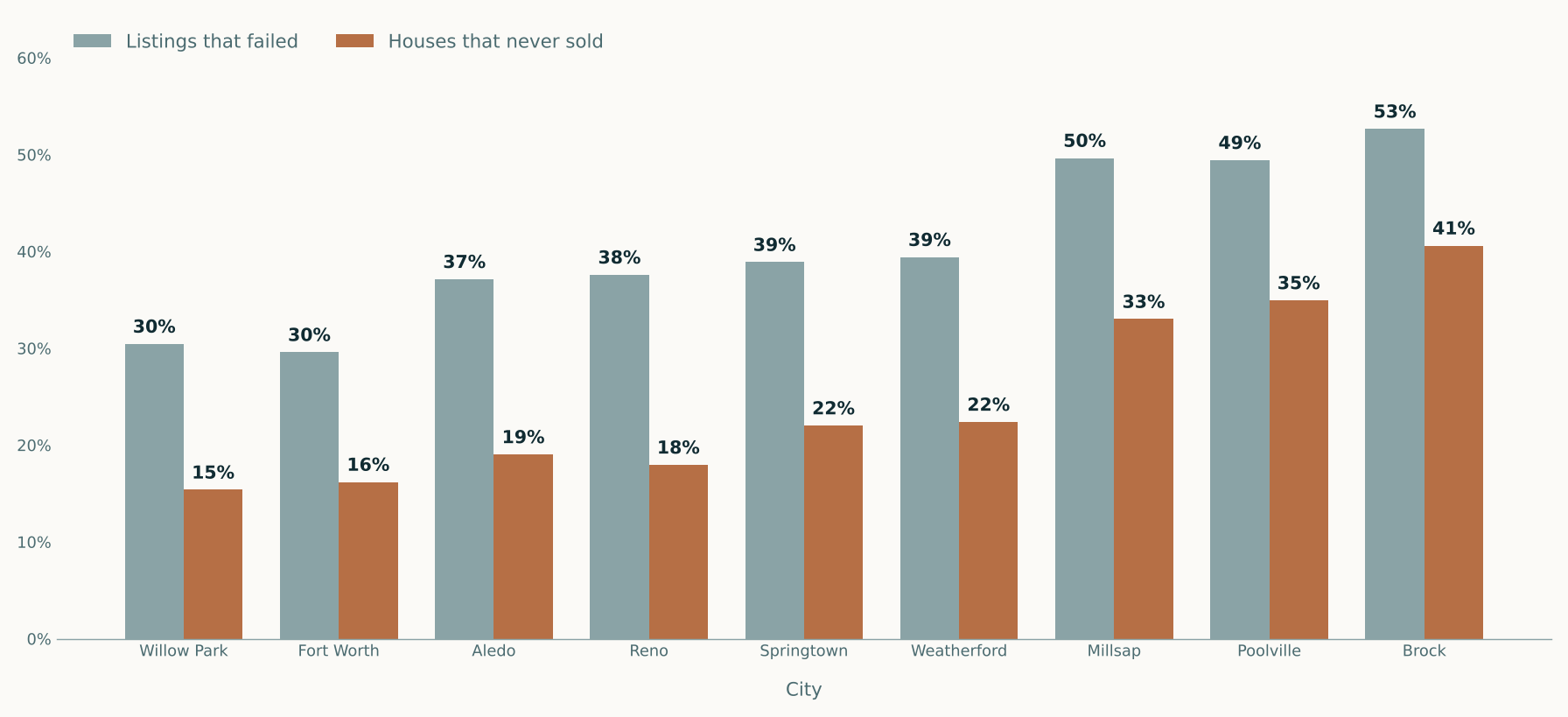
- Fifteen minutes decides a lot. Willow Park 15.4%, Brock 40.6%.
| 12 months ending | Sold | Listings that failed | Rate | Median price | $/sqft | CDOM |
|---|---|---|---|---|---|---|
| October 2024 | 2,899 | 1,817 | 38.5% | $460,000 | $207 | 67 |
| October 2025 | 3,085 | 2,133 | 40.9% | $468,950 | $208 | 74 |
| October 2026 | 3,250 | 2,058 | 38.8% | $464,995 | $208 | 74 |
Three years, three identical numbers for price per foot. Volume rose 12% and the market gave none of it back in appreciation.
Two ways to count a failure
15,243 listings reached an outcome and 6,009 ended without a sale — 39.4%. Those listings sat on 11,500 distinct addresses, 22.7% of which were listed more than once.
| Measure | Failed | Of | Rate |
|---|---|---|---|
| Listings that ended without a sale | 6,009 | 15,243 listings | 39.4% |
| Houses that never sold at all | 2,549 | 11,500 addresses | 22.2% |
2,489 of the failed listings — 41% — were at an address that sold under a different listing. Everything below is labelled, because the two measures do not always rank places the same way.
In Parker County, the asking price really does decide it
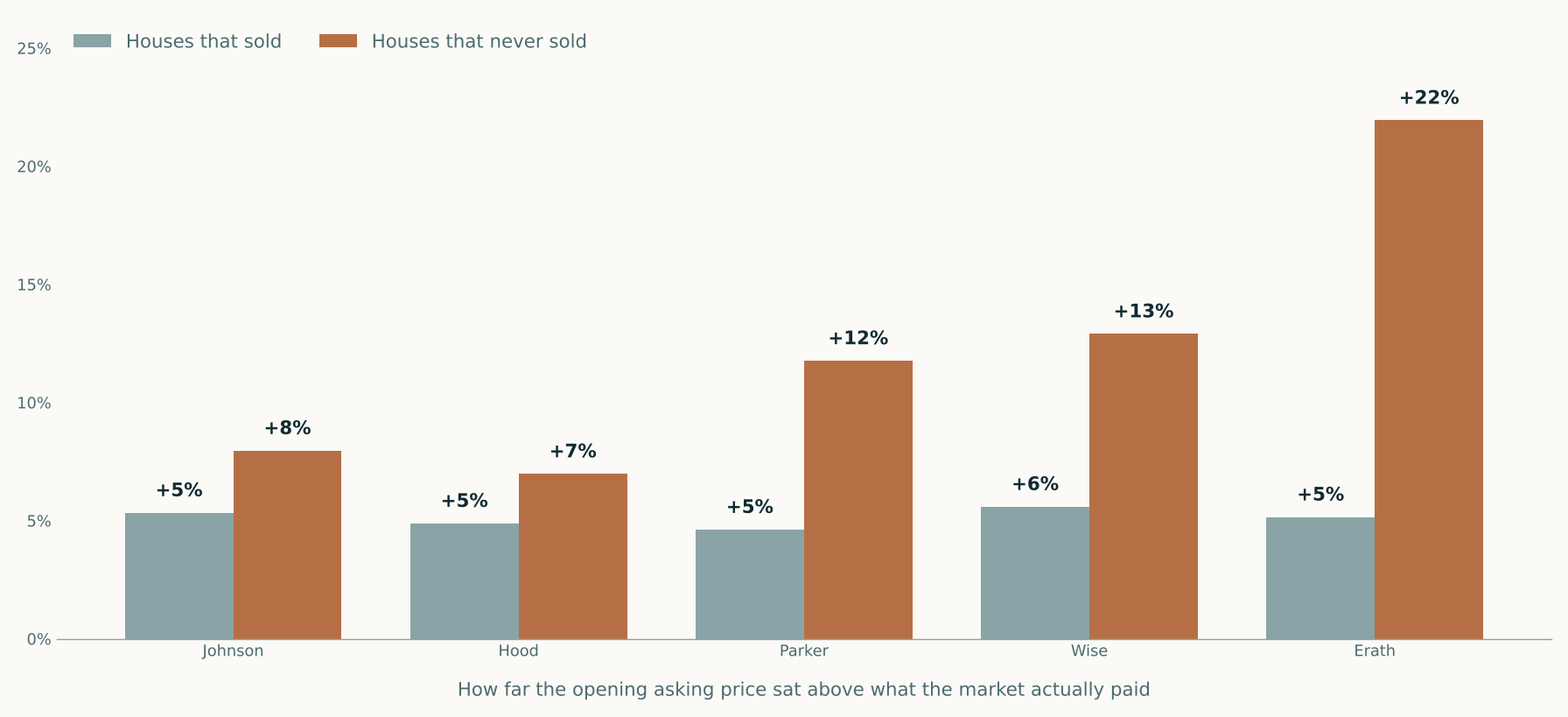
This is the most consistent finding in three years of data across five counties. Houses that sold opened at about 5% above the price per foot the market was actually paying — in every single county, within a point. Johnson 5%, Hood 5%, Parker 5%, Wise 6%, Erath 5%.
The houses that failed are where the counties separate. In Granbury they opened just 7% high, which is why price explains almost nothing there. In Parker County they opened 12% high — $232 per foot against the $208 that transacted.
So the standard advice works here in a way it does not everywhere. A Parker County seller who opens within about 5% of supportable value is behaving like the houses that sell. One who opens 12% above is behaving like the houses that do not.
Acreage is the Parker County problem
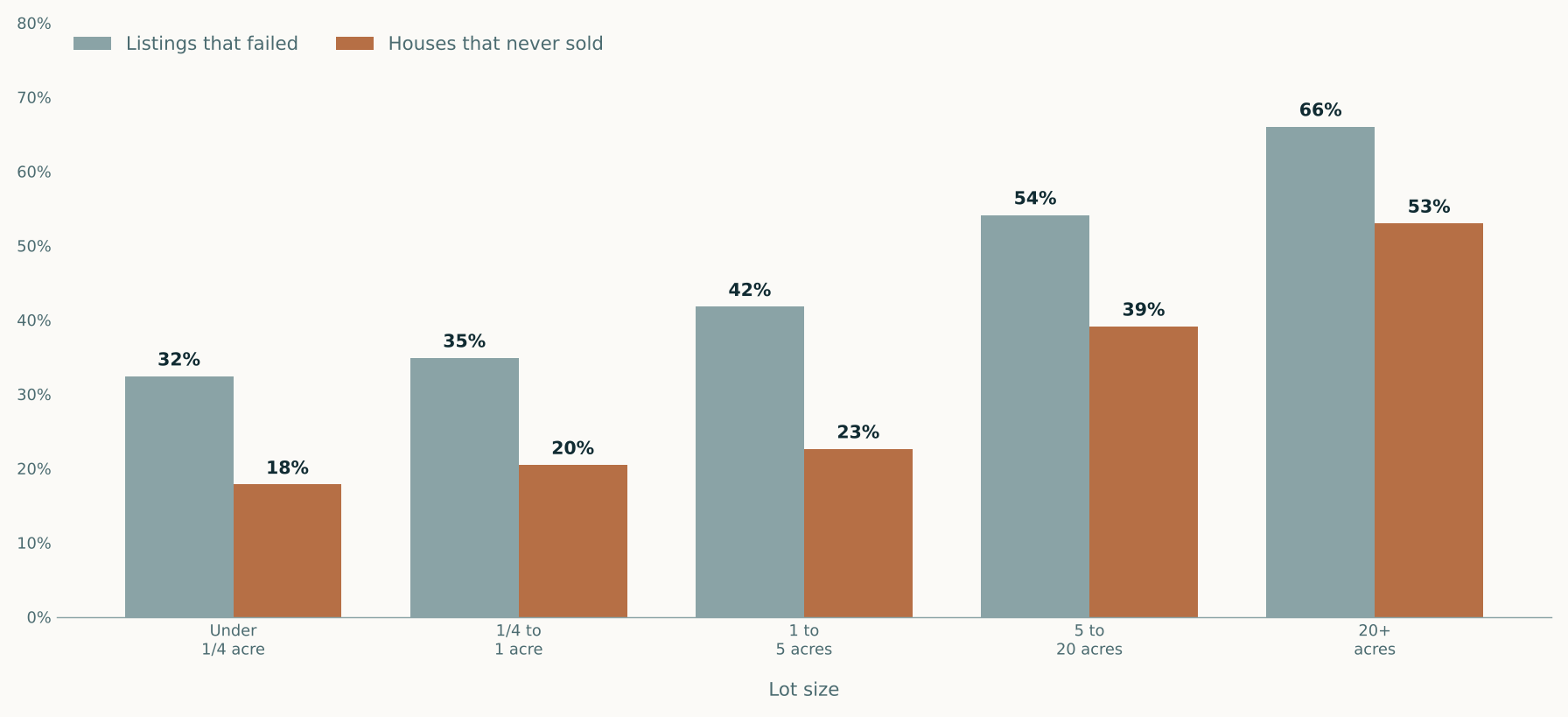
Parker is the land county. 5,511 addresses — nearly half of everything that resolved — sat on one to five acres, against 1,440 in Johnson. That is the defining feature of the market and it is where the failures concentrate.
| Lot size | Addresses | Listings that failed | Houses that never sold | Median sold |
|---|---|---|---|---|
| Under 1/4 acre | 3,388 | 32.4% | 17.8% | $395,000 |
| 1/4 to 1/2 acre | 1,039 | 35.3% | 21.1% | $336,700 |
| 1/2 to 1 acre | 661 | 34.2% | 19.8% | $425,000 |
| 1 to 5 acres | 5,511 | 41.8% | 22.6% | $520,000 |
| 5 to 20 acres | 754 | 54.1% | 39.1% | $722,500 |
| 20 acres and up | 183 | 66.0% | 53.0% | $1,432,500 |
Properties classified Farm/Ranch failed 48.8% of the time, and manufactured homes 34.7%.
Above twenty acres, a majority of what comes to market never sells. That has a direct consequence for valuation: the closed sales available to support a price on a large tract are the minority of attempts that worked, and there is no visible record in a comparable grid of the ones that did not.
Where in Parker County, and the I-20 line
| City | Addresses | Listings that failed | Houses that never sold | Median sold | CDOM |
|---|---|---|---|---|---|
| Willow Park | 312 | 30.5% | 15.4% | $434,500 | 49 |
| Fort Worth (Walsh) | 766 | 29.6% | 16.2% | $590,000 | 104 |
| Reno | 206 | 37.6% | 18.0% | $475,000 | 94 |
| Aledo | 1,749 | 37.1% | 19.0% | $553,275 | 73 |
| Hudson Oaks | 83 | 27.7% | 19.3% | $522,500 | 46 |
| Springtown | 1,717 | 38.9% | 22.0% | $376,338 | 80 |
| Weatherford | 4,547 | 39.4% | 22.4% | $425,000 | 62 |
| Lipan | 104 | 48.0% | 28.8% | $582,000 | 90 |
| Millsap | 209 | 49.6% | 33.0% | $494,950 | 76 |
| Poolville | 535 | 49.4% | 35.0% | $465,000 | 98 |
| Brock | 133 | 52.7% | 40.6% | $548,800 | 91 |
Willow Park, Hudson Oaks, Aledo and the Walsh side of Fort Worth sit on or beside Interstate 20. Poolville, Millsap and Brock do not. The corridor towns clear at 15–19%; the ones off it at 33–41%. Brock fails nearly three times as often as Willow Park at a comparable median price, which means the difference is not what the house costs.
Weatherford, at 4,547 addresses, is the county’s centre of gravity and sits at the county average on every measure.
Walsh, at 295 addresses, had 3.7% of its houses never sell. Covenant Park 6.2%, Morningstar 14.5%. These are builder-led communities with controlled release and standardised product, and they clear in a way the surrounding resale market does not. They also make poor comparables for an established house on acreage two miles away, which is a routine source of argument in this county.
The top of the market
| Asking price | Addresses | Listings that failed | Houses that never sold |
|---|---|---|---|
| Under $250,000 | 984 | 37.9% | 25.2% |
| $250,000–350,000 | 1,966 | 28.6% | 18.7% |
| $350,000–500,000 | 3,505 | 32.8% | 19.9% |
| $500,000–750,000 | 3,614 | 43.0% | 25.1% |
| $750,000 and up | 1,888 | 53.7% | 37.6% |
Parker carries far more volume above $500,000 than any other county here — 5,502 addresses, against 2,593 in Johnson — and that is also where it struggles. Over a third of houses asked above $750,000 never sold at all.
Combine that with the acreage finding and you have the Parker County seller most likely to end up with an expired listing: a large tract, above $750,000, off the I-20 corridor. That is also the hardest property in the county to price from comparable sales, because so few of them close.
What this means if you own a house here
The opening ask matters more here than in neighbouring counties. Five percent over market is what the houses that sell do. Twelve percent is what the houses that fail do. That is a narrower target than most sellers are given.
If you are on acreage, do not price from the closed sales alone. Above five acres, 39% of houses never sold; above twenty, 53%. The comparable grid shows you the survivors.
Know which side of I-20 you are on. Willow Park and Brock are twenty minutes apart and clear at 15% and 41%.
Do not price an established house off Walsh or Morningstar. Builder communities with 3.7% failure rates are not evidence about a 1998 house on three acres in Poolville, however close the square footage looks.
The county in two halves
The eastern edge of Parker County, running through Willow Park, Hudson Oaks and Aledo along the I-20 corridor, has absorbed a large share of Fort Worth's westward growth. That produces newer subdivision housing, municipal water and sewer in many locations, and a reasonably active sales market where conventional comparable selection works the way the textbook says it should.
Weatherford, the county seat, is the transition point. It carries an older core with pre-1940 housing near downtown, mid-century neighborhoods, and newer subdivision development around its edges, and it has enough sales volume to support most residential assignments internally.
Then there is the rest of the county: Springtown, Millsap, Peaster, Poolville, Brock, Reno, Cool, Sanctuary, the Annettas, and a great deal of unincorporated land in between. Out there the housing is acreage tracts with a house on them, manufactured and modular homes on land, barndominium-style construction, and older farmsteads. Sales are sparse, individual properties are highly varied, and the analysis is a different discipline.
No county zoning, so restrictions come from somewhere else
Texas counties do not have general zoning authority. In unincorporated Parker County there is no zoning map telling you what may be built next door. Land use control comes instead from recorded deed restrictions, plat notes, subdivision covenants, and state-level regulation of specific activities.
That has direct valuation consequences. A ten acre tract in a restricted rural subdivision with recorded covenants against manufactured housing and commercial use is a different product from an unrestricted ten acre tract on the same road, and buyers price the difference. I read the restrictions on the subject and I check what governs the comparables rather than assuming rural land is rural land.
It also means an adjacent use that would be impossible in a zoned city is entirely possible here. Where an external influence exists on the subject, I describe it and look for comparables that share it.
Agricultural valuation, and what it does and does not mean
Agricultural appraisal under the open space provision is common in Parker County, and it is one of the most misunderstood items in a rural transaction. It is a tax valuation based on the land's productivity, not a statement about market value. A tract with an ag valuation and an identical tract without one sell for similar money, but the annual carrying cost is very different, and buyers know it.
Parker County Appraisal District publishes minimum acreage and degree of intensity standards for qualification. Its guidelines have set thresholds such as five acres for improved seeded pasture, ten acres for native unseeded pasture, three acres for orchards at twenty trees per acre, five to twenty acres for beekeeping under specified hive ratios, and twenty acres for wildlife management. Qualification also requires demonstrated management practices, including adequate fencing for livestock and appropriate fertilization and weed control for the soil type.
The rollback is what buyers actually worry about. When land in agricultural use converts to a non-agricultural use, rollback taxes recapture the difference between the productivity value and market value taxation for the preceding three years. If part of a tract is being carved out for a homesite, that exposure is real and it belongs in the analysis of what a buyer is actually acquiring.
Wells, septic and the things a city appraiser skips
Water wells in Parker County fall under the Upper Trinity Groundwater Conservation District, which covers Hood, Montague, Parker counties and administers well registration and permitting rules. Whether a property has a producing well, a shared well, a rural water membership or nothing at all changes both marketability and cost, and I record which it is.
On-site sewage facilities are permitted under Texas Commission on Environmental Quality rules through the county or its authorized agent. Conventional versus aerobic system, system age, and whether the permit record matches what is on the ground are all questions worth answering. Aerobic systems carry ongoing maintenance contracts that conventional systems do not.
Access is the third item. Public maintained road frontage, a recorded easement, or a handshake across a neighbor's pasture are three very different situations, and the last one affects financeability. I look at the deed and the plat, not just the driveway.
Acreage analysis: what the land is doing
On a house situated on acreage, I have to separate what the site contributes as a homesite from what the remaining land contributes. Land is not linear. The first two or three acres under and around a house typically carry far more per acre than acres eleven through thirty, and treating a thirty acre tract as ten times a three acre tract produces nonsense.
Improvements other than the house get their own analysis. Barns, shops, equipment sheds, covered arenas, working pens, cross fencing, ponds and irrigation all contribute something, and that something is usually far less than replacement cost. I estimate contributory value from market evidence rather than adding up construction estimates.
Comparable search radius here is necessarily wide. Depending on the tract, I may search across most of the county and into Wise, Hood, Johnson or Palo Pinto, and I explain what I extended for and why. That is not laziness. In a market where a matching sale may not have occurred within five miles in the past year, an honestly explained distant comparable beats a nearby one that does not resemble the subject.
Scope and assignment types
I appraise one-to-four unit residential property and residential land, including houses on acreage, manufactured homes on owned land where the home is real property, and vacant residential and rural residential tracts. I do not appraise commercial property, apartment properties of five units or more, or subdivision development feasibility, and I do not take those assignments. The general Texas protest deadline is May 15 or 30 days after the notice of appraised value is delivered, whichever is later.
Fees are quoted before the assignment starts. Acreage assignments generally cost more and take longer than a subdivision house because the inspection and the research are larger, and I will tell you that up front. My fee never depends on the value reported or on any outcome. Terrence Bilodeau, Texas Certified Residential Appraiser #1360232-CR, (817) 903-4509. Fees start at $500 for a standard single-family home; large acreage tracts generally run 10 business days from inspection.
Acreage
“He came and walked the entire acreage and spent a few hours on site. He is a wealth of information and you can tell he thoroughly does his research. True value can be very hard to determine at times.”Leigh Gilliland · Google review
Common questions
Does an ag exemption lower what my land is worth?
No. Agricultural valuation is a property tax mechanism based on productivity, not a statement of market value. It lowers the annual tax burden, which buyers value, and it carries rollback exposure if the use changes. I address both in the report without confusing either with market value.
How wide do you search for comparable sales?
As wide as the property requires. On rural acreage that can mean most of Parker County and into Wise, Hood, Johnson or Palo Pinto. I state the search parameters and explain each extension rather than forcing a nearby sale that does not resemble the subject.
Do you appraise a house on twenty acres?
Yes. That is residential property with land, and it is within my scope. I analyze the homesite and the balance of the land separately, and I estimate contributory value for barns, shops, fencing and ponds from market evidence rather than construction cost.
Is there zoning in unincorporated Parker County?
Texas counties do not have general zoning authority, so there is no zoning map governing unincorporated land. Restrictions come from recorded deed covenants, plat notes and state regulation of specific activities. I read what applies to the subject.
What do you need to know about the well and septic?
Whether there is a producing well, a shared well or a rural water supply membership, and whether the sewage system is conventional or aerobic, its age, and whether the permit record matches what is installed. Those affect cost, marketability and financeability, so they belong in the report.
What percentage of houses sell in Parker County?
It depends whether you count listings or houses. Across the three years to October 2026, 39.4% of resolved Parker County listings ended without a sale — 6,009 of 15,243. Those listings sat on 11,500 distinct addresses, 22.7% of which were listed more than once, and 22.2% of those addresses never sold at all. Of the listings that failed, 41% were at an address that sold under a different listing. The rate varies widely by location: Willow Park 15.4% and the Walsh side of Fort Worth 16.2%, against Poolville 35.0% and Brock 40.6%.
Does overpricing cause listings to fail in Parker County?
More than in neighbouring counties. Houses that sold opened at a median 5% above the price per square foot the market was actually paying; houses that never sold opened at 12% above. That 7-point gap is much wider than in Hood County, where the two groups opened just 2 points apart. The 5% figure for successful sellers is remarkably stable — it holds within a point across Johnson, Hood, Parker, Wise and Erath counties over three years.
How hard is it to sell acreage in Parker County?
Harder the more land is involved. Over three years, 22.6% of Parker County houses on one to five acres never sold, rising to 39.1% on five to twenty acres and 53.0% above twenty acres, where the median sale was $1,432,500. Properties classified Farm/Ranch failed 48.8% of the time. Because only a minority of large tracts ever close, the comparable sales available to support a price on one are drawn from the attempts that succeeded, which is why acreage valuation in this county benefits from looking at the listings that did not sell as well as the ones that did.
- Source: North Texas Real Estate Information Systems (NTREIS) residential listing records for Parker County, 17 October 2023 to 15 October 2026. 17,030 listings on 11,500 addresses, of which 15,243 resolved — 9,234 sold and 6,009 expired, cancelled or withdrawn. Listings still active at the end of the period are excluded from failure rates. The county was exported in three price bands to stay within MLS export limits; the bands are combined and de-duplicated here.
- Two failure measures are reported. The listing rate is the share of resolved listings that came off the market without selling. The property rate groups listings by street address and counts an address as sold if any of its listings closed; 22.7% of addresses carried more than one listing. Sold listings are counted on close date and unsold listings on status-change date, so both sides of every rate cover the same span.
- Opening ask comparisons use original list price per square foot against closed price per square foot, both medians, excluding records without a usable living area.
- Lot sizes are derived from the MLS square-footage field rather than the acreage field; 3.9% of Parker County listings carry an acreage field that disagrees with it.
- Cities and subdivisions are reported where at least 60 addresses resolved. Figures are aggregate; no individual listing, address, price or client is identified.
Market statistics describe past transactions in aggregate and are not an opinion of value for any particular property. Nothing here is an appraisal. Data supplied by NTREIS and believed reliable but not guaranteed; NTREIS does not warrant it and it may not reflect all market activity. Figures as at the date of publication.