What the market pays for
Casita, guest house, mother-in-law suite, garage apartment, ADU. Different words, one question: if I build it, what is it worth when I sell?
The MLS carries an accessory-unit flag that listing agents answer on about a quarter of listings, and a size field on top of it. Across the closings where the flag was answered, 2,002 carried an accessory unit. Comparing each of those against non-unit sales in the same subdivision — holding living area, lot size, year built and sale date constant — a unit adds 7.2% (CI +5.5 to +9.0).
That is a real premium and a substantial one. It is also, as soon as you put it next to a construction bid, a losing proposition. Which is the rest of this article.
The finding that matters: size does not pay
Put two terms in the same model — one for whether there is a unit, one for how many square feet it has — and they separate cleanly.
| Term | Effect | 95% interval | p |
|---|---|---|---|
| Has an accessory unit | +5.4% | −0.3 to +11.3% | 0.061 |
| Each additional 100 sq ft of it | +0.30% | −0.52 to +1.12% | 0.476 |
The size term cannot be told apart from zero. On 753 units with a recorded size, the data give no evidence that a larger accessory unit is worth more than a smaller one.
Put the other way round: the median accessory unit in this market is 600 square feet. Doubling that to 1,200 buys you, as far as 753 sales can tell, nothing.
Interior living area in the main house behaves normally — it contributes roughly $186 per square foot at the margin on these properties. Accessory space, if you force it to explain the whole premium on its own, works out near $50 per square foot. About a quarter.
A buyer is not buying floor area out there. They are buying the fact of a separate place to put a parent, a guest, a returning adult child or a renter. Once that box is ticked, another four hundred feet of it does not change the answer.
What that does to the economics
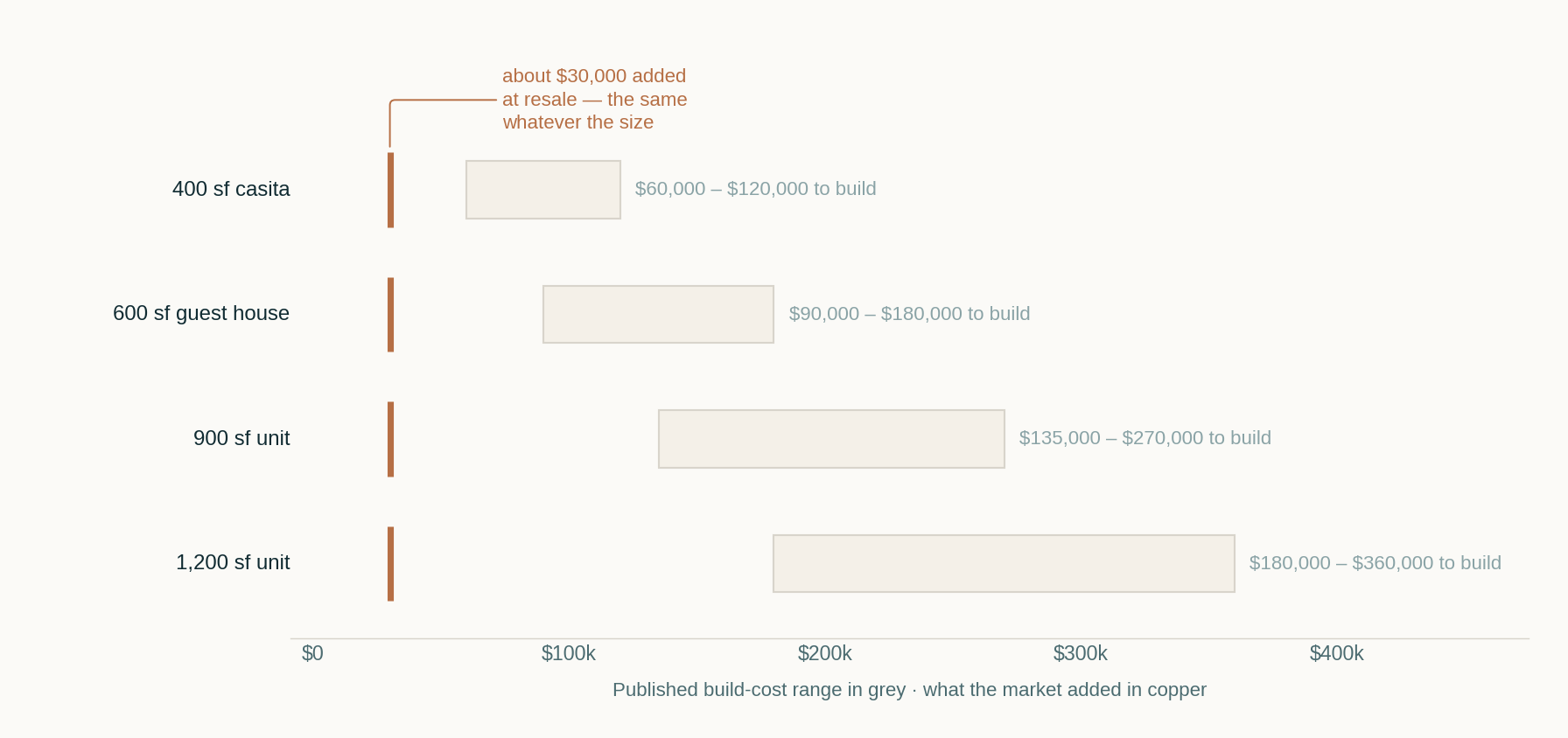
Published build costs for a detached accessory unit run $150 to $300 per square foot. That puts a 600 sf unit at $90,000 to $180,000 and a 1,200 sf one at $180,000 to $360,000.
Against that, the contribution is about 7% of the house — call it $25,000 in a mid-priced neighbourhood, $60,000 in an expensive one. Recovery somewhere between a fifth and a half, and worse the larger you build.
For comparison, a swimming pool in this market returns roughly half to all of its cost, and owned solar about 40%. An accessory unit is the weakest resale return of anything measured in this body of work.
That is not an argument against building one. It is an argument for building one for the use rather than the resale, and for building the smallest one that does the job. If the point is housing a parent, four hundred square feet houses a parent. The market will pay you about the same for it as for a thousand.
And if the point is rent, the arithmetic is different again and it is not a resale question. A unit that rents is an income stream; whether it pays depends on the rent, the vacancy, the financing and how long you hold it, none of which appear in a sale price.
Where it pays and where it does not
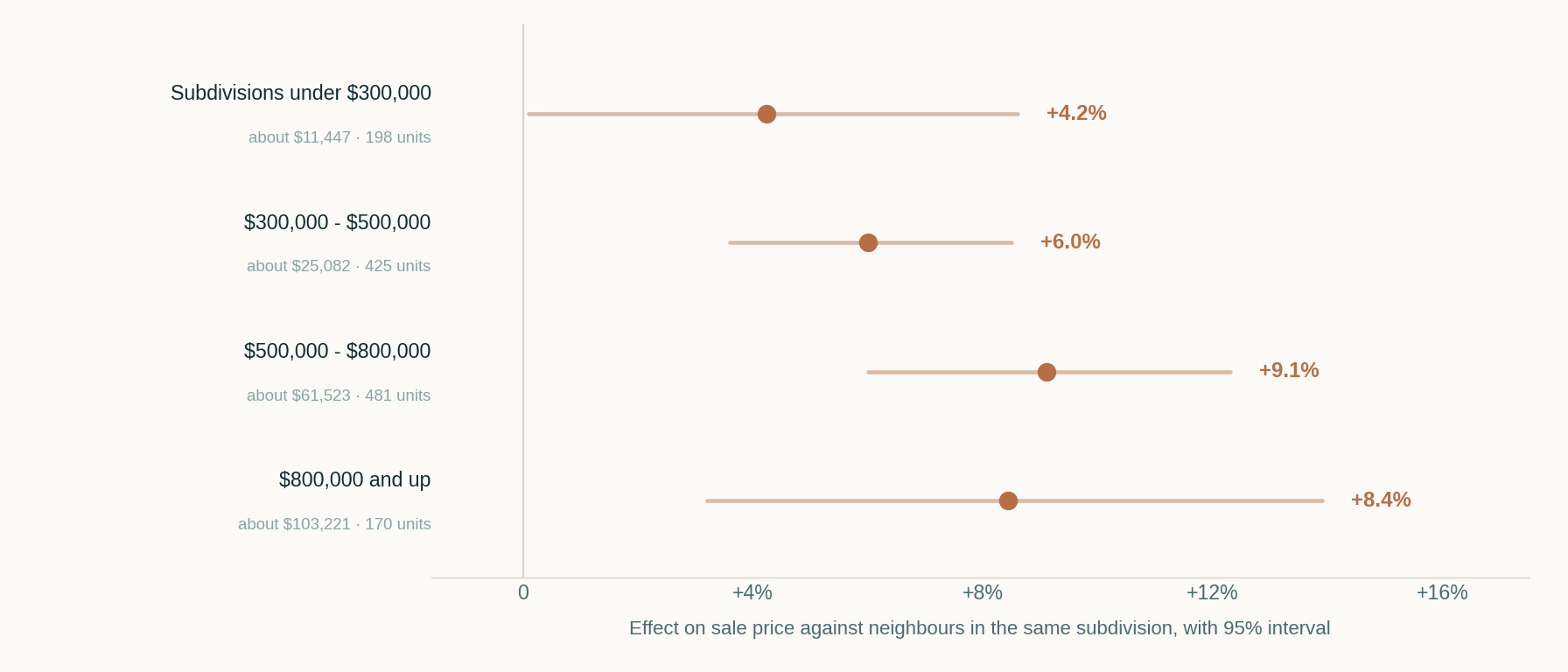
Banded by the price level of the subdivision, the premium runs:
| Subdivisions where houses sell for | A unit adds | Units | In dollars |
|---|---|---|---|
| Under $300,000 | +4.2% | 198 | about $11,400 |
| $300,000 to $500,000 | +6.0% | 425 | about $25,100 |
| $500,000 to $800,000 | +9.1% | 481 | about $61,500 |
| $800,000 and up | +8.4% | 170 | about $103,200 |
All four are statistically distinguishable from zero. The pattern is the familiar one: the same feature is worth more where the houses are worth more, and the dollars diverge by roughly nine to one across the range while the percentages move by about two to one.
It is also worth knowing how common they are. Among listings where the flag was answered, an accessory unit appears on 5.1% of sales in the $300,000 to $500,000 band and 24.6% above $1.2 million. At the top of the market a guest house is close to expected; in the middle it is unusual, and unusual features are the ones that price unpredictably.
Compared with everything else in the yard
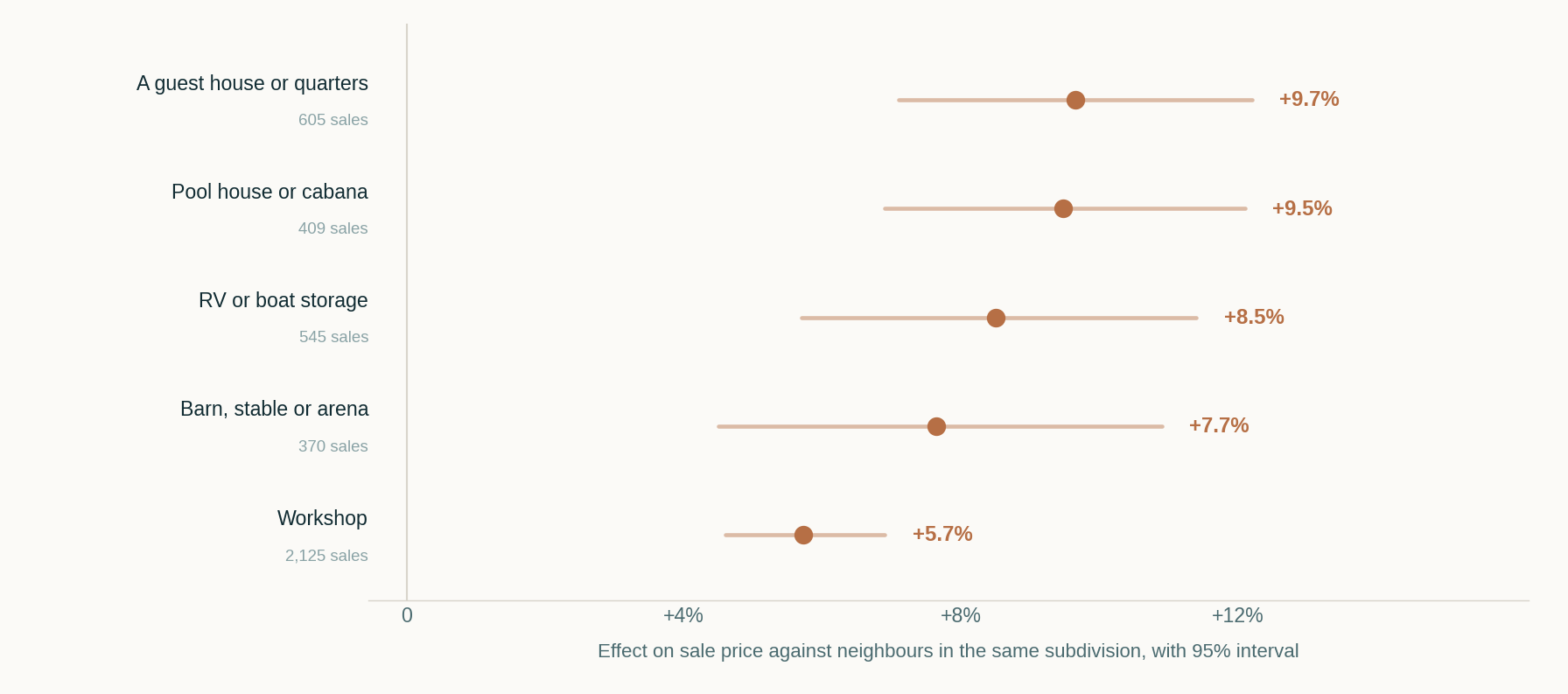
The MLS also records other structures on the lot, on far more listings than the accessory-unit flag. Measured identically:
| Structure | Adds | Sales | Roughly |
|---|---|---|---|
| Guest house or separate quarters | +9.7% | 605 | — |
| Pool house or cabana | +9.5% | 409 | — |
| RV or boat storage | +8.5% | 545 | about $51,000 |
| Barn, stable or arena | +7.7% | 370 | about $47,000 |
| Workshop | +5.7% | 2,125 | about $29,000 |
The workshop line is the interesting one, because a workshop is cheap. A metal building on a slab with power is a fraction of what habitable space costs to put up, and it returns 5.7% against a guest house's 9.7%. Per dollar spent, the shop is the better buy by a wide margin.
And unlike the guest house, the shop scales with land:
| Lot size | Workshop adds | Guest house adds |
|---|---|---|
| Under a quarter acre | +3.4% | +9.7% |
| A quarter acre to an acre | +5.5% | +6.7% |
| One to five acres | +7.9% | +8.0% |
| Five acres and up | +8.8% | not measurable |
A shop on a tenth of an acre is storage. A shop on five acres is why somebody bought five acres. The guest house does not behave that way — it is worth about the same on a suburban lot as on acreage, because what it does for the buyer is the same either way.
They also sell more slowly
Within the same subdivisions, houses with an accessory unit went under contract in a median 32 days against 27, and closed at 96.3% of original asking against 97.1%.
Five days slower and about eight tenths of a point weaker. Small, but it runs the opposite direction from a pool, which sells eight days faster. A pool is a common feature in the neighbourhoods that have them. An accessory unit is a specific answer to a specific need, and the buyer who has that need is a smaller slice of the market.
A note on how these were banded
This is technical, and it is here because it changed several of the numbers above by a wide margin before they were published.
When you want to know whether a feature is worth more in expensive neighbourhoods than cheap ones, the obvious move is to split the sales into price bands and run the model inside each. It is also wrong, and wrong in a direction that matters.
Sale price is the thing being explained. Splitting on it conditions on the outcome. Inside a band of, say, $250,000 to $300,000, a house that has the feature and still landed in that band must be weaker in some other respect than a house without it that landed in the same band — otherwise the feature would have carried it into a higher band. The comparison is rigged against the feature, and the rigging is worst in the bottom band where the floor truncates hardest.
The fix is to band on something that is not the outcome. Here that is the median price of the subdivision — a description of the neighbourhood, fixed before any individual house sells. Every banded figure above uses that.
Banded on sale price, the accessory-unit premium reads +0.9% / +1.9% / +3.0% / +7.0% from the bottom band to the top. Banded on the subdivision's price level, it reads +4.2% / +6.0% / +9.1% / +8.4% — and the second set is consistent with the pooled 7.2% while the first is not. The same check on the pool analysis moved its bottom band from +2.4% to +8.4% — a change large enough that that article carries its own note on it.
Handling one in a report
Do not cost it. A cost approach on an accessory unit produces a number three to five times what the market is paying. Contributory value here is a market-extracted figure or it is nothing.
Do not adjust on square footage. There is no support in this data for a per-square-foot adjustment on accessory space, and a per-foot adjustment on a 1,200 sf unit produces an indefensible number. Bracket on presence, not on area.
Establish what it legally is. Permitted second dwelling, converted garage, unpermitted addition, or a shop somebody put a bathroom in. These are different properties with different marketability, and the MLS flag does not distinguish them. Utilities, kitchen, separate entry, separate meter and the permit history all matter more than the size field.
Check whether it is occupied. A unit with a tenant in place on a lease is an encumbrance as well as an improvement, and the assignment conditions need to say which one is being valued.
And separate the unit from the land it sits on. An accessory unit is frequently on a larger-than-typical lot, which is why the naive comparison overstates it: controlling only for city, the same flag reads +12.6%. Most of that gap is lot.
What this does not say
The flag is optional and thinly answered. About a quarter of listings answer it. Everything above compares houses where an agent said yes against houses where an agent said no — not against the market at large. Units that exist and were never flagged are sitting in the comparison group, which biases the premium down.
The size result rests on 753 sales. It establishes that any size effect is small, not that it is exactly zero. A finding of no effect on a modest sample is weaker evidence than a finding of an effect.
Quality and legality are invisible. A permitted 700 sf casita with its own kitchen and meter records identically to a converted garage with a hot plate.
The label made a difference and I cannot fully explain it. Listings tagged “Guest Quarters” came in at +11.4%; those tagged “Accessory Dwelling Unit (ADU)” at +2.8% and not distinguishable from zero. That may be language, or it may be that the two words describe genuinely different things — guest space attached to a nice house versus a rental unit in a yard. On 128 ADU-tagged sales I would not build an adjustment on it, but it is worth knowing before you choose a word.
And this is Dallas–Fort Worth, 2023 to 2026, a market where land is comparatively cheap and detached construction is comparatively easy. It should not be carried to a city where an accessory unit is the only way to add a second household to a lot.
Terrence Bilodeau is a Certified Residential Appraiser (TX-1360232) and a Texas real estate broker. Clearfork Appraisals provides private-client appraisals in Fort Worth and across Tarrant, Parker, Johnson and Hood counties. This article is a general market study. It is not an appraisal, not tax advice, and not a valuation opinion about any specific property.
- North Texas Real Estate Information Systems (NTREIS) closed sales, detached single-family, Dallas–Fort Worth, 2023 – September 2026. 89,302 closings; 21,487 with the accessory-unit field answered, of which 2,002 carried a unit. Author's analysis; figures reported in aggregate.
- HomeGuide — ADU cost (per-square-foot and by-size build cost ranges)
- Angi — ADU costs (detached new-construction range)
Build costs are published national ranges, not independent estimates or local bids. The accessory-unit flag, its type and its size are as entered by the listing agent and are not independently verified; permit status, legality and utility separation are not recorded at all.