- One in 642. 139 barndominium sales in 89,302 closings. The comparable you need frequently does not exist.
- The raw figure says +25.7%. Hold size, lot, age and sale date and it falls to +4.0%. Against neighbours in the same subdivision it is +6.8%, interval −0.2% to +14.2%, which is not distinguishable from zero.
- 53.4% of barndominium listings fail to sell — cancelled or expired — against 28.3% of everything else.
- Above $750,000, two in three never sell. 66.2% against 40.6%.
- After holding price, acreage, year built and county, a barndominium listing still carries 1.38 times the odds of failing (interval 1.11 to 1.72).
- The sign flips by county. Parker +7.8%, Hood −6.0%. There is no regional adjustment to take off a shelf.
One Sale in Every 642
Across 89,302 closed sales of detached single-family homes in Dallas–Fort Worth, the record carries 139 barndominiums. Parker County holds 47 of them, Johnson 22, Tarrant 16, Wise 11, Hood 12, Ellis 11 and Denton 8.
That is the first and largest problem, and no amount of analysis fixes it. On a recent assignment in a strong Parker County school district, a twenty-four-month search of the district turned up exactly one other barndominium sale, and it was half the size of the subject on half the land. The search had to be widened to the county before a usable pair existed.
So when somebody tells you what a barndominium is worth in your market, the first question is how many sales they are working from. Usually the honest answer is one or two.
The Premium That Disappears When You Look at It
Barndominiums sell at a median $535,000 and $241 per square foot, against $378,000 and $187 market-wide. Taken straight, that looks like a large premium for the form.
It is not. It is the land and the calendar. The median barndominium sits on 2.85 acres and was built in 2020. The median house in this market sits on 0.19 acres and was built in 2005.
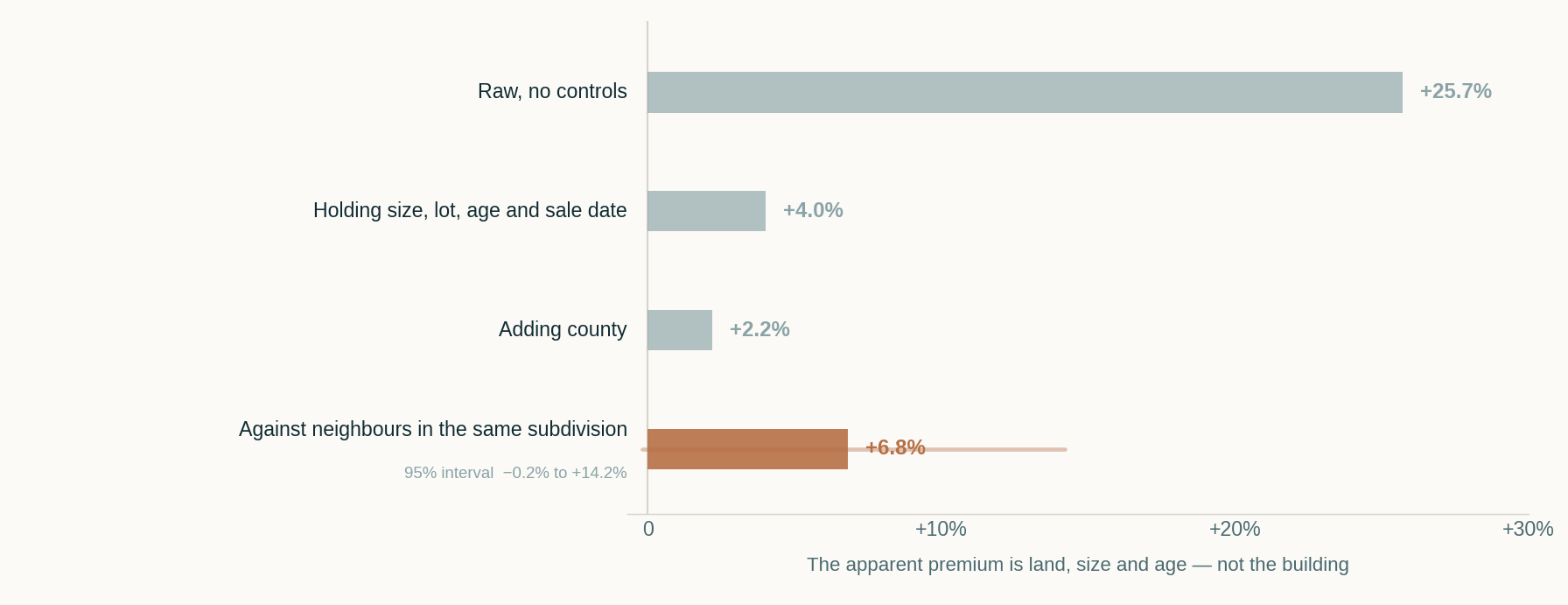
| What is held constant | Barndominium premium | 95% interval |
|---|---|---|
| Nothing | +25.7% | — |
| Living area, lot size, year built, sale date | +4.0% | not distinguishable from zero |
| … and county | +2.2% | not distinguishable from zero |
| … and neighbours in the same subdivision | +6.8% | −0.2% to +14.2% |
Nine tenths of the apparent premium is composition. What remains cannot be told apart from zero on this sample.
What the Amenities Explain, and What They Do Not
A reasonable objection: barndominiums are not just newer and on more land, they are better equipped. That is partly true and it is worth testing rather than asserting.
42% of barndominium sales carry an outbuilding of record, against 8% market-wide, and they report a median three covered parking spaces against two. But they are less likely to have a pool — 11% against 14%.
| Controls | Premium | 95% interval |
|---|---|---|
| Size, lot, age, date | +6.8% | −0.2 to +14.2% |
| … and pool | +7.6% | +1.1 to +14.6% |
| … and outbuildings | +5.9% | −0.8 to +13.0% |
| … and covered spaces | +6.0% | −1.2 to +13.8% |
Adding the outbuildings pulls the estimate down by about a point, which is real but small. The amenities explain a little. They do not explain the premium away, because on this evidence there was no premium to explain.
More Than Half of Them Never Sell
Here is where the form stops being invisible.
Of 348 barndominium listings that reached a resolution — closed, cancelled, expired or withdrawn — 162 closed and 186 did not. That is a 53.4% failure rate against 28.3% for the other 136,764 resolved listings in the same data.
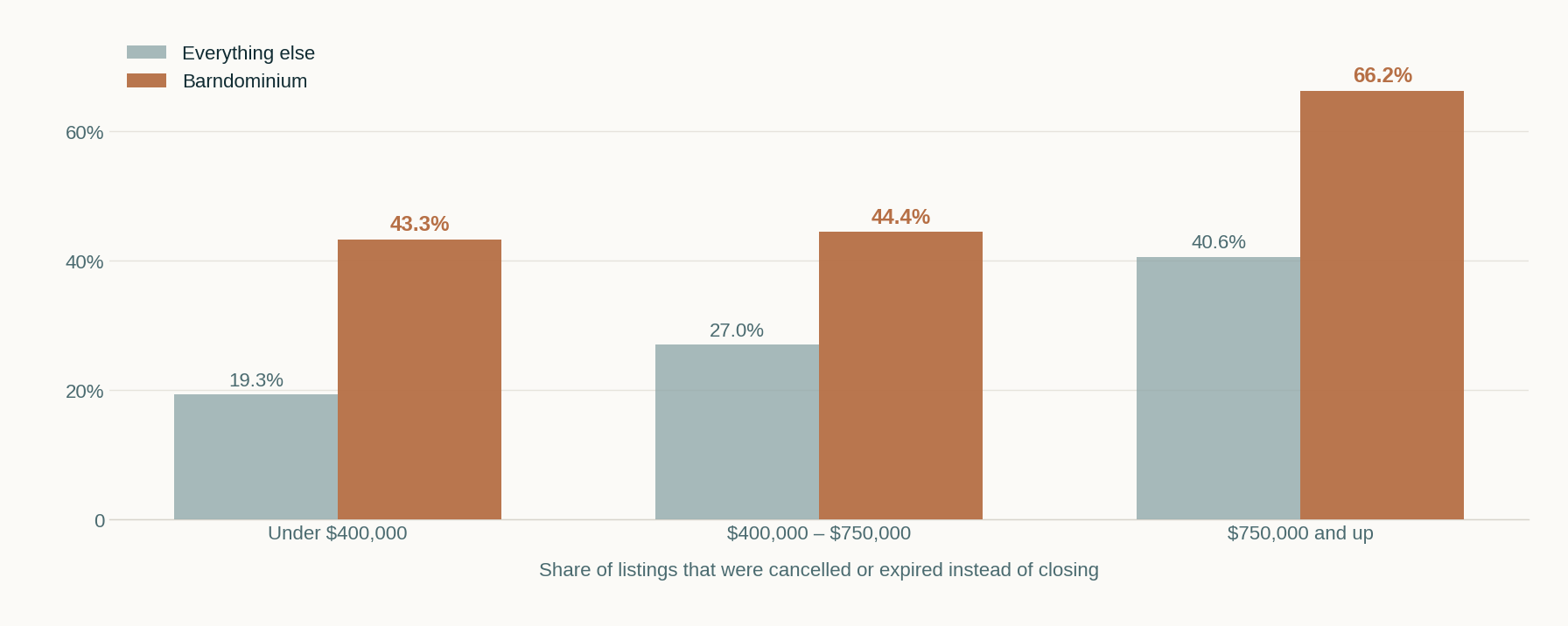
And it is worst where the money is. Below $400,000 a barndominium fails 43.3% of the time against 19.3%. Between $400,000 and $750,000 it is 44.4% against 27.0%. Above $750,000 it is 66.2% against 40.6% — two out of three listed and never sold.
Barndominiums sit on acreage, and acreage listings fail more often regardless of what is built on them. They also list at higher prices, and expensive listings fail more often. Both are true, and both account for a large part of the raw gap.
They do not account for all of it.
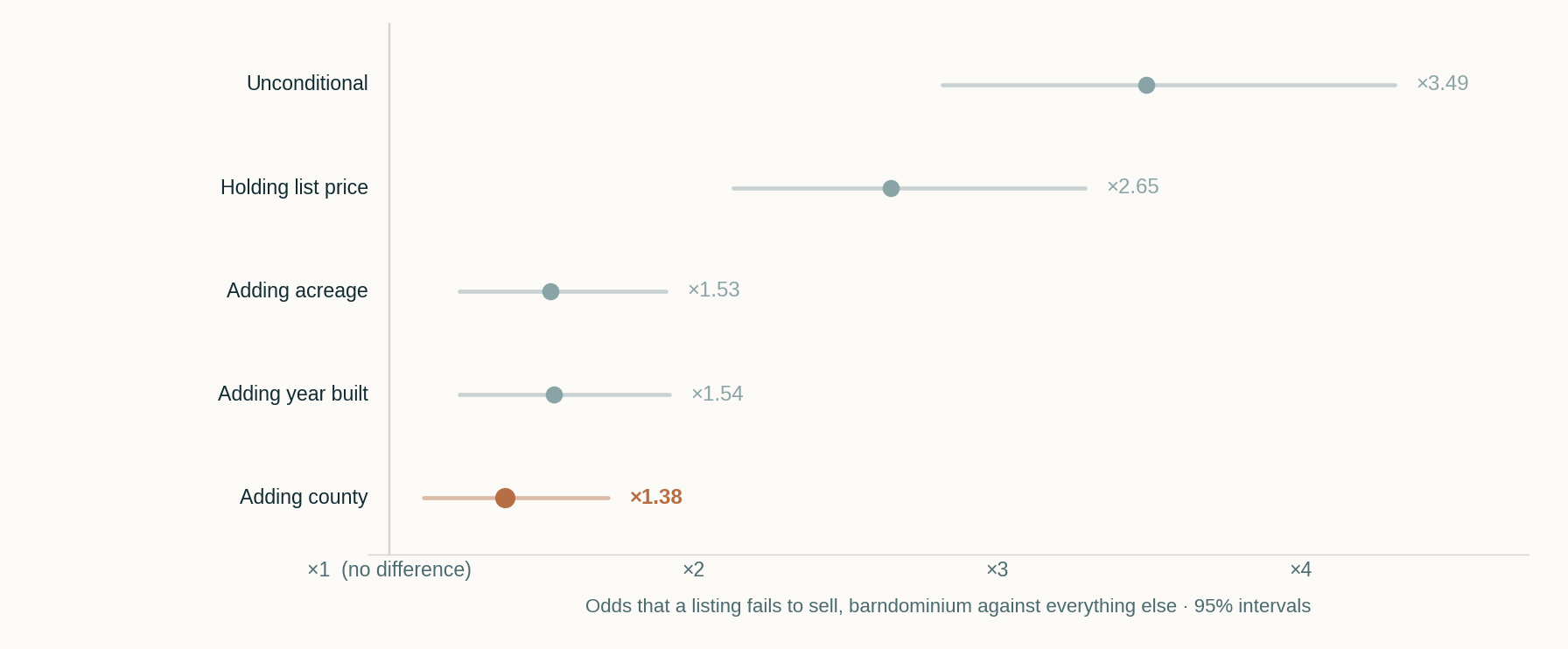
Holding the list price alone takes the odds from 3.49 to 2.65. Adding acreage takes it to 1.53 — so the single biggest piece of the raw difference really is the land, exactly as the objection predicts. Adding year built and then county leaves 1.38 times the odds of failing, with an interval of 1.11 to 1.72.
A barndominium listed at the same price, on the same acreage, of the same age, in the same county as a conventional house is still meaningfully less likely to sell.
Why the Price Model Cannot See This
These two findings look contradictory. They are not. They are the same finding seen from two sides, and the reason is worth understanding because it applies well beyond barndominiums.
A price regression only sees properties that sold. The 186 barndominiums that were listed and withdrawn are invisible to it — they have no sale price to analyse. So the closed sales are a survivor sample: the ones that found the right buyer, usually after a long marketing period, often after a price reduction that is already in the closed figure.
When a feature narrows the buyer pool, the first thing it does is not lower the price. It lowers the probability of a sale. Sellers who cannot find that buyer withdraw rather than cut to clearing. The ones who do find a buyer transact at something close to market — and that is all a price model ever observes.
“Barndominiums sell for about the same” is a true statement about closed sales and a misleading statement about owning one. The cost is carried in exposure time, in the risk of not selling, and in the concentration of that risk at the top of the market — none of which appears in a price per square foot.
The Sign Flips Between Counties Forty Miles Apart
| County | Barndominium sales | Premium | 95% interval |
|---|---|---|---|
| Parker | 47 | +7.8% | −7.0 to +24.9% |
| Hood | 12 | −6.0% | −12.5 to +1.0% |
| Johnson, Tarrant, Wise, Ellis, Denton | 8 to 22 each | too thin to estimate within subdivision | |
Parker points positive, Hood points negative, and both intervals are wide enough to contain almost any adjustment an appraiser might want to defend. That is not a failure of the method. It is the answer: there is no regional barndominium adjustment, and anybody quoting one is quoting an average across markets that disagree with each other.
It is the same pattern as the workshop premium, where Parker County pays 7.6% and Wise County pays nothing at all. Forty miles changes the answer.
Extracting the Adjustment Instead of Quoting One
On a recent Parker County assignment — a steel-frame residence of about three thousand square feet on two acres, custom finish, detached conditioned shop and a pool — the comparable set had to be built from two different places: barndominium sales drawn from across the county, and conventional custom homes drawn from the subject’s own school district.
Paired against conventional sales of similar quality, the design indication was a 5% discount, applied to the conventional comparables. The reasoning was specific rather than general: the lower material cost of steel-frame construction, and the functional limitations of a rectangular floor plan at that size.
That figure sits comfortably inside the Parker County interval above. The regional estimate is too imprecise to confirm it or contradict it — which is exactly why a local paired extraction is the better instrument and the regional number is not an instrument at all.
A regression over seven counties answers “does this feature have a general effect?” A paired analysis within one market answers “what is the adjustment here, today, against these comparables?” Only the second one belongs in a grid.
Handling One in a Report
Expect to leave the neighbourhood. With one barndominium in every 642 sales, the subdivision and often the school district will not contain a second one. Widening the search is not a weakness in the report; failing to disclose that you widened it is.
Bracket with both. Barndominium sales establish the form; conventional sales in the subject’s own market establish the location and finish. Neither set alone does both.
Extract the design adjustment, do not quote one. The county figures above are not adjustments. They are evidence that an adjustment taken from a schedule will be wrong in an unknown direction.
Address exposure time explicitly. On a form where the market is described as stable and typical marketing time is stated, a property type that fails to sell 53% of the time — 66% above $750,000 — deserves a sentence of its own.
Describe the construction. Steel frame, post frame, slab specification, insulation method, ceiling height, span, and whether the shop portion is conditioned. None of it is recorded and all of it separates one barndominium from another far more than it separates two conventional houses.
What This Does Not Say
139 sales is a small sample and the intervals say so. Nothing here establishes that the price effect is zero — only that it cannot be distinguished from zero on this evidence. A true effect of five points in either direction would be entirely consistent with what is measured.
Quality and finish are invisible. A barndominium can be a shop with a bed in it or a custom residence with commercial-grade everything. The record calls both the same thing, and the variation inside the category is almost certainly larger than the gap between the category and conventional construction.
The architectural-style field is self-reported. It is entered by the listing agent. Some barndominiums are not flagged, and the ones that are flagged may be the ones whose agents thought the form was worth mentioning — in either direction.
Failure to sell is not only about the property. A listing is cancelled or expires for reasons that include price, agent, timing, seller motivation and circumstances that have nothing to do with the house. The models above hold price, land, age and county constant; they do not hold the seller constant.
The county estimates are thin. Only Parker and Hood had enough sales inside mixed subdivisions to estimate at all, and both intervals are wide.
Terrence Bilodeau is a Certified Residential Appraiser (TX-1360232) and a Texas real estate broker. Clearfork Appraisals provides private-client appraisals in Fort Worth and across Tarrant, Parker, Johnson and Hood counties. This article is a general market study. It is not an appraisal and not a valuation opinion about any specific property.
Common questions
Do barndominiums sell for less than conventional homes?
Not measurably, in price. Across 139 barndominium sales in 89,302 Dallas–Fort Worth closings, the premium measured against neighbouring houses in the same subdivision is +6.8% with a 95% interval of −0.2% to +14.2% — not distinguishable from zero. The raw figure of +25.7% is almost entirely land, size and age, since the median barndominium sits on 2.85 acres and was built in 2020.
Are barndominiums harder to sell?
Substantially. Of 348 barndominium listings that reached a resolution, 53.4% were cancelled or expired rather than closing, against 28.3% of all other listings. After holding list price, acreage, year built and county constant, a barndominium listing still carries 1.38 times the odds of failing, with a 95% interval of 1.11 to 1.72.
Is it harder to sell an expensive barndominium?
Yes, and this is where the effect concentrates. Below $400,000 a barndominium listing fails 43.3% of the time against 19.3% for everything else. Between $400,000 and $750,000 it is 44.4% against 27.0%. Above $750,000 it is 66.2% against 40.6% — two listings in three never close.
If they are harder to sell, why do they not sell for less?
Because a price analysis only observes properties that sold. When a feature narrows the buyer pool, the first consequence is a lower probability of sale rather than a lower price: sellers who cannot find the buyer withdraw instead of cutting to clearing, and those withdrawals leave no sale price to analyse. The closed sales are a survivor sample.
What adjustment should an appraiser use for a barndominium?
One extracted from the subject's own market, not quoted from a regional figure. Within-subdivision estimates are +7.8% in Parker County and −6.0% in Hood County, with intervals wide enough to contain almost any value — which is evidence that no regional adjustment exists rather than guidance on what to use. On a recent Parker County assignment a paired analysis against conventional sales of similar quality indicated a 5% design discount.
How many barndominiums actually sell around Fort Worth?
139 in 89,302 closed sales over three years — about one in every 642. Parker County holds 47 of them, Johnson 22, Tarrant 16, Hood 12, Wise 11, Ellis 11 and Denton 8. In a single school district a twenty-four month search will frequently return one comparable sale or none.
Does the MLS record how a barndominium is built?
No. Architectural style is recorded and is self-reported by the listing agent, but steel frame versus post frame, slab specification, insulation method, ceiling height, clear span, and whether the shop portion is conditioned appear nowhere. Those differences separate one barndominium from another far more than the category separates itself from conventional construction.
- North Texas Real Estate Information Systems (NTREIS), Dallas–Fort Worth, 2023 – September 2026. 89,302 closed sales of detached single-family homes, 139 flagged barndominium in the architectural style field; 150,149 unique listings of which 137,112 reached a resolution, 348 of them barndominium. Author’s analysis; figures reported in aggregate.
Price premiums are measured within subdivisions containing both barndominium and conventional sales, holding living area, lot size, year built and sale date constant, with standard errors clustered by subdivision. Failure-to-sell odds come from a logistic model of resolved listings, holding original list price, lot size, year built and county constant. Architectural style is as entered by the listing agent and is not independently verified. Construction method, insulation, ceiling height, clear span and finish are not recorded in the MLS at all. The assignment described in this article is summarised generically; no client, property, address or value conclusion is disclosed. This article is a general market study. It is not an appraisal and not a valuation opinion about any specific property.