What a concession actually is
A sales concession is anything of value the seller gives the buyer outside the price: closing costs paid, a rate buydown funded, prepaid taxes and insurance, a title policy, an HOA transfer fee, a repair allowance, sometimes a flat credit.
It is not a discount in the way a price reduction is a discount. The recorded price stays where it is. What moves is the amount of money the buyer had to bring, or the payment they ended up with. And because the price is what gets recorded, published and pulled into every comparable-sales analysis afterwards, a market can discount itself substantially without the headline number moving at all.
That is the whole subject of this article, and across 89,295 closings it is not a marginal effect.
The number is rising every year
Across everything — new and resale, every price point — 55.0% of closings carried a concession, at a median of $7,250, or 2.00% of price. Split that by whether the house was new:
| Closings | Share with a concession | Median when paid | As % of price | |
|---|---|---|---|---|
| New construction | 21,066 | 71.6% | $10,000 | 2.45% |
| Resale | 68,229 | 49.8% | $6,452 | 1.82% |
And it has moved steadily in one direction:
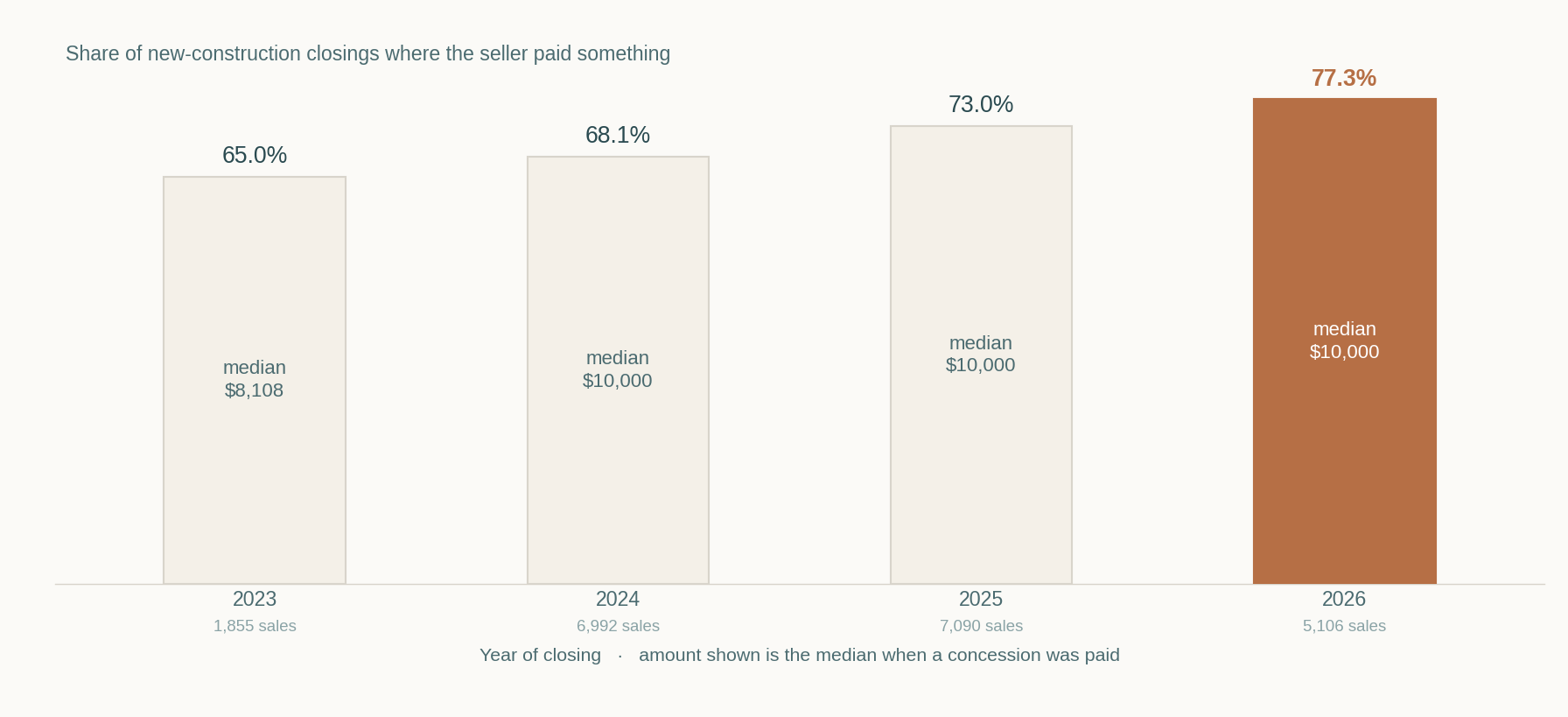
From roughly two in three closings to better than three in four, with the typical amount up about 23%. Whatever builders are doing about affordability, they are doing it here rather than on the price board out front.
It tracks the loan, not the house
Split the same 89,295 closings by how the buyer paid, and the pattern is unmistakable.
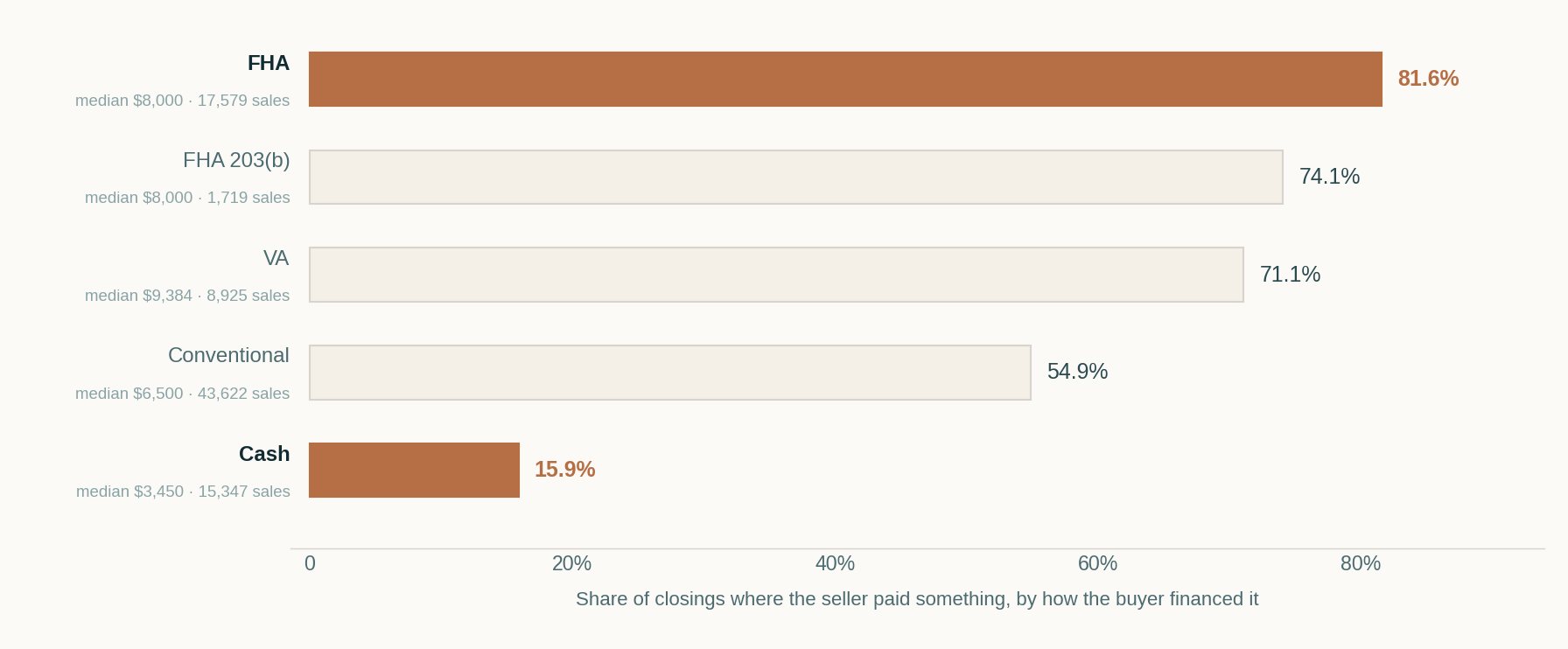
81.6% of FHA closings carried a concession, and 71.1% of VA, against 54.9% conventional and 15.9% cash. The median paid runs $8,000 on FHA and $9,384 on VA against $3,450 on cash.
The house did not change. The buyer's costs did. A low-down-payment borrower needs closing costs covered or a rate bought down, and the mechanism available is the seller's side of the settlement statement. The cash buyer has no such costs to move, which is why the cash column collapses.
That has a direct consequence for analysis: concession size correlates with buyer financing, so a comparable set weighted toward FHA and VA closings carries more embedded concession than one weighted toward cash, even in the same subdivision at the same time.
Where it is heaviest
New-construction concessions as a share of price, in markets with at least 80 new-build closings:
| Market | New-build closings | Share with a concession | Median paid | As % of price |
|---|---|---|---|---|
| Waxahachie | 1,089 | 70.2% | $15,000 | 3.3% |
| Godley | 548 | 75.5% | $11,895 | 3.0% |
| Midlothian | 1,388 | 77.0% | $15,000 | 2.9% |
| Crowley | 787 | 86.9% | $10,000 | 2.8% |
| Joshua | 338 | 79.9% | $12,000 | 2.8% |
| Aledo | 474 | 48.5% | $16,461 | 2.8% |
| Alvarado | 330 | 86.7% | $10,000 | 2.8% |
| Burleson | 325 | 74.8% | $12,000 | 2.8% |
| Mansfield | 999 | 63.0% | $15,000 | 2.6% |
Crowley and Alvarado stand out on frequency — nearly seven in eight new-build closings. Aledo is the interesting case on the other axis: fewer than half carry one, but when they do the median is the largest in the table at $16,461, which is the signature of a higher-priced product where the concession is used selectively rather than as standing policy.
Adjusting for it, and getting it wrong
The requirement is not controversial: a sale made on terms not typical for the market needs analysing, and where the terms affected the price the comparable is adjusted. What makes concessions difficult is not the principle but three practical traps.
Dollar-for-dollar is an assumption, not a finding. Subtracting the full concession from the price assumes a buyer would have paid exactly that much less without it. Sometimes true. Frequently not, particularly where a rate buydown bought a payment the buyer could qualify for rather than a discount they could have negotiated. The adjustment is a market question and it should be supported like any other.
Typicality matters more than existence. Where 86.9% of new-build closings in a market carry a concession, a concession is the market. Adjusting every comparable down to a hypothetical no-concession price and leaving the subject unadjusted produces a conclusion the market would not support. The question is whether the terms were typical, not whether they existed.
The field is frequently incomplete. The amount recorded is what someone entered. Rate buydowns funded by a builder's affiliated lender, design-center credits and lot-premium waivers are all value moving from seller to buyer, and they do not reliably land in a concession field. What is recorded is a floor, not a total.
The practical answer is the unglamorous one: read the field on every comparable, ask the listing agent or the builder's sales office what was actually paid and in what form, state in the report what was found and what was done about it, and treat silence as unknown rather than as zero.
What this does not say
The concession field is self-reported. Everything here rests on what agents entered. Under-reporting is likely, which makes these figures conservative rather than inflated.
“New construction” here means a house that sold in or within a year of its build year. That is a proxy, and it will include a small number of quick resales.
Correlation with financing is not proof of cause. FHA and VA buyers differ from cash buyers in more ways than their loan, and price point is entangled with all of it.
And none of this describes any particular builder. These are market aggregates. Individual builders, subdivisions and phases vary enormously.
Terrence Bilodeau is a Certified Residential Appraiser (TX-1360232) and a Texas real estate broker. Clearfork Appraisals provides private-client appraisals in Fort Worth and across Tarrant, Parker, Johnson and Hood counties. This article is a general market study. It is not an appraisal and not a valuation opinion about any specific property.
- North Texas Real Estate Information Systems (NTREIS) closed sales, Dallas–Fort Worth, 2023 – September 2026. 89,295 closings with a seller-paid field of record. Author's analysis; figures reported in aggregate.
- Fannie Mae — Appraiser Update (sales concession analysis and reporting)
Concession amounts are as entered in the MLS and are not independently verified. Buydowns, credits and waivers that do not appear in that field are not captured here.