A claim I made, now tested
In the article on contributory value I wrote that solar panels “tend to contribute very little” in this market, and that I had to report what buyers actually do rather than what seems like it ought to be true.
That was an assertion. Here it is measured, and it turns out to have been half right in a way that matters: the average is very little, but the average conceals two completely different answers.
989 closings carrying solar generation out of 89,302, about 1.1% of the market. The MLS field distinguishes owned from leased, which is the distinction the entire question turns on.
Owned, leased, and unspecified
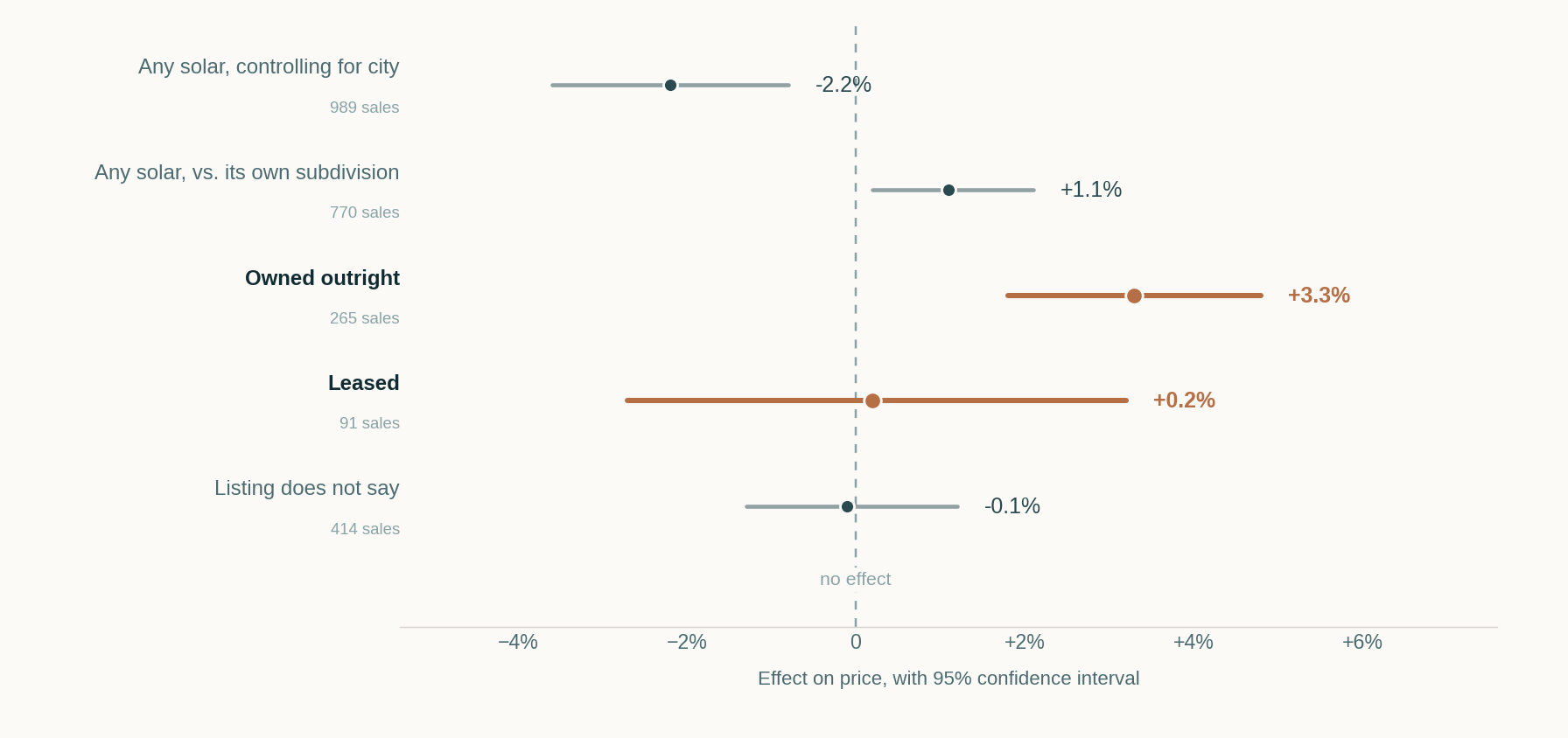
Start at the top. Controlling only for city, houses with solar sold 2.2% below otherwise comparable houses (p = 0.003). Taken at face value that says panels destroy value. They do not — it is selection. Panels cluster in particular neighbourhoods and price points, and a city-level control is too coarse to remove that.
Compare each solar house against others in its own subdivision and the figure turns slightly positive: +1.1% (CI +0.2 to +2.1). Small, but real.
Then split by ownership, and the small average comes apart:
| Sales | Effect on price | 95% interval | p | |
|---|---|---|---|---|
| Owned outright | 265 | +3.3% | +1.8 to +4.8% | <0.001 |
| Leased | 91 | +0.2% | −2.7 to +3.2% | 0.876 |
| Listing does not say | 414 | −0.1% | −1.3 to +1.2% | 0.909 |
On the median solar house at $380,000, 3.3% is about $12,500. The leased figure is indistinguishable from zero, and so is the unspecified one.
Why a lease is worth nothing
Owned panels are an improvement to the real property. They convey with it, they reduce the electricity bill, and there is nothing further to pay. That is a straightforward contributory-value question and the market answers it with roughly three percent.
A lease or a power purchase agreement is a different object. The panels belong to somebody else. The buyer inherits an obligation — a monthly payment, often escalating, running years into the future — in exchange for power they would otherwise buy from a retailer. Whether that is worth anything depends on the rate, the escalator, the remaining term and the buyout, and it frequently nets close to zero.
It also creates friction that has nothing to do with value. The lease has to be assumed, which means the buyer qualifying with the provider. There is often a UCC filing against the property that has to be dealt with at closing. Both of those are reasons a buyer discounts the transaction rather than the panels.
The result is a feature that costs the seller real money and returns, as far as this data can tell, nothing.
The listing that does not say
The most useful number here is the third one, because it is the one anybody can act on for free.
In 414 closings — the largest of the three groups — the field recorded “Solar” with no indication of ownership. Those houses priced at −0.1%. Not the +3.3% of owned systems. Effectively the leased result.
Some of those are genuinely leased and simply not tagged. But it is unlikely that 414 closings are all leases when the tagged split runs three owned to one leased. The more plausible reading is that an unanswered question gets priced as the bad answer. A buyer who cannot tell whether panels convey free and clear or carry a payment assumes the payment.
“Solar — owned outright, no lien, conveys with the property” is a sentence that appears to be worth about three percent. The same panels described as “Solar” appear to be worth nothing. That is the cheapest three percent in this entire body of research.
What it costs now the credit is gone
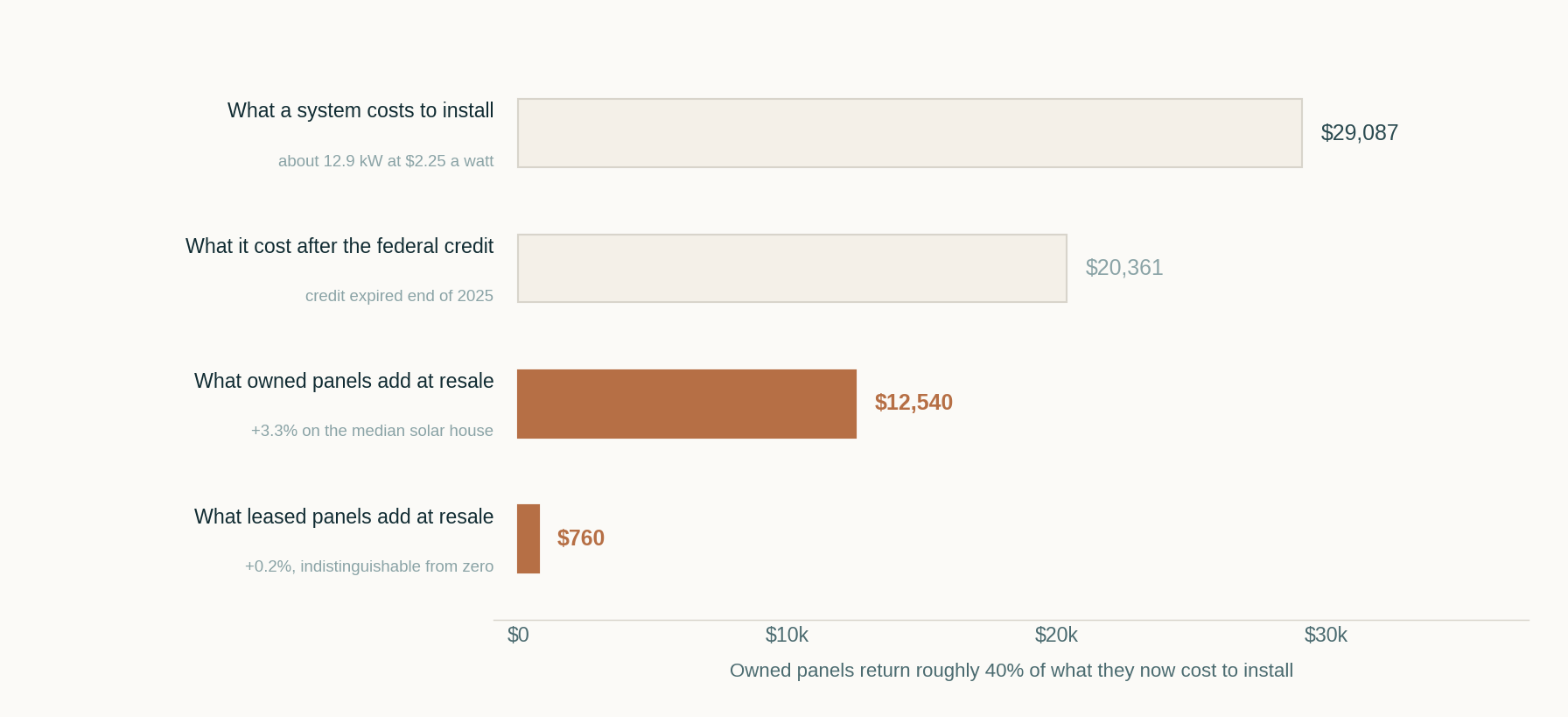
A typical Texas residential system runs about $2.25 per watt at a median size near 12.9 kW — roughly $29,000 installed. Against that, an owned system returning about $12,500 recovers something like 40% at resale.
That number used to be carried by something else. The federal residential clean energy credit expired at the end of 2025 for cash and loan purchases. A system that effectively cost around $20,000 after the credit now costs the full amount, while the resale contribution stays where it is.
Which means the case for owned solar in this market now rests almost entirely on the electricity it displaces over the years the owner stays, rather than on anything recovered at sale. That is a real case — it is simply a different one, and it is sensitive to a rate assumption rather than to a market premium.
It is also worth noting what would change the answer. Everything above measures how buyers behaved from 2023 to 2026. If power got materially more expensive, or the grid materially less reliable, the contribution would move — not because the panels changed, but because the thing they replace did.
Handling it in a report
Establish ownership before anything else. Owned, financed with a lien, leased, or a power purchase agreement. These are four different things and only the first is straightforwardly an improvement to the realty. A system financed with a UCC filing is not the same as one owned free and clear, even though both are “owned.”
Do not value a lease as an improvement. It is a contract that runs with the property and it is, at best, value-neutral. Where a lease is present, the analysis is about whether the obligation impairs marketability, not what the panels contribute.
Treat the MLS field as a starting point. Given that 414 of 989 records simply said “Solar,” ownership has to be confirmed from the owner, the agreement or the title work rather than read off the listing.
And extract the adjustment locally if the data supports it. Three percent is a market-wide figure across a thin sample. In a subdivision with enough solar sales to bracket, measure it there instead.
What this does not say
989 sales is a small sample, and the leased group is 91. The owned result is solid; the leased result establishes that any effect is small rather than that it is exactly zero.
System size is invisible. A 4 kW array and a 15 kW array with battery storage are recorded identically. The 3.3% is an average across whatever was installed.
Ownership is self-reported, and 42% of records did not report it at all.
And this describes 2023 through 2026 in Dallas–Fort Worth, a market with comparatively cheap electricity. It should not be carried to a state with higher power costs or different net-metering rules.
Terrence Bilodeau is a Certified Residential Appraiser (TX-1360232) and a Texas real estate broker. Clearfork Appraisals provides private-client appraisals in Fort Worth and across Tarrant, Parker, Johnson and Hood counties. This article is a general market study. It is not an appraisal, not tax advice, and not a valuation opinion about any specific property.
- North Texas Real Estate Information Systems (NTREIS) closed sales, detached single-family, Dallas–Fort Worth, 2023 – September 2026. 89,302 closings, 989 with solar generation of record. Author's analysis; figures reported in aggregate.
- EnergySage — Texas solar panel cost (cost per watt, median system size, expiry of the federal credit)
Cost figures are published market averages, not independent estimates. Ownership status is as entered in the MLS and was unreported in 42% of solar records; it should be confirmed from the agreement or title work for any specific property.