- Six stores measured across fifteen years and three market regimes. Burleson 2010, Hudson Oaks 2017 and 2019, Alliance and Mansfield 2024, Irving 2024–26, Walsh Ranch 2025. No reliable effect on price or on the number of homes sold.
- Hudson Oaks is the cleanest test — an ordinary market, only 4.0% distressed sales, eighteen quarters of baseline. The share of nearby closings went from 29.80% before the store opened to 29.61% after.
- What looks like an effect is composition. Near the Alliance store, 1.6% of sales were built after 2022. In the ring around it, 25.3%. Match the building vintage and the apparent effect dissolves.
- The land purchase is not the signal. The construction date is. H-E-B has held 15 acres on McPherson Boulevard since March 2023 with no date announced. The Overland site came with one.
- This cannot rule out small effects. With 170 to 840 nearby sales per store, the price intervals run roughly ±4%. A genuine 2% effect would be invisible.
- For an appraisal there is nothing to adjust for. A planned or newly opened grocery anchor does not support a location or market-conditions adjustment on this evidence.
Two H-E-B stores are coming to this side of Fort Worth. One at FM 3325 and the I-20 service road in Walsh Ranch, framed and due to open in December 2026. One at the northeast corner of Chisholm Trail Parkway and Oakmont Boulevard, announced on 2 October 2026, with construction starting in early 2027 and an opening in late 2028.
The question arriving with them is whether a grocery store makes the houses around it worth more. It is a reasonable question with a long pedigree — people have followed commercial build-out as a leading indicator for decades, first McDonald’s and Walmart, then Starbucks, now Costco, and in Texas, H-E-B.
I measured it six times, in markets fifteen years apart. The answer is no — and the reason it keeps looking like yes is worth more than the answer.
Start With What the Retailer Is Actually Doing
In The Founder, the money man tells Ray Kroc he is not in the burger business, he is in the real estate business. The line is the film’s invention rather than a documented quotation, but the structure behind it is real and a matter of record.
Harry Sonneborn became McDonald’s first president in 1959, and in 1956 he had already created Franchise Realty Corporation — the vehicle through which McDonald’s took the land under its restaurants and leased it back to its own franchisees. The hamburger margin was never the engine. The ground lease was.
The relevance to a homeowner is direct. If an anchor tenant is partly a land business, buying a site is a cheap option rather than a commitment, and a land purchase is not news about your neighbourhood. It is news about a company’s balance sheet.
In March 2023 H-E-B bought 15 acres on the north side of McPherson Boulevard at The Shops at Chisholm Trail Ranch. The company said it had purchased the land “in anticipation of our future needs.” No construction date was given then, and there is still none.
In October 2026 H-E-B bought more than 20 acres at Chisholm Trail Parkway and Oakmont and announced construction beginning in early 2027 and an opening in late 2028.
Same company, same corridor, same kind of headline. One is an option. One is a decision. What separates them is a date.
That distinction is the most useful filter available to anyone reading these announcements, and it costs nothing to apply. Ask whether a construction timeline came with it. If not, the retailer has told you it is keeping its choices open.
Site Selection Is a Forecast, Not a Cause
The second thing worth understanding is why a grocery announcement correlates with growth even when it creates none.
A retailer committing nine figures to a store runs serious trade-area work first — rooftop counts, drive-time catchments, traffic volumes, the competitive set, and projections several years out. When the announcement lands, the public is seeing the output of a growth forecast made by a well-capitalised company with good analysts.
Then everyone reads the forecast backwards and treats it as the cause.
This is the flaw in the best-known version of the claim — the assertion that homes near a Starbucks appreciate faster than homes that are not. Starbucks opens stores where growth is already underway. The correlation is real; the direction of causation is the problem.
The same logic applies at Oakmont. H-E-B did not choose that corner because it is a good place for a grocery store in the abstract. It chose a corner with highway access on Chisholm Trail Parkway and a large catchment inside a short drive — including much of what the McPherson site would have served, which is part of why McPherson has stayed an option.
Six Stores, One Method
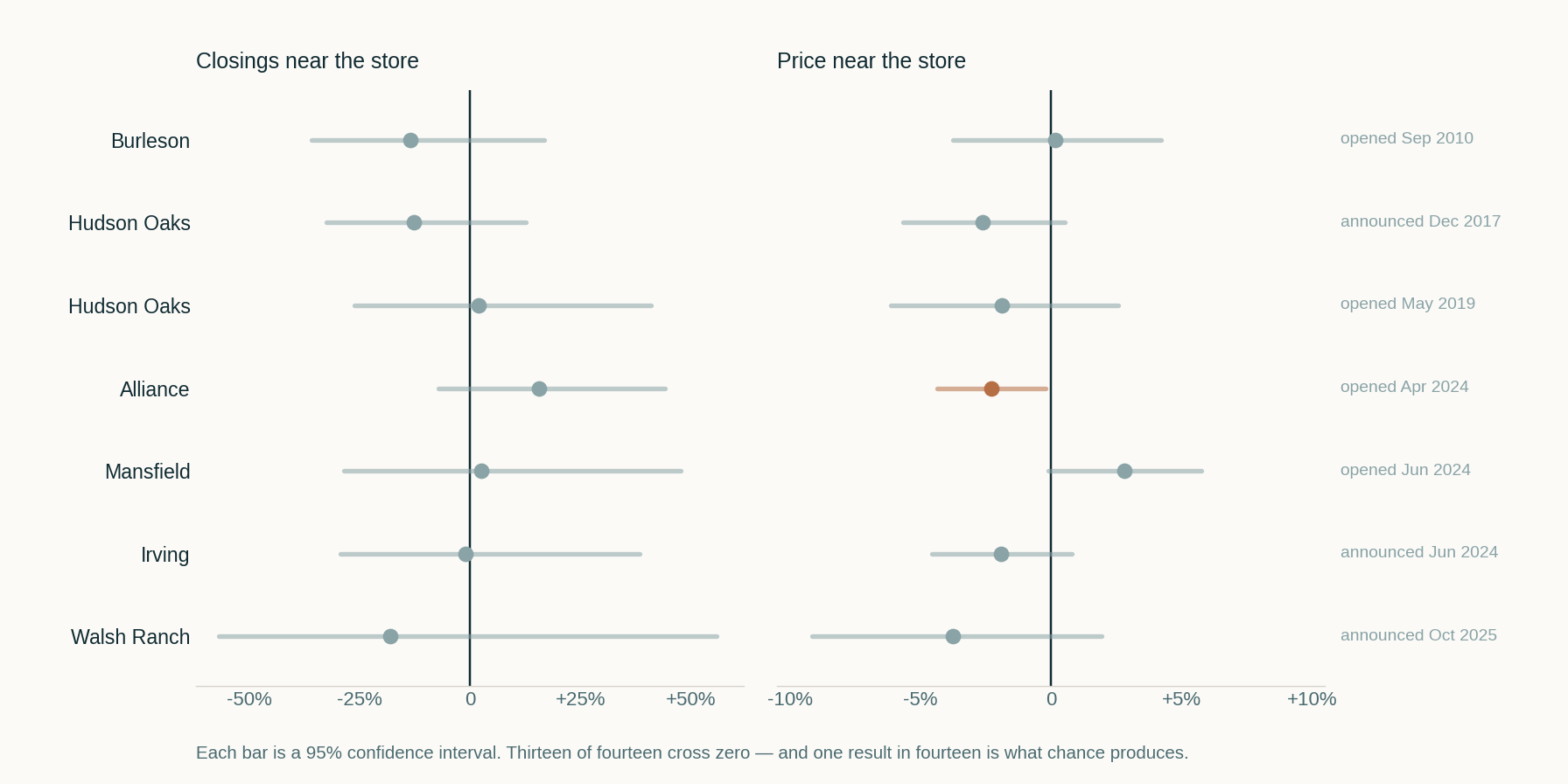
Each store is measured the same way: homes close to it against homes in a ring further out in the same market, before and after the event, holding living area, lot size, year built and sale quarter constant, comparing within subdivisions, with standard errors clustered by subdivision.
| Store | Event | Closings nearby | Price nearby |
|---|---|---|---|
| Burleson | opened Sep 2010 | −13.4% (−35.8 to +16.7) | +0.15% (−3.8 to +4.2) |
| Hudson Oaks | announced Dec 2017 | −12.8% (−32.5 to +12.6) | −2.62% (−5.7 to +0.5) |
| Hudson Oaks | opened May 2019 | +2.0% (−26.1 to +40.9) | −1.89% (−6.2 to +2.6) |
| Alliance | opened Apr 2024 | +15.6% (−7.2 to +44.1) | −2.29% (−4.4 to −0.2) |
| Mansfield | opened Jun 2024 | +2.6% (−28.6 to +47.6) | +2.80% (−0.1 to +5.8) |
| Irving | announced Jun 2024 | −1.1% (−29.4 to +38.3) | −1.92% (−4.6 to +0.8) |
| Walsh Ranch | announced Oct 2025 | −18.1% (−56.9 to +55.8) | −3.77% (−9.1 to +1.9) |
The estimates swing from −18% to +16% on volume and from −3.8% to +2.8% on price, with intervals wide enough to contain almost anything. That is not a small effect. That is no detectable effect, found six times.
The Market Was Never Normal, So Measure Several
There is a sensible objection to any one of these. Four of the events happened after 2022, when high mortgage rates kept people in houses they would otherwise have left; if few can move at all, an amenity may not move anything either. Burleson answers that one — it opened in September 2010 — but 2010 carries its own distortion, with 23.6% of nearby sales bank-owned or short sales, depressed incomes and frightened buyers.
Which is the honest problem with this whole class of question. There is no clean period. 2010 had the crash. The middle of the last decade had the recovery and a technology shift rewriting where people work. 2020 had the pandemic. 2022 onward has the rate shock, arriving alongside a supply and energy disruption that reset the cost of building anything. You do not find the pristine window; you measure across several and see whether the answer moves.
The closest thing to an ordinary market in the set is Hudson Oaks, west of Fort Worth on US 180 — announced in December 2017, opened on 10 May 2019, with only 4.0% distressed sales and no crisis at either end.
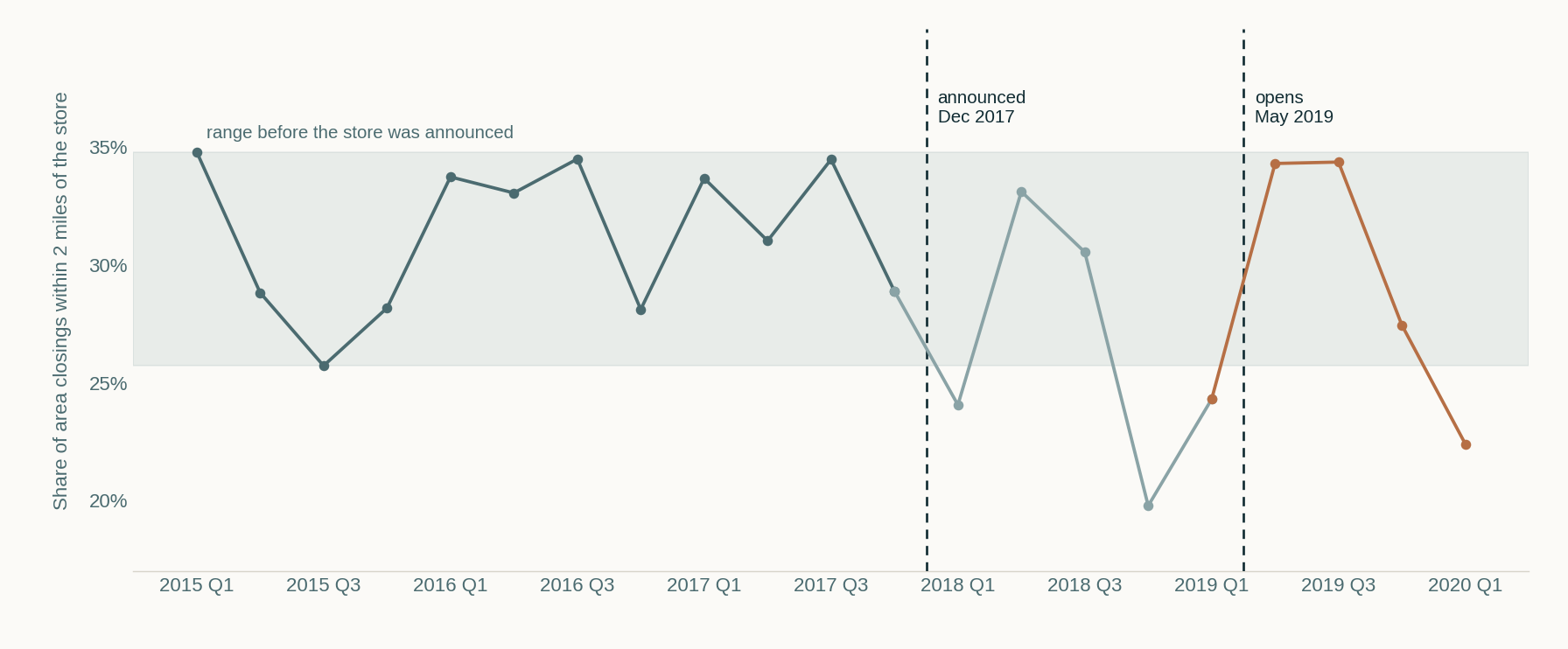
The share of area closings within two miles of the store ran 29.80% across the eighteen quarters before it opened and 29.61% across the four after. On the announcement in December 2017, with twelve quarters of baseline, closings fell 12.8% and price fell 2.62% — neither distinguishable from zero, and both pointing the wrong way for anyone selling a premium.
A post-crash market with a quarter of sales distressed. An ordinary market with almost none. A rate-locked market where discretionary moves nearly stopped. The grocery anchor does nothing measurable in any of them.
Why the Raw Comparison Keeps Showing Something
Run the Alliance comparison without matching on what was built, and a 22% increase in nearby closings appears, comfortably significant. It is an artefact, and the mechanism matters well beyond grocery stores.
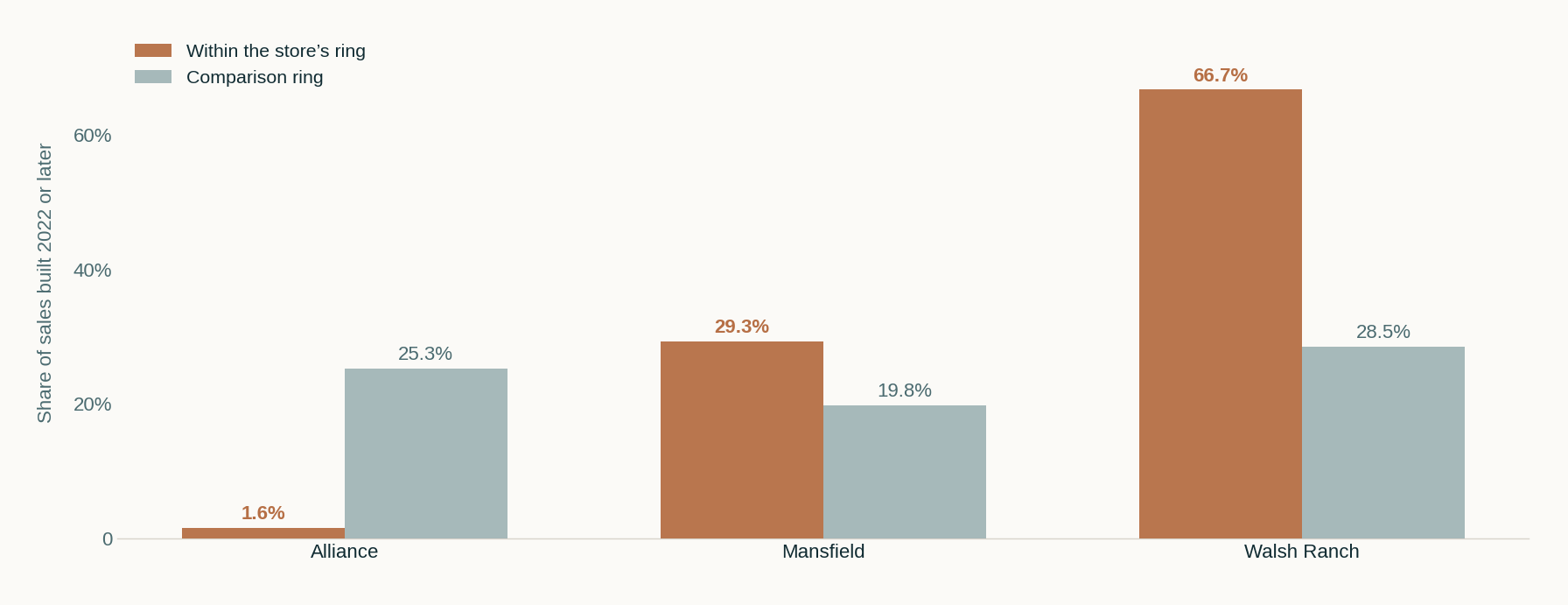
Within two miles of the Alliance store, 1.6% of sales were built in 2022 or later; the area is established, two thirds of it built in the 2000s. In the comparison ring, 25.3% were. Those two areas were never going to move together, store or no store.
Mansfield shows the same problem from the other direction, and it is a good argument against trusting a median. The median year built near that store is 2002, which sounds like a settled neighbourhood. But the most common year built is 2024, and the ring is genuinely bimodal — 31% from the 2020s, 18% from the 1990s. Exactly 1% of the homes that sold there were built in 2002. The median is describing a house that barely exists.
Match the building vintage on both sides and the Alliance result falls to +15.6%, interval −7.2% to +44.1%. The signal was never about groceries. It was about what the builders were doing.
What This Study Cannot See
A null result is only as honest as its limits, and these matter.
It cannot see small effects. With roughly 170 to 840 sales near each store, the price intervals run about ±4%. A real effect of 1% or 2% would not be detectable. What is ruled out is a large effect, not any effect.
It cannot see enquiries or foot traffic. Closed sales are the only thing recorded. If a visible building shell is pulling people into a sales office this month, none of it enters the record until those contracts close — and for new construction that lag runs to several quarters.
It cannot see destination choice. If a planned store changes where buyers land without changing how many buyers there are, transaction counts in a two-mile ring will not register it. People reporting that a store affected their decision and a measurement finding no change in volume can both be true.
It cannot see corridors that had no retail to begin with. Irving sits in a saturated retail corridor, where another anchor changes a household’s options very little — substitution doing ordinary work. Whether a first store in a genuinely underserved area behaves differently is a question these six cannot answer.
What It Means Inside a Report
For an appraisal the conclusion is firm, and it runs the direction most people do not expect.
A planned or newly opened grocery anchor does not support a location adjustment. Nothing here would survive review. An adjustment has to be extracted from paired sales in the subject’s own market and defended; “a store is coming” is not an extraction, and six measurements say the market has not priced it.
It does not support a market-conditions adjustment either. Time adjustments come from measured price change in the competitive market, and the change attributable to these stores is indistinguishable from zero.
What does belong in a report is the ordinary locational analysis an appraiser already owes — access, road network, proximity to services as one locational characteristic among several, and comparables drawn from the market that actually competes with the subject. The store is a fact about the neighbourhood. It is not a line in the grid.
If a client, an agent or a lender asks for value to reflect an announced store, this is the article to send back.
If You Own a Home Near a Planned Store
Treat the announcement as information about the area, not about your equity. A company’s analysts concluded your area is growing, which is genuinely worth knowing. It is not the same as your house being worth more, and the evidence says it is not.
Check whether a construction date came with it. Land purchases sit for years. McPherson is on year four.
Do not price a listing on it. Buyers have not paid a premium for proximity to any of the six stores measured here, and a list price built on an expectation the market has not validated buys exposure time rather than money.
Value the convenience personally, because that is where the value is. Shopping every second day instead of buying a week ahead is a real improvement in daily life and it wastes less food. That is a good reason to like where you live. It is not an appreciation thesis.
Common questions
Does a new H-E-B increase nearby home values?
Not measurably. Across six North Texas stores spanning 2010 to 2026, the estimated effect on nearby prices ranges from minus 3.8% to plus 2.8%, and every interval but one includes zero. The closest thing to an ordinary market in the set, Hudson Oaks, shows minus 1.89% after opening with an interval of minus 6.2% to plus 2.6%. Large effects are ruled out; effects of one or two percent would be too small to detect with these sample sizes.
Do more homes sell near a new grocery store?
Not reliably. Measured the same way at six stores, the change in nearby closings runs from minus 18% to plus 16%, with intervals wide enough to contain almost any value. At Hudson Oaks the share of area closings within two miles of the store was 29.80% across the eighteen quarters before opening and 29.61% across the four after.
Why do people believe a new H-E-B raises values?
Partly because retailers forecast growth rather than cause it. A company committing to a store has already studied rooftops, drive times, traffic counts and growth projections, so the announcement reflects an expectation of growth that existed beforehand. Partly because raw comparisons are confounded: the area near a store is frequently building different housing from the area around it, which produces an apparent effect on its own.
Does an H-E-B land purchase mean a store is coming?
Not necessarily. H-E-B bought 15 acres on McPherson Boulevard in far southwest Fort Worth in March 2023, stating it had purchased the land in anticipation of future needs, and no construction date has been announced since. By contrast the Chisholm Trail Parkway and Oakmont site, announced in October 2026, came with construction starting in early 2027 and an opening in late 2028. The construction date is the signal, not the purchase.
Should an appraiser adjust for a planned grocery store?
No. An adjustment must be extracted from paired sales in the subject's own market and supported. Six measurements across fifteen years find no price effect attributable to a new or announced store, so there is nothing to extract. The store belongs in the neighbourhood description and in comparable selection, not as an adjustment line in the sales comparison grid.
When is the new southwest Fort Worth H-E-B opening?
H-E-B announced on 2 October 2026 that it had acquired more than 20 acres at the northeast corner of Chisholm Trail Parkway and Oakmont Boulevard, in the Overland community on Edwards Ranch land. The company said construction would begin in early 2027 with an opening in late 2028.
Could the high-rate market be hiding the effect?
It does not appear to be. If mortgage lock-in were suppressing a real response, older openings in different conditions should show it. The Burleson store opened in September 2010 in a post-crash market where 23.6% of nearby sales were distressed, and the Hudson Oaks store opened in May 2019 in an ordinary market with 4.0% distressed. Neither shows an effect either.
- North Texas Real Estate Information Systems (NTREIS). Closed sales of detached single-family homes. Dallas–Fort Worth 2023 – September 2026 (89,302 sales) for the Alliance, Mansfield and Walsh Ranch stores; a 4.5-mile radius around the Irving store, October 2023 – October 2026; a 4-mile radius around the Burleson store, 2009 – 2013; a 5-mile radius around the Hudson Oaks store, January 2015 – March 2020. Author’s analysis; figures reported in aggregate.
- Store facts: H-E-B Newsroom releases for the Mansfield (opened June 2024), Hudson Oaks (100 Hudson Oaks Drive, opened 10 May 2019), Irving (2351 West Interstate 635, announced 1 June 2024, opened 17 June 2026) and Edwards Ranch / Overland (announced 2 October 2026) stores; Walsh Ranch development announcement, 22 October 2025, for the FM 3325 and I-20 store; The Dallas Morning News, 21 March 2023, for the 15-acre McPherson Boulevard purchase.
- Harry J. Sonneborn and Franchise Realty Corporation, established 1956. The line attributed to him in The Founder (2016) is the film’s dramatisation and is quoted here as such.
Effects are estimated by difference-in-differences around each store’s announcement or opening date, comparing homes near the store against homes in an outer ring of the same market. Closing counts are modelled by Poisson regression on subdivision-quarter counts with subdivision and quarter fixed effects. Prices are modelled within subdivisions, holding living area, lot size, year built and sale quarter constant. Standard errors are clustered by subdivision throughout. Alliance, Mansfield and Walsh Ranch estimates are matched on building vintage between the near and control areas; Burleson and Hudson Oaks estimates exclude bank-owned, short-sale and third-party-approval transactions. Sample sizes near each store range from roughly 170 to 840 closed sales, which is sufficient to rule out large effects but not effects of one or two percent. Distances are computed from recorded coordinates to the store site. This article is a general market study. It is not an appraisal and not a valuation opinion about any specific property.