Who asks, and why the answer matters
The elevator question reaches me from four directions, and they want four different things out of the answer.
An estate. A house is being valued as of a date of death, the house has an elevator, and the heirs — or the CPA preparing the return — want to know whether it moved the number. That answer has to survive a reader who may be the IRS.
A divorce. Two people are dividing a house that one of them built with a lift in it, and the money spent on the lift is a live argument.
An owner about to list, usually holding a contractor's invoice and hoping the invoice is the answer. It is not, and the reason why is the subject of a separate article on contributory value.
And a builder or owner deciding in advance, framing a house that is going to have three floors, asking whether to put the shaft in now.
All four are the same technical question: what does a residential elevator contribute to the market value of the whole property. So I went and measured it.
What is in the sample
89,302 closed sales of detached single-family houses across Dallas–Fort Worth, essentially all of them closing between January 2023 and September 2026, pulled from NTREIS. Attached product and condominiums are excluded on purpose: a shared elevator in a mid-rise is a building amenity, not a feature of a unit, and mixing the two is the fastest way to get a meaningless number.
An elevator is counted when the listing carries one in the Interior Features field. Listings whose remarks describe a future elevator, an elevator shaft roughed in, an attic lift or a common elevator are removed, because those describe something other than a working elevator inside the house.
That leaves 121 elevator sales — one in every 738 closings — spread across 20 cities and 89 subdivisions. Fort Worth has 45 of them, Southlake 15, Westlake 13, Arlington 12, Granbury 8.
One hundred twenty-one is a small number, and everything below should be read with that in front of it. It is, however, considerably more than the three or four an appraiser normally finds when this question lands on a specific assignment, which is the whole reason for doing it this way.
Who actually has one
Before any premium is calculated, it is worth seeing where these houses live in the distribution, because the shape of this table is most of the explanation for everything that follows.
| House size | Closings | Share with an elevator |
|---|---|---|
| Under 3,000 sq ft | 72,788 | 0.04% |
| 3,000–4,000 | 12,398 | 0.14% |
| 4,000–5,000 | 2,950 | 0.75% |
| 5,000–6,000 | 798 | 2.76% |
| 6,000–8,000 | 369 | 4.88% |
| 8,000 sq ft and up | 89 | 17.98% |
| Close price | Closings | Share with an elevator |
|---|---|---|
| Under $700,000 | 79,479 | 0.04% |
| $700,000–$1,000,000 | 6,377 | 0.20% |
| $1,000,000–$1,500,000 | 2,281 | 0.53% |
| $1,500,000–$2,500,000 | 1,120 | 2.32% |
| Above $2,500,000 | 405 | 9.38% |
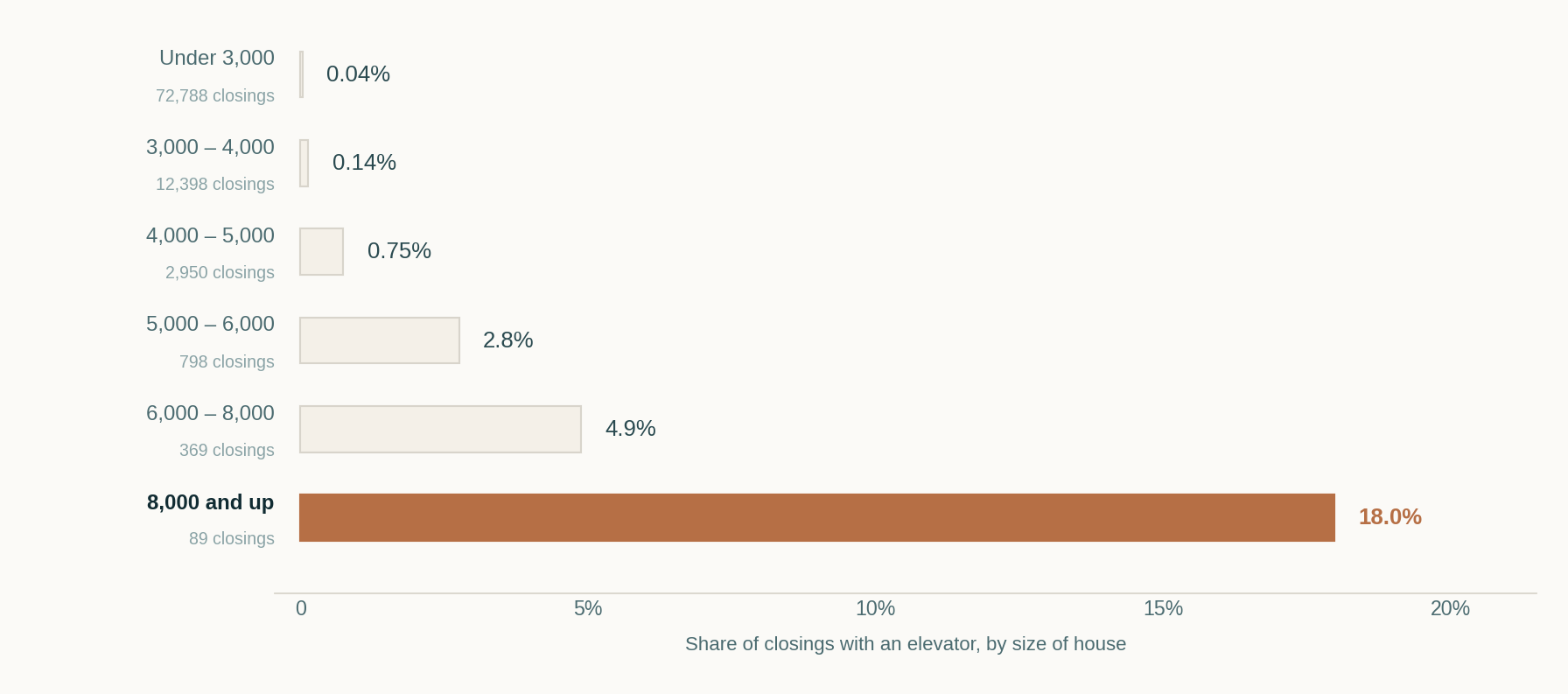
The prevalence rises by a factor of roughly 450 from the bottom of the market to the top. The typical elevator house closed at $1,595,000 on 4,872 square feet, about $335 a foot, built in 2005, on a lot of about 15,600 square feet. The typical house in the whole file closed at $378,000 on 2,096 square feet at $187 a foot.
Which sets up the trap. Any comparison that does not fully neutralize size, price tier and neighborhood will attribute to the elevator everything else that comes with a house expensive enough to have one.
What is actually in the shaft
Before pricing the thing it helps to know what the thing is, because six fairly different machines all get typed into a listing as “Elevator,” and the spread between the cheapest and the dearest of them is wider than any premium measured in the rest of this article.
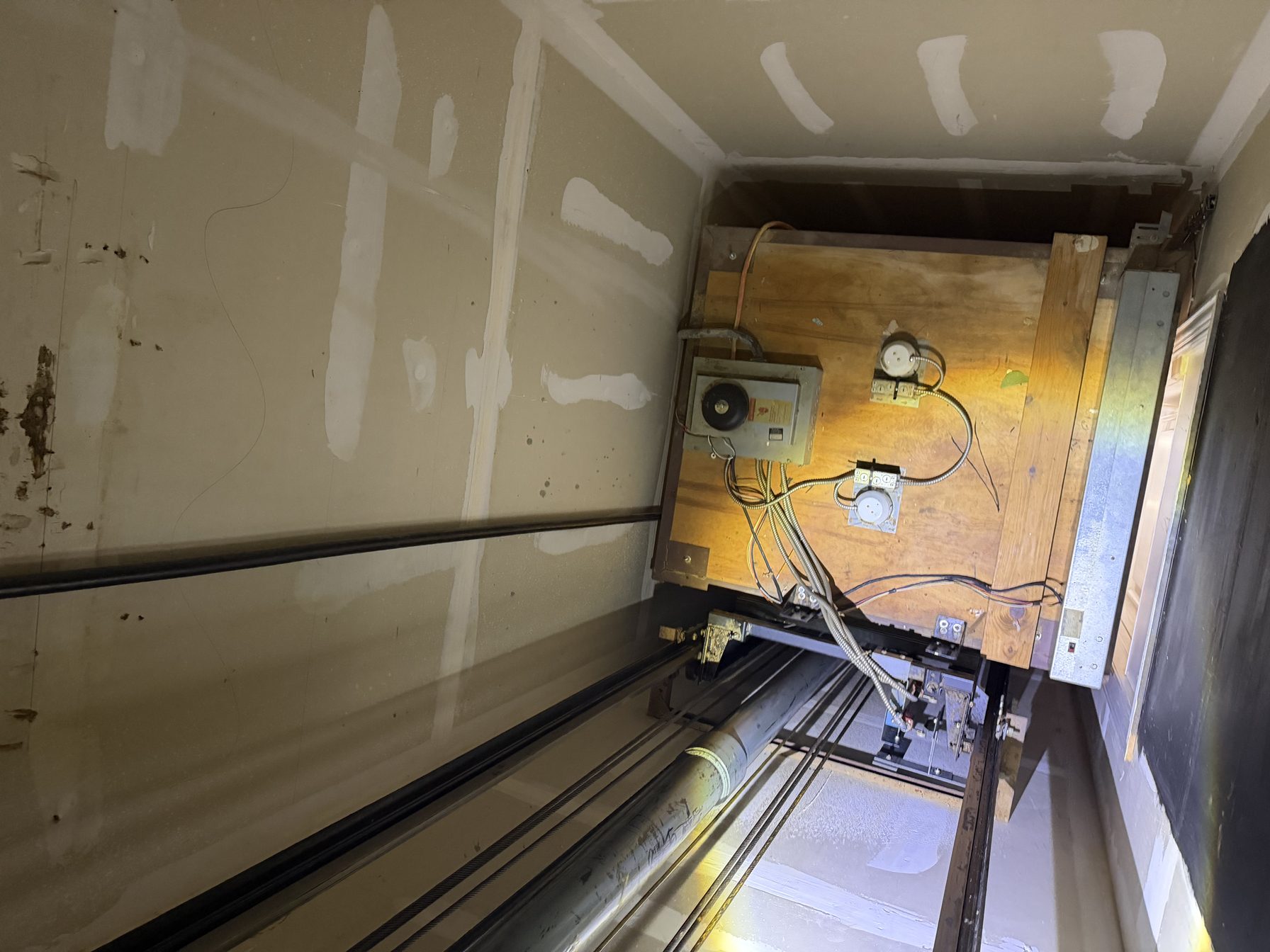
Six machines, one checkbox
Hydraulic. A jack pushes the car up and a valve meters fluid back out to lower it. The photograph above is one — the cylinder runs beside the guide rails, and the plywood board carries the pump controller and disconnect. Hydraulics are the workhorse of the residential market: heaviest loads, smooth ride, and a small machine space for the pump and tank. They also have fluid to maintain and a jack that can eventually seep.
Winding drum. A motor winds steel cable onto a drum, with the machine usually overhead rather than in a separate room. Fewer components, less to service, and a common answer in a retrofit where there is nowhere to put a pump closet.
Traction. Ropes over a sheave with a counterweight carrying most of the load. Efficient and quiet, the standard in commercial buildings, and in houses it appears in higher-end and machine-room-less installations where the machine lives inside the hoistway.
Chain drive. A chain in place of cable, geared for load rather than speed. Durable, and well suited to wheelchair use.
Pneumatic vacuum. A sealed transparent tube in which air pressure above the car is reduced so the car rises. No pit, no hoistway, no machine room — it lands in a room and is the easiest retrofit on the list. It is also the most limited: small car, lower capacity, not the machine for a wheelchair, and serviced on a trip count rather than a calendar.
Through-the-floor, or shaftless. Strictly a lift rather than an elevator. Cut an opening between two floors and drop in a platform on a drum or hydraulic drive. Cheapest, slowest, smallest — and the one most often typed into a listing as an elevator.
Published installed prices run from roughly $30,000 to $40,000 for a shaftless lift, $45,000 to $75,000 for a conventional two- or three-stop elevator with a hoistway, and $75,000 and up once you add stops or glass. That is a range of better than two to one inside the same MLS checkbox, which is the first reason no single elevator adjustment can be right.
How this differs from the elevator at the office
Private residence elevators have their own part of the safety code, ASME A17.1/CSA B44 Section 5.3, and it describes a deliberately small machine. The clear inside area of the car is capped at 15 square feet. Residential drives are published at around 40 feet per minute, and the code's overhead-clearance tables top out at that speed. A commercial passenger elevator runs several times faster, carries several times the load, and arrives with fire service recall, standby power, ADA-compliant dimensions and controls, and a mandatory inspection cycle behind it.
There is also a safety history worth knowing. The gap between a hoistway door and an accordion-style car gate was wide enough on older residential installations for a small child to be caught in it, and the code tightened. Current checklists call for no more than three inches between the hoistway door and the car gate, and three-quarters of an inch between the hoistway door and the sill. Older equipment predates the rule. For an appraisal that is a condition and marketability question rather than a code-enforcement one, but it is a concrete reason a 1998 elevator and a 2019 elevator are not the same product sitting behind the same word.
Texas: the inspection nobody schedules
Texas regulates elevators under Health and Safety Code Chapter 754, and houses are largely carved out of it. Section 754.0111(b) provides that the chapter does not apply to an elevator located in a single-family dwelling — with one exception. Section 754.0141 requires equipment installed in a single-family dwelling on or after January 1, 2004 to comply with ASME A17.1 or A18.1 and to be inspected by a registered elevator inspector once installation is complete, with the report handed to the owner. After that, an inspection of residential equipment may be performed only at the request and with the consent of the owner.
One inspection at installation, and then nothing, indefinitely, unless somebody asks for it. So there is usually no certificate on the wall and no state file to pull, and whether a particular elevator has been serviced in the last decade is a question for the owner and the service company rather than a record. Ask for the installation report and the most recent service invoice. The median elevator house in this data was built in 2005, which puts most of this market just on the far side of that 2004 line.
The raw number, and what it is measuring
The model is the ordinary one: the logarithm of close price against the presence of an elevator, the logarithm of living area, the logarithm of lot size, year built, a time trend, and fixed effects for city. The coefficient on the elevator term converts to a percentage premium.
| What is being compared | Sales | Elevator premium | 95% interval |
|---|---|---|---|
| Everything, city fixed effects | 89,302 | +35.1% | +29.6% to +40.8% |
| Restricted to $700,000 and up | 10,028 | +30.9% | +24.3% to +37.9% |
| Restricted to 3,500 sq ft and up | 8,307 | +28.9% | +20.8% to +37.6% |
| Both: $700,000+ and 3,500 sq ft+ | 5,542 | +21.4% | +14.4% to +28.8% |
Thirty-five percent of a $1.6 million house is over half a million dollars, which would make a residential elevator the single best-returning improvement in the history of residential construction. It is not. Watch what happens to the number as the comparison gets fairer: each time the set of houses being compared is narrowed to ones more like each other, the premium falls.
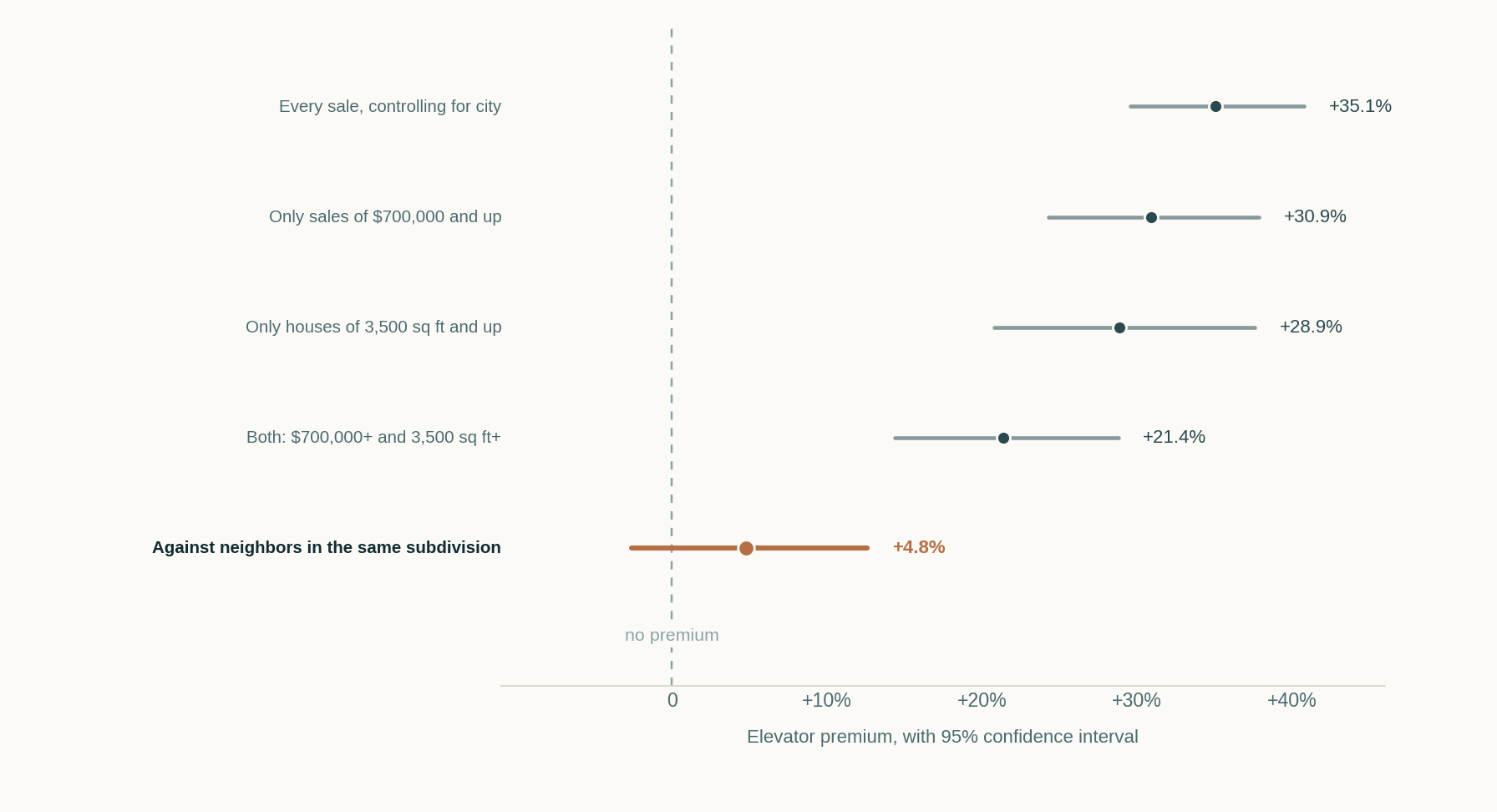
That pattern is the signature of a variable that is standing in for something else. The elevator is not causing the price. It is marking a house — larger, better finished, on a better street, built by a builder whose houses command a premium for a dozen reasons the model cannot see. Controlling for square footage and price tier removes some of that. It does not remove the part that is the neighborhood and the specification.
So remove those too.
Inside the subdivision, the number collapses
The cleanest available control is to compare each elevator house only with houses in its own subdivision. Keep the subdivisions that contain at least one elevator sale and at least three sales without one, put in a fixed effect for each subdivision, and cluster the standard errors by subdivision. Now the comparison is Montserrat against Montserrat, Westlake Entrada against Westlake Entrada, on top of the size, lot, age and time controls.
Fifty-nine subdivisions qualify: 2,805 sales, 75 of them with an elevator.
| Specification | Sales | Premium | 95% interval | p |
|---|---|---|---|---|
| Subdivision fixed effects | 2,805 | +4.8% | −2.6% to +12.6% | 0.21 |
| Same, with year-of-sale fixed effects | 2,805 | +4.8% | −2.5% to +12.7% | 0.20 |
| Requiring 5+ comparable sales per subdivision | 2,758 | +6.5% | −0.3% to +13.8% | 0.06 |
| Requiring 10+ | 2,658 | +6.0% | −1.8% to +14.4% | 0.13 |
| Dropping the largest elevator subdivision | 2,767 | +4.6% | −3.1% to +12.9% | 0.25 |
| Excluding single-story listings | 1,368 | +4.0% | −3.3% to +11.8% | 0.29 |
| Restricted to $1,000,000 and up | 585 | +4.4% | −3.2% to +12.6% | 0.27 |
| Restricted to houses built 1990 or later | 1,911 | +7.0% | +0.6% to +13.9% | 0.03 |
| Restricted to 3,500 sq ft and up | 741 | +8.6% | +1.1% to +16.7% | 0.02 |
| Restricted to 4,000 sq ft and up | 501 | +8.4% | +0.6% to +16.8% | 0.04 |
The +35% becomes about +5%, and in the main specification it cannot be distinguished from zero. Every one of the first seven rows has a confidence interval that includes no premium at all.
Two rows do clear the usual bar, and they point the same direction: the signal, such as it is, lives in large houses. Restricted to 3,500 square feet and up the estimate is +8.6% with an interval of +1.1% to +16.7%. That is a real finding and also a fragile one, resting on 51 elevator sales, with an interval wide enough to be consistent with almost anything between "a rounding error" and "a great deal of money."
Against that, the $1 million-and-up cut — a different way of getting at the same upper market — produces +4.4% and does not clear the bar. Size discriminates here; price does not. That is consistent with an elevator being worth something in a house that is physically tall and long enough to need one, and worth very little in an expensive house that does not.
There is also a modest but instructive data problem worth naming: 25 of the 121 elevator listings are coded single-story. Some of those are real — a lift to a bonus room over a garage, or down to a basement, which exist here but are rare — and some are almost certainly field-entry noise. Dropping every single-story listing moves the estimate from +4.8% to +4.0%, which is to say it changes nothing material.
Forty-nine matched pairs
Regression is one route. The traditional route is the paired sale, and it is worth running because it rests on different assumptions and can be read without any statistics at all.
For each elevator sale, take the sales in the same subdivision, within 15% on living area, closing within eighteen months, without an elevator. Where at least two such sales exist, compare the elevator house's price per square foot with the median of its matches. Forty-nine elevator sales find a usable set.
| Matched-pair result | Value |
|---|---|
| Usable pairs | 49 |
| Median premium per square foot | −0.3% |
| Mean premium | +1.9% |
| Share of pairs where the elevator house was higher | 47% |
| Interquartile range | −9.8% to +12.8% |
| Signed-rank test | p = 0.71 |
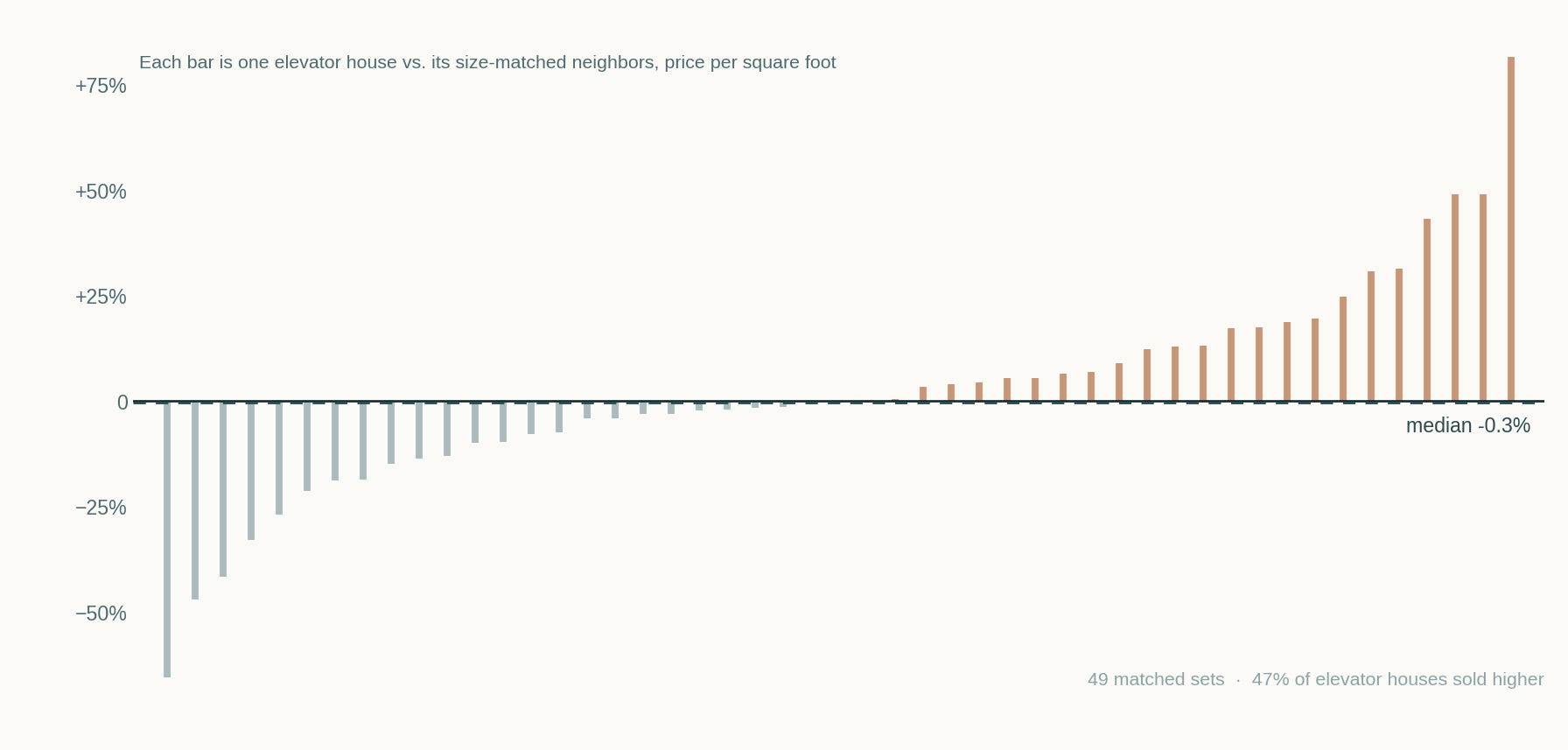
A coin flip. Fewer than half the elevator houses outsold their matched neighbors on a per-foot basis, the middle of the distribution sits on zero, and the spread in both directions is far larger than any plausible elevator adjustment — which is what you would expect, because condition, finish level, view and lot position are all still in there and all of them are bigger than an elevator.
The pairs do not contradict the regression. They confirm the thing the regression is telling you: at this sample size, in this market, the elevator is not big enough to find reliably against the noise.
What that is in dollars
Percentages are the wrong unit for this, and converting them is clarifying.
| Estimate | Applied to | Point value | Interval |
|---|---|---|---|
| Within-subdivision, all sizes (+4.8%) | $1,595,000 median elevator house | about $77,000 | −$41,000 to +$201,000 |
| Within-subdivision, 3,500 sq ft+ (+8.6%) | $1,970,000 median in that subset | about $169,000 | +$22,000 to +$329,000 |
| Matched pairs (−0.3%) | $1,595,000 | about $0 | wide and centered on nothing |
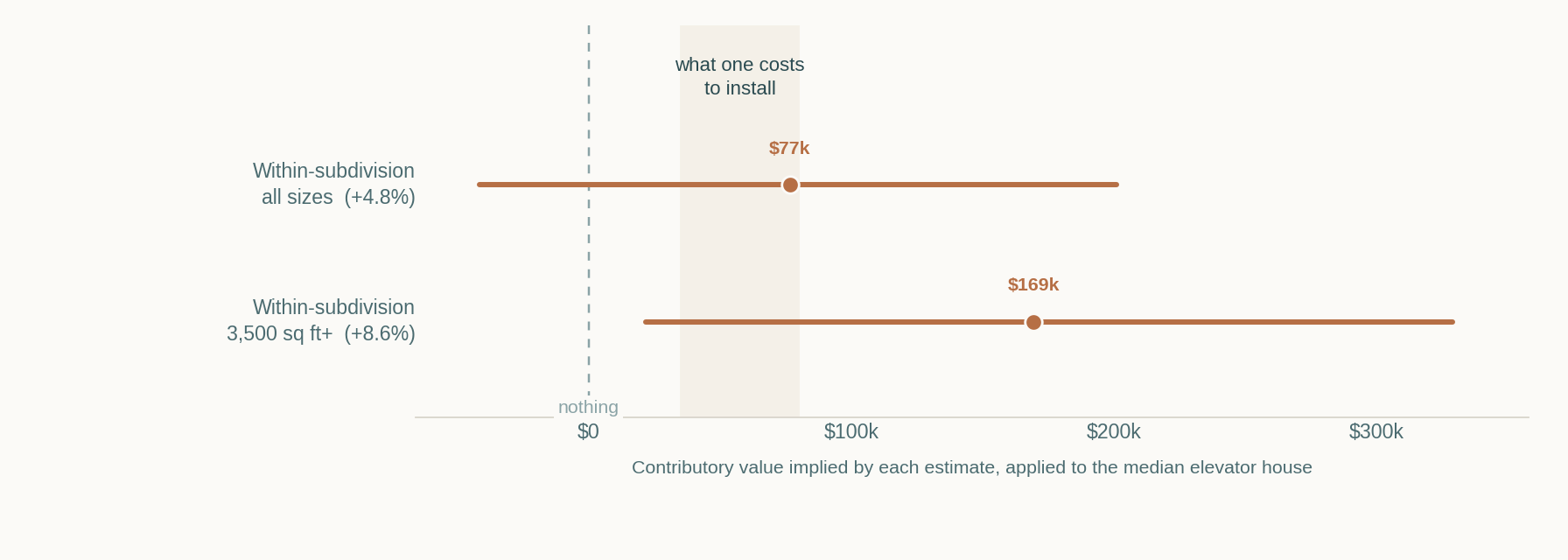
Now put the cost of the thing next to it. Trade sources put an installed residential elevator in the range of $30,000 to $40,000 for a shaftless through-floor lift, $45,000 to $75,000 for a conventional two- or three-stop elevator with a hoistway, and $75,000 and up for more stops or higher finish; another puts the overall range at roughly $35,000 to $80,000-plus installed. Retrofitting an existing house costs more than framing one in from the start, for the obvious reasons.
So the cost of building one falls inside every interval in the table above, and the point estimate from the main specification — about $77,000 — sits within a few thousand dollars of the top of the ordinary cost range.
That is the answer, stated the way I would state it to a client: a residential elevator in this market contributes something in the neighborhood of what it costs to install, the data cannot rule out that it contributes nothing, and there is no support anywhere in 89,302 sales for a contribution that is a meaningful percentage of a luxury house's value.
It is worth saying plainly that a supported adjustment of zero is a finding, not a failure to find one. Owners hear it as the appraiser not having looked. Frequently it is the most defensible number on the page.
Why it lands near cost instead of above it
Three reasons, and each one can be checked independently of the statistics.
It is infrastructure, not an amenity. Nobody tours a house and falls in love with the elevator. A pool changes how a family imagines living in a backyard; a kitchen renovation is visible in every photograph. An elevator solves a logistics problem — groceries, luggage, a bad knee, a fourth floor — and buyers who do not have that problem assign it close to nothing. Features that solve problems get valued by the share of the buyer pool that has the problem.
The buyers who most need one are not the buyers in this price range. This is the uncomfortable part. Accessibility is the strongest genuine driver of demand for a home elevator, and the households for whom it is decisive are disproportionately not shopping at $1.6 million for an 8,000-square-foot house with three staircases. Where the need and the price point do line up, the elevator is worth a great deal to that one buyer — but market value is what a typical buyer would pay, not what the most motivated one would.
In the class of house that has them, having one is closer to normal than special. Eighteen percent of houses over 8,000 square feet in this file have an elevator. That is not yet the baseline, but it is heading that direction, and for a standard feature the penalty for lacking it is usually a larger number than the premium for having it. In a four-story house on a narrow lot, no elevator is a defect. That asymmetry is the same one described in the contributory value article, and it is the single most useful idea in this whole area.
The part that shows up in time rather than price
Contributory value is not the only thing a feature does to a sale. Elevator houses in this file took a median of 43 days to go under contract against 35 for the market, and closed at 95.0% of original list price against 97.0%.
Both of those are contaminated by the same thing the price comparison was: expensive, unusual houses take longer to sell and negotiate harder whether or not they have a lift. Running them inside the subdivision fixed effects shrinks the effect and neither clears the usual threshold — roughly 28% longer on market (p = 0.13) and about 2.4 points lower against original list (p = 0.10). Directionally slower, not provably so.
And there is a carrying cost that never appears in any of this. An elevator is a mechanical system in a house. It needs annual service, it will eventually need parts, and an inspection report noting a lift that has not been serviced in years is a negotiating item, not a feature. For an appraisal, the relevant question is not whether the house has an elevator but whether it has a working, maintained, current elevator — and those are different properties with different contributory values.
How I would support an elevator adjustment in a report
None of the above is a lookup table, and none of it should be pasted into a grid. What it is good for is knowing the order of magnitude before the assignment starts, which is most of the battle. Applied to a specific house, the work is:
- Define the competitive set first. Not "luxury homes in Fort Worth" — the specific subdivision, price tier and product type this house competes in. The premium is different in each, and the whole point of the analysis above is that the sloppier the comparison, the larger and more wrong the number.
- Ask what is normal in that set. If most competing houses have one, the correct analysis is a penalty for absence, not a premium for presence. If almost none do, an elevator may be a superadequacy — an improvement past what the market will pay for.
- Look at the equipment, not the checkbox. Which of the six drive systems it is, how many stops, its age, its finish, whether it was framed in or cut in later, and whether it runs today. A shaftless lift and a three-stop hydraulic cab are not the same line item.
- Ask for the paper. For anything installed since January 2004 there should be an installation inspection report, and there may be service invoices. Texas requires nothing after that, so their absence is common and is itself worth a sentence in the report.
- Find the pairs if they exist, and say so if they do not. With one in 738 sales carrying one, in most assignments they do not exist, and the honest report says which secondary method carried the adjustment instead — depreciated cost tested against the market, grouped data, a broader statistical analysis like this one — rather than presenting a figure with nothing behind it.
- Do not use cost as the conclusion. The fact that the market answer here lands near cost is a finding from the sales. It is not permission to substitute an invoice for an analysis. In a market where an elevator is unusual for the price point, the supported number will be well below cost, and cost would be the wrong answer arrived at confidently.
If you are on the other side of a report — an owner, an agent, an attorney — the useful question is the same one that works on every adjustment: which sales support this figure, how alike were they really, and if there were no clean pairs, what was used instead?
What this does not say
The honest limits, in order of how much they should bother you.
121 sales is not many. The intervals in these tables are wide because the data are thin, and thin data cannot be argued into precision. Anyone quoting a single tidy percentage for what an elevator adds is quoting something the evidence does not contain.
The field is a checkbox. Interior Features is entered by the listing agent. It does not distinguish a shaftless through-floor lift from a three-stop hydraulic or traction cab — a spread of better than two to one on cost alone — and it says nothing about condition. Twenty-five of the 121 are coded single-story, which tells you something about entry discipline.
This is Dallas–Fort Worth, in 2023 through 2026. In a coastal market with elevated pilings, or a city of four-story townhouses, elevators are ordinary and the analysis would look completely different. Contributory value is local, and it moves over time.
Nothing here is an opinion of value about any property. It is a market study. A specific elevator, in a specific house, at a specific date, is an appraisal problem, and the number may reasonably land outside every range above once the particular facts are in front of it.
If you are the one deciding whether to build one
Three things follow from the data, and only one of them is about resale.
If you are framing new construction, the cheap move is the shaft. Stacked closets on each floor, structurally ready, wired for it. The cost of that at framing is a small fraction of a retrofit, it costs nothing to leave as closets, and it converts the question from a $75,000 decision into a $10,000 option you can exercise later or never. Nothing in this data will tell you the finished elevator pays for itself. The option is a different proposition.
If you are retrofitting because someone in the house needs one, build it and stop thinking about resale. You are buying the ability to stay in your house, which is worth what it is worth to you, and the market's opinion is not the relevant opinion. Treat whatever comes back at sale as a rebate rather than a return.
If you are adding one because you believe it will come back, this is the case the data argue against. The best-supported estimate is around cost, the interval includes zero, and it takes a large house for any of the estimates to clear the significance bar at all. That is not a catastrophic investment — near cost is better than most discretionary improvements do — but it is not a money-maker, and a contractor telling you otherwise is selling you an elevator.
Terrence Bilodeau is a Certified Residential Appraiser (TX-1360232) and a Texas real estate broker. Clearfork Appraisals provides private-client appraisals in Fort Worth — estate and date-of-death, divorce, tax protest, partial interest, and pre-listing. This article is a general market study of how one feature has been priced in aggregate. It is not an appraisal and not a valuation opinion about any specific property.
- North Texas Real Estate Information Systems (NTREIS) closed sales, detached single-family, Dallas–Fort Worth, January 2023 – September 2026. Author's analysis; figures reported in aggregate.
- Savaria — How much does a home elevator cost (installed price ranges by elevator type)
- Lifeway Mobility — Home elevator cost guide (installed price ranges by elevator type)
- Texas Health and Safety Code Chapter 754 — §754.0111(b) single-family exemption; §754.0141 installation inspection
- Texas Department of Licensing and Regulation — Elevator Safety FAQ
- Georgia OCI — Residential elevator contractor checklist (ASME A17.1 Rule 5.3.1.10.1 platform area; door and sill clearances)
- Inclinator — Understanding the safety code for elevators (Section 5.3 cab area; door clearance history)
- Southeast Elevator — Home elevator systems compared (drive types, speeds, service intervals)
- Retirement Living — Types of home elevators (drive types, capacities, price ranges)
- TALCB — Appraisal, Evaluation, Broker’s Price Opinion: What’s the Difference?
Cost and equipment figures are published ranges from elevator manufacturers and installers and are not independent estimates; they are used here only as a reference point against the market evidence. Code citations are to secondary sources describing ASME A17.1 Section 5.3, not to the standard itself, which is copyrighted and sold by ASME. Statutory references are to the Texas Health and Safety Code. Confirm current code and statute before relying on either.