What you're actually buying
A house is a structure on a piece of land, and the decisions about it are yours. The roof goes when it goes, you get bids, you pick one, you pay. Painful, but legible.
A condominium is two things at once. It's an interest in a specific unit — the airspace, the finishes, whatever the declaration says is yours. And it's an undivided share in everything else: the structure, the roof, the elevators, the garage, the plumbing risers, the fire system, the lobby, the pool deck. Your share comes with a bill, and the bill is not set by you.
That second part is the part people don't price. You are buying a share of a building and a seat in a governance structure that decides when, whether, how, and by whom that building gets maintained. You get one vote. The board sets the budget. And whatever they decide, you pay your share.
There's a real benefit on the other side of that trade — you're buying a lifestyle, and part of what you're paying for is not having to think about the roof. That's a legitimate thing to want. But the premium isn't just the monthly fee. The premium includes the risk that comes from not controlling the decision.
What fourteen years of sales actually show
I pulled every closed sale I could get for five Fort Worth condo projects — a mix of historic conversions and purpose-built towers, ranging from a small building with a few dozen units to the largest projects in the city. Then I normalized the dues to a per-square-foot-per-year figure, so buildings with different unit sizes could be compared, restricted the sample to ordinary units between 850 and 1,800 square feet rather than penthouses, and used three-year rolling medians because several of these buildings sell fewer than ten units a year.
That's 711 closed sales. For the dues figures only, I also counted the 33 units currently listed in these buildings. A list price tells you nothing reliable, so no asking price is anywhere in this analysis. But monthly dues are a disclosed fact about the building, published the same way whether the unit sells or not — and in a building that trades three times a year, throwing away the current listings means reporting a number that is two years stale. Prices here are closed sales only. Dues are closed sales plus what the building is disclosing right now.
I'm not naming the buildings — people live in them, and the point here is the pattern, not any particular address.
One disclosure before the charts, since it bears on how you read them: I owned a unit in one of these five buildings for eight years. Part of why I bought was that I'd been appraising units in buildings like it, and I figured owning one would be useful experience — for the appraisal work and the brokerage work both.
It was useful. Just not in the way I had in mind.
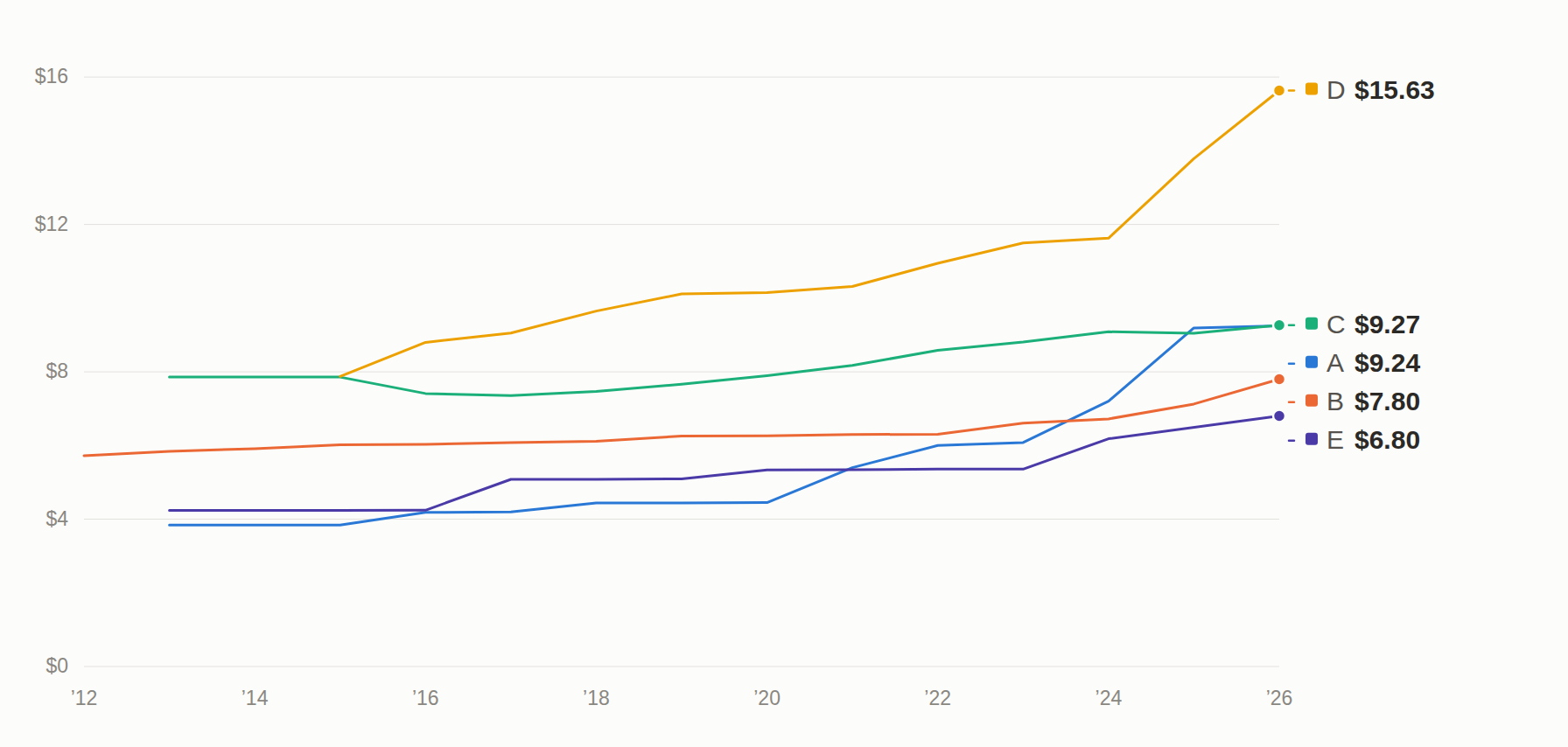
- A — 1928 building, converted to residences
- B — 1972 office tower, converted in the mid-2000s
- C — 1921 building, converted; the smallest sample here
- D — purpose-built residential tower, 2008, with hotel services attached
- E — 1930 building, converted; almost no amenities
Look at where A starts and where it ends.
In 2013 it was the cheapest building in the group at $3.84 per square foot per year — about $400 a month on a 1,263-square-foot unit. Today it's $9.24. Its dues went up 141%.
Now look at C, which in 2013 charged more than twice what A did: $7.86. Eleven years later it's at $9.09. Up 16%.
They ended up in the same place. One of them charged the true number from the beginning. The other spent thirteen years discovering it.
And the values went in opposite directions
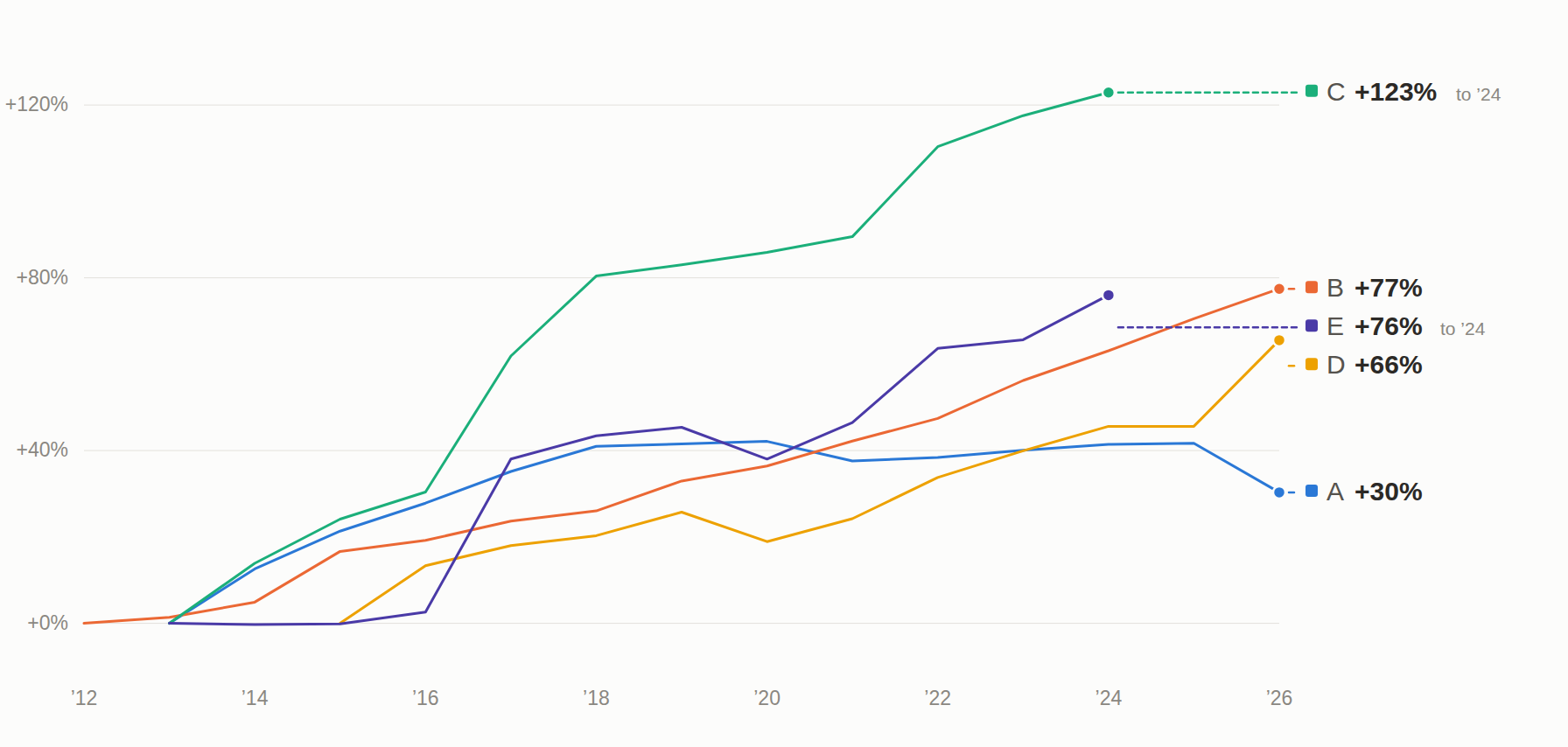
| Building | Years covered | Dues change | Price per sq ft change |
|---|---|---|---|
| A | 2013–2026 | +141% | +30% |
| B | 2012–2026 | +36% | +77% |
| C | 2013–2024 | +16% | +123% |
| D | 2015–2026 | +98% | +66% |
| E | 2013–2024 | +46% | +76% |
Buildings enter the table when they first have enough sales to produce a median, and leave it when they stop selling, so the windows differ. Both columns and both charts run off the same figures.
The building whose dues nearly tripled delivered roughly a quarter of the price growth of the building that held its dues flat. And A is the only one of the five worth less per square foot today than at its peak — the only line on that chart pointing down.
How far down depends on what you hold still. Across all unit sizes it's off about 8% from 2020. Control it to the single most common floor plan in the building — the cleanest like-for-like comparison available anywhere in this data, because it's the same plan in the same building — and the median closing is down about 18% from its 2023 high. That second number is the one an owner there feels.
That is not what most people expect. The intuition is that high fees are a warning sign and low fees are a bargain. The data says the opposite, and the reason is structural rather than coincidental.
A word on limits before I explain why. Buildings C, D and E are thin samples — 42 to 45 closed sales each across fourteen years, sometimes only one or two in a year. C also started from a distressed price base, so some of its 123% is simply recovery rather than outperformance. These are five buildings in one city, not a controlled experiment. What survives all of that is the ordering, and the ordering is consistent.
Where this stands in 2026
The charts use three-year rolling medians because several of these buildings sell too few units for a single year to mean anything on its own — building C recorded no closed sale at all in the first eight months of 2026. Reading the current year is exactly where the listings earn their place: between closings and live listings there are 27 disclosures for A this year and 21 for B, which is enough to say something.
Building A's pause is over. Its dues per square foot by single year: $7.20 in 2022, $7.80 in 2023, then $9.24 in 2024 and again in 2025 — and $9.60 in 2026. Two flat years, then another increase, landing in the middle of this year: units that were disclosing the 2024 figure in January are disclosing about four percent more by summer.
I want to be careful about what that does and doesn't mean. Four percent is not a crisis; it is roughly what a well-run building does every year, and A's increases from 2021 to 2024 were far steeper. The honest reading is that A has finished catching up and has now started doing what it should have been doing all along. The correction is behind it. The cost is not, because the cost never goes away — that's the whole argument.
Building B is still closing the gap. Its dues by single year: $6.31 in 2022, $6.93 in 2023, $6.89 in 2024, $7.37 in 2025, and $8.41 in 2026 — the largest single-year increase in its history, and still roughly nine percent short of where A and C independently settled.
So I'll put this on the record as a prediction rather than an observation. B's dues should keep climbing toward the nine-dollar line, because that appears to be what a converted high-rise in this market costs to run. If I'm wrong, this paragraph will still be here.
Why: the level and the slope are two different things
Once you look at all five buildings together, two separate variables come apart, and confusing them is how buyers get hurt.
The level is set by how much building you're maintaining. A tower with a pool deck, a spa, a fitness center, a guarded entrance, and a concierge costs more per square foot to run than a building with an elevator and a lobby. That's not mismanagement. That's arithmetic. The number of units matters too: the same elevator modernization spread across sixty doors costs each owner far more than it does across three hundred.
The level is mostly about services. D is a purpose-built tower with a hotel's worth of them attached, and it charges roughly twice what any conversion here does — $15.63 per square foot per year against a $6.80-to-$9.27 band for the other four. E, which has almost nothing beyond a lobby and a club room, sits at the bottom. Nothing surprising in either.
What is surprising is that between those two poles, the amenity list explains very little. C offers less than B and charges more.
The slope is set by whether the association charged the true number from the beginning. And that's the one that costs you money.
Because here is the thing that stopped me when I saw it: two of these buildings, run by different boards with different managers and different amenity packages, independently arrived at nearly the same dues per square foot — $9.24 and $9.27, a third of a percent apart. A third is climbing toward the same number from below. That figure appears to be roughly what it actually costs to run a converted high-rise in this market — a number the building cannot negotiate its way out of, because it's set by concrete, elevators, insurance, and time.
One of those buildings charged that number from day one. Another charged less than half of it for a decade, and then spent thirteen years discovering it, in a series of sharp increases that owners experienced as a crisis and that were really just an overdue invoice.
The money those owners didn't pay in dues was real. They kept it. What was never avoided was the cost — the garage kept aging, the elevators kept running down their service life, and the envelope kept failing, on exactly the schedule they would have followed if the account had been funded. All the low dues bought was time, and postponed repairs generally get more expensive rather than less.
There's a second problem, and for a buyer it's the important one. The people who enjoyed the low dues and the people who paid the catch-up are usually not the same people. An owner who bought early and sold before the increases got a decade of cheap assessments and left ahead of the invoice. Whoever owned the unit during the correction paid for maintenance deferred before they ever arrived — partly in higher dues, partly in special assessments, and partly in the value their unit lost while the market repriced it for the new carrying cost.
Which is the single most useful sentence I can give you: when you buy into an underfunded building, you are buying somebody else's deferred bill. Nothing on the listing tells you that. The reserve study does, which is why it's the first document I'd ask for.
And the reason it starts underfunded is written into the declaration
I went and read one. It's a standard provision and you'll find something like it in most declarations for a new or newly converted project, and once you see it the whole pattern makes sense.
While the developer still controls the association, the declaration obliges him to cover the gap — to pay the amount by which the building's actual common expenses exceed what owners are paying in monthly assessments. That's how initial dues get set below what the building costs to run: the developer is quietly making up the difference, because low dues sell units.
The obligation runs until the earlier of the end of developer control or three years from the first unit sale. And in the declaration I read, the developer's obligation to cover the shortfall expressly excludes the portion allocable to reserves. Twice, in two separate sentences.
Read that again. During the sell-out period, the operating gap is covered — but the reserve contribution isn't part of the deal. So the building can run for years on dues that look affordable, with a reserve account that was never going to be adequate, and nothing about that is a failure or a scandal. It's the document working exactly as written.
Then the subsidy ends, control passes to the owners, and a board of volunteers inherits a budget that has never once paid the true cost of the building they now own.
You can see the starting number in the record. One declaration I read sets it out on the ownership-allocation exhibit: dues per square foot, 27 cents a month, as of the day the condominium was created. That's $3.24 a year per square foot — and the sales data shows the building was still charging almost exactly that rate four years later. Today the same building is above nine dollars.
The original number wasn't a mistake or a low-ball. It was a marketing decision, recorded in a legal document, and it held long enough that a decade of buyers took it for the cost of owning there.
That's the whole mechanism. Not bad management. Not bad luck. A structure that hands owners a pleasant number at the start and the real one later, and the real one arrives with interest.
You can check this before you buy. It's in the declaration, it's recorded, and it's free to read at the county.
What the current listings say, and how far to trust them
Everything above this point is closed sales. But a building that sells three units a year tells you very little through closings alone, and there's a second source sitting in plain sight.
An asking price is not a value. It is an upper bound on one, and a soft one — a seller who would take less can still ask more, but almost nobody asks less than they would take. That makes listings useful in a specific and limited way:
- A unit that sits unsold is evidence that value is below the ask, and the longer it sits the stronger the evidence.
- A withdrawn or cancelled listing is stronger evidence still. It's a number the market was shown and declined.
- A repeat offender is the most informative of all — the same unit listed, cancelled, relisted lower, cancelled again. That isn't a market telling you nothing. It's a market telling you no, three times, at three different numbers.
I watched this play out in building E while writing this. One unit of a given floor plan has been offered for over a month with no contract. The same floor plan on a lower floor, with a worse view and no obvious difference in condition, was listed twice at materially higher numbers and cancelled both times. The last actual closing of that plan was years ago and well below all of it. The asking prices were never achievable; the closing was the only real number in the set. If you were valuing that unit off the listings you'd be wrong by a wide margin — but if you read the listings as a ceiling rather than a value, they told you exactly what you needed to know.
Which is why the price chart above uses closed sales only, and the dues figures use both. Dues are disclosed the same whether a unit sells or not. Prices are not.
Building A's current listings are worth sitting with. Twelve units of its most common floor plan are on the market right now. Two-thirds of them are asking less than I paid for the same floor plan in 2014, and the median asking price across all twelve is below my purchase price as well. These are asking prices — ceilings, not values — which means the real numbers are lower still.
Twelve years. In the most-traded floor plan of a well-located building, in a metro that grew the entire time.
Why it shows up in the price
Here's the part that surprises people who assume dues are just an operating cost.
Lenders count HOA dues in your debt-to-income ratio. They are, for qualification purposes, indistinguishable from mortgage payment. So every additional dollar of monthly dues removes roughly a hundred and fifty dollars of what a qualified buyer can borrow for that unit.
Run that forward on a building whose dues rise by several hundred dollars a month over a decade and the arithmetic is brutal. Two things happen at once. Every buyer who walks through the door can now borrow tens of thousands of dollars less for that unit than they could have before — same income, same credit, smaller budget. And some buyers who used to qualify no longer do at all, so there are fewer of them.
The building didn't get worse. What buyers could pay for it did. And the price follows what buyers can pay.
This is also why one of the five buildings breaks the pattern in an instructive way. Its dues are the highest in Fort Worth by a wide margin and they've risen steeply — and it appreciated anyway. The reason is that the overwhelming majority of its buyers pay cash. Dues don't constrain a cash buyer's borrowing power because there isn't any. They reduce yield, which a buyer at that price point absorbs.
So the risk isn't "high dues." The risk is rising dues in a building whose buyers need mortgages — which describes most of the condos most people are actually considering.
What actually breaks, and when
Buyers grade a building on what they can see: the lobby, the gym, the finishes in the unit. Those are the cheapest things in the building.
The expensive things are the ones nobody looks at:
- The parking garage. In a concrete structure, slab waterproofing and spall repair is routinely the single largest line in the reserve study. It fails invisibly, from the inside, over decades.
- Elevators. Not repair — modernization. Per car, on a multi-decade cycle, and there's no version where it's cheap.
- The building envelope. Sealants and caulking on a short cycle, masonry repointing, flashings. Note that in a conversion the glazing is usually not original — new windows are normally part of the job, because the building's original commercial glass won't meet residential energy and egress requirements. The masonry behind them is another matter entirely.
- Any structural deck above occupied space. A rooftop pool is a waterproofing membrane holding back a body of water over people's ceilings. When that reaches the end of its life, it is not a pool project.
- Central plant — chillers, boilers, cooling towers.
- Risers and domestic water piping. In-unit plumbing is usually replaced at conversion; the vertical stacks and mains running through the building's shafts frequently are not. That split is the one that turns an old conversion into a decade-long problem.
- Fire and life safety — sprinklers, standpipes, alarm panels.
Each of those has a replacement cost and a remaining life, and that pairing — what it costs to put back, how much service is left in it — is the arithmetic a reserve study runs on every component in the building.
It's worth being clear about where I'm borrowing that from, because it isn't from the condo appraisal itself. On a unit in a stacked building there's no sensible way to develop cost: you can't isolate a share of the land under a twenty-story tower, and you can't depreciate a slice of a structure you don't independently own. So the cost approach generally isn't applied to a condominium unit, and a report that leaves it out isn't cutting corners. Value comes from the market — what comparable units in that building actually sold for.
But the habit of thinking in replacement cost and remaining life is central to how appraisers look at a building, and it's the standard method on single-family work where developing cost is meaningful. Applied here, it doesn't produce a value for your unit. It produces something more useful: a read on what the association is facing and whether it has the money. A properly funded building has been setting money aside against each item on a schedule. An underfunded one has been hoping.
In a conversion, ages are mixed, and the mix is invisible
This is where buyers of converted buildings get caught, and it's worth being precise about it, because the lazy version of this warning is also wrong.
A good conversion replaces a great deal. New windows, new mechanical, new electrical, new plumbing inside the units, new finishes throughout. Someone walking through sees a building that is, in every respect they can inspect, about as old as the conversion.
What doesn't change is the structure. The frame, the foundations, the exterior masonry, the shafts that everything runs through. And a third category is simply a coin toss: elevators may have been fully modernized or may be original equipment behind a new cab interior. The garage is often the one built for the original use, doing a job nobody designed it for.
So the question isn't how old is the building. It's what was replaced at conversion and what wasn't — and the answer is different in every building. A proper reserve study gives it to you component by component, with installation dates and remaining lives. That's the difference between a building with a twenty-year-old roof and one with a ninety-year-old parapet standing behind it.
And there's a category nobody has funded yet, because the studies were written before it mattered: EV charging. Service capacity, panel upgrades, sub-metering, sometimes a transformer. I raised this with a developer in this market years ago, back when his building was new, and was told electric cars were a fad. That building has no charging infrastructure today, and retrofitting a garage is not a small number.
One caution on the other side: a building with very few amenities has low dues partly because there's little to maintain — which is genuinely safer. But it also means the things buyers now expect have to be added later, by an association that never budgeted for them.
The costs that don't appear anywhere
Three categories of money never show up in a listing, a price, or a monthly fee.
Special assessments. These are the ones that change how people feel about ownership. A dues increase is a number you can plan around. An assessment is a bill. And once you've received one, the reasonable question is whether there will be another — which is a question the monthly fee cannot answer.
Here is what one looks like in practice. In February 2021, Winter Storm Uri froze and burst pipes across North Texas. In one downtown building the water damage ran through at least thirteen areas of the common elements — four floors of one wing, two elevator lobbies, both main lobbies, every stairwell in one tower, the stairwell on the pool deck, and the plumbing crawl space beneath the deck itself. Water came down an elevator shaft and into a package room, where it destroyed the fire panel.
That June the board levied a special assessment of ten dollars per square foot, allocated by each owner's interest, payable in four quarterly installments over the following year.
On a typical 1,263-square-foot two-bedroom, that is $12,630 — about $3,160 a quarter for a year, on top of the monthly dues. At that building's dues at the time, the assessment equalled roughly one and two-thirds of an entire year's assessments, arriving all at once.
Three things about that are worth sitting with.
The insurance was expected to cover a significant portion — but nobody knew how much. The board said as much: recovery would be held in trust and applied against the fourth installment, if it arrived. Owners paid first and found out later. That's not bad faith; it's how casualty claims work. It's also not something you can budget for.
The assessment covered more than restoration. Alongside repairing the damage, it addressed "safety concerns" in the lobbies, the third-floor amenity areas, the fitness center, hallways, stairwells, and resident parking. Some of that is genuinely necessary. Some of it is improvement. Owners paid for both, and the distinction was not theirs to draw.
And look at what was damaged. Elevator shafts. Stairwells. The plumbing crawl space under a pool deck. A fire panel. Those are the long-lived items from the list above — the expensive, invisible ones. A single weather event accelerated several of them at once, which is the thing a reserve study schedule can't anticipate: components don't only fail on their own timeline, and in a shared building you pay for all of them simultaneously.
I'll put one more number on it, because it's the clearest illustration in this article of why the monthly fee is not the cost of ownership. An owner who held a unit like that one for eight years in this period made roughly $25,000 on the sale. That single assessment was about half of the entire gain. Add the dues paid across those eight years and the carrying cost came to roughly two and a half times everything the unit appreciated.
Transfer costs. Buying into an association typically means a resale disclosure package fee, a transfer fee, sometimes a utility deposit, and a working capital contribution. In one Fort Worth building those add to roughly three thousand dollars at closing, plus several hundred more if you need the documents on a short timeline. None of it is in the price.
And there's a detail worth knowing: working capital contributions are often denominated in months of assessments rather than dollars. In the declaration I read, it's defined outright as the monthly assessment multiplied by two. Which means when the dues in that building roughly tripled, the cost of buying in tripled with them — automatically, with no vote, no announcement, and no amendment required, because the escalator was in the original document from day one.
Put those together and you get a result that surprises people: a nominal gain is not a gain. I've watched units in these buildings resell a year or two after purchase for slightly more than the owner paid — and the owner still lost money, by five figures, once a year of dues, the entry costs, and the cost of selling were counted. The price went up. The owner went backwards. On a detached house with no dues, the same nominal gain would have been roughly break-even.
Insurance. I won't tell you what master policy premiums have done in this market, because I haven't reviewed enough association budgets recently to say it honestly. What I can tell you is where the mortgage market thinks the problem is. Effective July 1, 2026, Fannie Mae capped the per-unit deductible on a master property policy at $50,000 — and regulators don't cap a number that isn't climbing.
Insurance is also the one large cost a board genuinely cannot manage its way out of. They can defer a garage repair. They cannot defer the premium.
So make it a question rather than an assumption. When you get the documents, find the insurance line in the budget and compare it to three or four years ago. Get the certificate and look at the deductible — particularly whether wind and hail carries a separate one, and whether it's a flat dollar amount or a percentage of the insured value, because on a high-rise those are very different numbers. And ask what the master policy covers versus what your own HO-6 has to pick up. Owners routinely discover the answer to that last one after a loss.
What Texas gives you, and what it doesn't
After Surfside, Florida legislated hard — milestone structural inspections, mandatory reserve studies, funding requirements.
Texas passed none of that. There is no state requirement that a Texas condominium association commission a reserve study, no mandated structural inspection, and no statutory minimum reserve balance. Chapter 82 permits reserves. It has never required them.
The reckoning still arrived here — it just didn't come through Austin. It came through the mortgage market and the insurance market. Which is worse for an owner, because it doesn't arrive as fix your building. It arrives, years later, as your buyer can't get a loan, with no warning and nobody to appeal to.
And that pressure is increasing right now. Fannie Mae's Lender Letter LL-2026-03 changed the rules for condominium projects this year, and the changes land in stages:
- August 3, 2026 — the Limited Review process was retired for established projects, so every condo loan now goes through full project review. Reserve study review was tightened, the baseline funding method is no longer acceptable, and a reserve study must have been completed or updated within three years of the loan application.
- July 1, 2026 — master property insurance policies are capped at a $50,000 per-unit deductible.
- January 4, 2027 — the minimum replacement reserve allocation rises from 10% to 15% of assessment income.
Read that three-year rule again, because it is the one most owners will miss. A stale reserve study is now a financing problem. An association that hasn't commissioned one recently isn't just under-informed — its units are harder to finance, which shrinks the buyer pool, which shows up in the price.
A lot of Fort Worth associations are about to face a choice between raising dues again and watching their units drift toward cash-only. If you own in one, that decision is coming whether or not it's been discussed at a meeting you attended.
What you can actually demand
Here's the part I'd want a buyer to take away, because it's concrete and it costs nothing.
Texas Property Code §82.157 requires the resale certificate to disclose the current operating budget, the amount of reserves for capital expenditures, and what portion of those reserves is earmarked for specific projects. That's a statutory right. You get it on every purchase. Almost nobody reads it.
When you get it, here's what you're looking for:
- The reserve study — its date and its conclusion. Is there one? When was it done? What percent funded is the association against its own recommendation? A stale study is itself information.
- The gap between recommended and actual funding. This is the single number that predicts your future dues, and it is the closest thing to a crystal ball you will ever be handed.
- The special assessment history. Not whether one is pending — what's happened over the last ten years, and for what.
- The dues history, not the dues. Five years of numbers. Flat with one step is a board doing its job. Flat for a decade in an old building is a board deferring.
- Board minutes, if you can get them. The bad news appears there first, in plain language, months before it appears in a budget.
- The insurance certificate and the deductible. Particularly the wind and hail deductible, and whether it's a percentage.
And two things that aren't documents:
Count the active listings of your floor plan and compare them to how many sold last year. If there are more units for sale than the building sells in a year, you are buying into a line, and you'll be standing in that line again when you sell.
Go walk your parking space. From the car to your door, carrying something. Two units with the same square footage, the same floor plan, and the same dues can be meaningfully different properties because one of them means crossing a catwalk with groceries in February. That difference is permanent, it affects what you'll get at resale, and it appears in no listing field anywhere. I check it on every condo I appraise now, because I lived it. Most appraisers don't — and to be honest, even when I document it for the subject, I usually can't tell you what the comparable units' parking was like, because that information doesn't exist in the data. Nobody downstream is going to catch this for you.
This cuts both ways, and it's worth saying so. Two Fort Worth buildings can both list "assigned covered parking" and deliver completely different daily lives. One sits on a large site with surface spaces ringing the building, so for a quick trip you park, walk into the lobby, and you're upstairs in two minutes. The other is on a downtown block where street parking is scarce and the garage climbs several levels, so every arrival is a spiral and every departure is another one. Neither of those facts is in the listing, neither is a board decision, and neither will ever change — they're consequences of the site and the shape of the building.
Which makes them exactly the kind of thing worth checking in person, and exactly the kind of thing that will still be true in fifteen years.
The comparables trap, which is mine as much as anyone's
There's a version of this problem that catches appraisers, and I should name it, because I've spent this entire article comparing units to each other as though identical square footage made them the same property.
Two units on the same floor plan, in the same building, in similar condition really are close to interchangeable. There's a short list left over. Which parking space conveys and where it sits, how far the door is from the elevator, whether the unit shares a wall with the trash chute or a mechanical room. Those are real and they affect resale — and they're visible, which is why they get adjusted for.
The trap is the unit that looks close on paper and isn't.
Take the most common plan in a converted building — say 1,263 square feet — and a corner unit on the same floor at 1,500. On a grid that's a modest size adjustment and nothing else. Two hundred and forty feet. The adjustment gets made, it looks reasonable, the file closes.
Now go stand in both of them. Commercial buildings were built with deep floor plates, because daylight didn't have to reach every desk. The interior unit inherits that geometry: long and narrow, with three windows grouped at the far end. The corner unit has glass along two full walls. I owned one of the interior ones, so I can tell you the difference is not nineteen percent of anything — it's the difference between a room with a view and a corridor with a window at the end of it. Buyers price what they feel.
So the danger isn't the comparable that looks different. It's the one that looks close. A large adjustment announces itself and invites somebody to check it. A small one quietly says these are nearly the same property — which is precisely the wrong message when the two units differ most in the one attribute the grid has no line for.
And I'd put the same warning on the other number people rely on, which is the one I produce wearing my other hat.
A comparative market analysis is usually the first value a seller hears and often the only analysis anyone in the transaction performs. A careful one is genuinely useful. A fast one is built by pulling the building's recent sales, taking a price per square foot, and multiplying — which quietly treats floor plan, floor level, exposure and finish-out as noise. In a high-rise none of those is noise. The eighth floor and the twenty-fourth floor are different products. A corner unit and an interior unit are different products. A unit renovated three years ago and one with its conversion-era finishes are different products. Average them together and the result describes no actual unit in the building.
Which way that hurts depends on which unit you own. If yours is the better one, an undifferentiated CMA underprices it and you leave money on the table quietly, with nobody ever telling you. If yours is the weaker one, it overprices it and you sit on the market, reduce twice, and sell for less than a correctly priced listing would have brought in the first month.
So ask. Which specific units did you use, and what did you do about the ways they differ from mine? A good answer names the units and explains the reasoning. A bad answer is a price per square foot for the building. Whether you're hiring me or somebody else, that's the question that separates the two.
So the honest caveat on everything above: the building-level findings in this article — the dues, the trajectories, the convergence — are sound, because those apply to every unit equally. But no median in here is a value for any particular unit, and it shouldn't be read as one.
Don't assume the appraiser will catch it, because the appraiser can't
This is the part I'd most like buyers to understand, and it cuts against my own interest to say it.
When a condo goes through financing, somebody usually sends the association a project questionnaire — on a conventional loan, typically Fannie Mae Form 1076. It's worth knowing exactly what that document is. The association or its management company fills it out and returns it to the lender. It asks good questions: whether a reserve study has been done in the past three years, what the reserve balance is, whether there's a funding plan for deferred maintenance, whether the last inspection turned up anything touching the safety, soundness or structural integrity of the buildings.
Now notice three things about that.
It goes to the lender, not to me. On a lot of assignments the appraiser never sees it. What reaches the appraiser is frequently just the dues figure and what the listing says the dues include.
It is the association describing itself, in checkboxes. The form asks whether a reserve study exists. It does not require anyone to attach it. Nobody audits the answers.
And it is a snapshot of paperwork, not of the building. Even where I do get a budget, a budget is a lagging document: adopted before the year it covers, and resting on a reserve study that may be two or three years old, or that nobody has updated since the last board turned over.
Then there's what none of it covers. I am not an engineer and an appraisal is not a building inspection. I don't open a riser, pull a section of roof membrane, or evaluate elevator equipment, and I'd be practicing outside my competency if I pretended otherwise. A chiller that failed in July, an insurance carrier that declined to renew in August, litigation filed last month, an assessment the board voted on three weeks ago — none of that is anywhere I can reasonably reach. I can ask. Sometimes I get an answer.
So when an appraisal comes back at the contract price, it means the unit is consistent with what comparable units in that building have been selling for. It does not mean anybody checked the building. No one in that transaction is doing what this article describes. The lender is checking eligibility against a form, and I am checking the unit against its neighbors.
And before you assume the inspector covers what I don't: the inspector is looking at your unit.
Texas sets the scope, and it's worth reading it against the list of things earlier in this article. An inspection is "a limited visual survey and basic performance evaluation." The inspector isn't required to look at anything "buried, hidden, latent, or concealed" — which is where the risers and the shaft piping live. On a multi-family property the standards specifically allow departing from the foundation under another unit or another building, because that's a common element. And the standards state that an inspector may not determine the life expectancy or age of a system or component, or provide engineering services.
Read that last one again, because it's the whole article. Remaining life is the number that decides what this building costs you, and the professional you hired to evaluate condition is expressly not permitted to give it to you.
I've also never met an inspector who inspects the amenities. Nobody is climbing onto the pool deck to evaluate the waterproofing membrane over the parking garage as part of a $600 unit inspection, and nobody should expect them to — it isn't the engagement, it isn't the scope, and it isn't their license.
So count who actually looked at the building in a normal condo purchase. The agent looked at the unit. I looked at the unit and at what other units sold for. The inspector looked at the unit, and was prohibited from telling you how much life was left in anything. The lender looked at a form the association filled out about itself.
Nobody looked at the building. The only people who ever do are the reserve study preparer and whatever engineer the association hires — and both of them work for the association, on the association's schedule, and report to the board rather than to you.
Here's the part that should change how you behave. Under Texas law you can demand the resale certificate, and it has to disclose the budget, the reserve balance, and what portion of those reserves is already spoken for. You have a right to documents I don't have. On the thing that actually determines what this building costs you over ten years, the buyer is better positioned than every professional in the transaction — and that only helps if the buyer reads them.
What's durable and what isn't
One more distinction, and it's the one I'd want to leave a buyer with.
Some of what you're buying is recorded: your unit, your square footage, a deeded parking space, an assigned storage unit, a limited common element described in the declaration. Those are durable. A board can't vote them away.
Some of what you're buying is a service — concierge hours, amenity access, staffing levels, how the building is run. Those feel like part of the purchase. They aren't. A board can change any of them at a meeting, and an owner who paid a premium for them has no remedy. You can't withhold dues. You can run for the board.
I've watched this happen in the resale data: one section of a building that received better service for years carried a measurable price premium over an identical floor plan elsewhere in the same building, paying identical dues. When the service difference went away, so did the premium.
If the thing you're paying extra for isn't in a recorded document, you don't actually know you're buying it.
Parking is the cleanest example, and it's worth knowing exactly where to look. In the declaration I read, a "parking space" is defined as a limited common element appurtenant to a particular unit — and the declaration says those spaces are designated to specific units in each deed conveying a unit. Not in the listing. Not in the MLS. In the deed, and on the recorded condominium map.
The same declaration also reserved to the developer the right to assign, sell, or lease parking spaces on whatever terms he chose. Which is why, in buildings like this, some units have a good space, some have a poor one, and some have one nowhere near their own front door — and the pattern follows no logic a buyer could reconstruct from the outside.
So if parking matters to you, and in a high-rise it matters more than people expect, the question isn't "does the unit come with a space." It's which space, where is it, and is it named in the deed. Then go walk it.
The thing nobody plans for: the end of the building's life
Every building has an economic life. At some point the cost of keeping it running exceeds what it returns, and the land underneath is worth more than the structure standing on it. That's not pessimism — it's the ordinary arithmetic of the cost approach, and it's true of every improvement ever built.
When that happens to a house, the market handles it quietly. Somebody buys the property for the land, takes the house down, and builds something new. The land value is the floor under a house. No matter how worn out the improvement gets, the dirt is still worth what the dirt is worth.
A condominium owner does not have individual access to that floor.
You own an undivided share of the land, but you can't sell your share of it. You can't take your unit off the stack. The only way the land value is ever realized is if the entire condominium is terminated and the property sold as a whole — and declarations set that bar very high. The one I read requires owners holding 80% of the allocated interests to agree, plus consent from mortgagees. One path in that document requires 100% of the mortgage holders; another, framed around the property becoming "obsolete," requires two-thirds.
Eighty percent of several hundred owners is a hard number. And the economics work against it: if the sale only happens when almost everyone agrees, every individual owner's best move is to hold out for more. Fragmented ownership blocks redevelopment even when redevelopment obviously makes sense.
Meanwhile, any developer weighing that fight has alternatives. Fort Worth has large projects underway right now on vacant land and former commercial sites — ground that required assembling nobody. A clean site with a known timeline beats an uncertain negotiation with hundreds of households and their lenders every single time.
So what does that mean for you, practically?
Your exit is the resale market. Not eventually the land, not a buyout, not a developer — the next buyer of your unit, on essentially the same terms you bought it. For as long as you own it, and for as long as the next owner does.
That's fine. It's how most condo ownership works everywhere. But it's worth knowing that the land value you can see out the window, on a site that may be worth a great deal, is not a cushion under your particular unit. The reserve study is what protects your value. The dirt isn't going to.
So should you buy one?
Plenty of people should. In my judgment it comes down to two things, and the first one matters more than anything else in this article.
The best condo buyer is a well-informed one. Not a cautious one, not a wealthy one — an informed one. Someone who read the resale certificate, found the reserve study, looked at five years of dues instead of this month's, and knows what the building owes itself before they sign. Everything else is downstream of that. The people I've watched get hurt were rarely reckless. They were working from the information they were handed, which was the price, the finishes, and a number on a listing sheet.
The second is understanding that you're buying a lifestyle, not an investment. Buy a condo because you want that life — the location, the lock-and-leave, not thinking about the roof. Buy it expecting to enjoy it. Do not buy it expecting appreciation, and don't let appreciation be the reason the math works. Across five buildings and fourteen years in this market, condo appreciation has been uneven at best, and the buildings that did well did well for reasons a buyer couldn't have predicted from the listing.
The shared-cost intuition is backwards
A lot of people buy into a building because it feels like safety in numbers. Three hundred owners splitting the cost of a roof has to beat one owner paying for it alone.
The data doesn't support that, and once you see why, it's obvious. You are not sharing the cost of the building you would have bought by yourself. You are sharing the cost of a building nobody would have bought by themselves. A pool deck, a fitness center, a concierge, a parking structure, elevators, a fire suppression system, a lobby — you'd never have bought any of that on your own, and now you own a share of all of it, permanently, whether you use it or not.
Splitting a cost you wouldn't otherwise have is not a saving.
Which brings up the thing nobody tests before they buy
A lot of people bought into the building I knew best because they liked the pool. They pictured themselves out there. Most of them almost never went.
The dues are fixed and mandatory. The consumption is optional and, for most owners, low. You pay for the amenity at a hundred percent and use it at five, and the gap between those two numbers is the part of your monthly payment that buys you nothing. COVID made this vivid — the amenities closed, then reopened to people who'd gotten out of the habit — but it was true before and it's true now.
So before you buy, estimate your own use — and estimate it from last year, not from next year. How many times in the past twelve months did you actually swim? Go to a gym? The number is usually lower than people expect.
Most buyers answer that question by saying it would be different if it were downstairs. Sometimes that's true. Often it isn't, and the people I knew who bought for the pool were not the people I saw at the pool.
Either way, put a price on it. If the amenities are adding a few hundred dollars a month to your dues, that is what they cost you — every month, in every month you don't use them, for as long as you own the place.
The building in my study that performed best on this measure is the one with the highest fees in the city, where owners genuinely use the services and pay cash for the privilege. They're getting what they pay for. That's the version of this that works.
Be careful if you're financing a mid-priced unit in a building whose fees look like a bargain relative to its age and amenity load, and the reason you like it is a list of amenities rather than the unit itself. That's the specific profile that got hurt in this market, and it's the one that looks most attractive on a listing.
What I did
I sold my unit in 2022, and the honest version of why is less clever than it probably sounds.
I didn't model any of this at the time. I watched a building come down in Florida because saltwater had been quietly eating the structure for years, and my first thought wasn't about that building. It was that every association in the country was about to be asked questions it couldn't answer — and that I couldn't answer them either. I couldn't have told you the age of the garage waterproofing, when the risers were last touched, or what condition the elevator equipment was in. I owned a share of all of it and I'd never seen a report on any of it.
Then came the freeze, and the assessment, and I learned what it feels like to get a bill you had no part in deciding. The amount wasn't really the problem. The problem was that I had no way to know whether it was the last one.
So I sold, and I put the money into detached property — not because a house is cheaper, because it isn't, but because when the roof goes I'll know it's going, I'll take the bids, and I'll decide when. I traded a lower-maintenance life for a more predictable one. That was the right trade for me. It isn't the right trade for everyone.
I'm not telling you not to buy a condo. I'm telling you what I didn't know when I bought mine, and what it cost me to find out.
Here is the part I'll put plainly, since it's mine. I held that unit for eight years and sold it for more than I paid. A gain, on paper.
I wasn't happy with it. Every other property I owned over those years did better, and it wasn't close — the condo was the underperformer in the group and I knew it well before I sold. Over those same eight years I paid roughly twice that gain in dues, and the one special assessment took about half of what was left. What looked like a modest win on the settlement statement was not a win.
And I'd bought it for reasons that had nothing to do with any of that.
I was thirty. I wanted a building with a front desk and a locked lobby after something happened at my previous house, and I'd been inside this one many times on assignment, so it felt like the informed choice. I figured the experience would be good for my work. And if I'm being accurate rather than flattering: owning something like that hadn't seemed like a thing that was going to happen to me, and when it turned out that it could, I jumped.
I enjoyed living there. It was, in the end, useful experience — this article is most of what it taught me, and I'd rather you had it without paying what I paid for it. I'd also looked at a detached house in another part of town at the same time, and with everything I know now, that house was the better purchase. Not because the condo was a bad building. Because I was buying a lifestyle and telling myself it was also an investment.
Which is the part I'd ask you to sit with, if you recognize yourself in it. I was three years into a career built on valuing real estate and I still didn't ask for a reserve study, because I wasn't in an analytical frame of mind. I was in the frame of mind of somebody who had gotten somewhere. That isn't a knowledge problem and you don't fix it by reading more articles. You fix it by making the request anyway, at the exact moment you least feel like slowing down.
That's worth separating, and it's most of what I'd want a buyer to take from this. Buy the lifestyle if you want the lifestyle. It's a real thing to want and there's nothing soft about it. Just don't let it wear the costume of an investment, because the two are priced very differently and only one of them sends you a bill every month.
I wasn't careless, and I didn't buy a bad unit. I bought a share of a building that was charging less than it cost to run, at a moment when that looked like a good deal — and I was the owner standing there when the bill for the previous decade came due.
That's the whole article, really. The monthly fee is not the price of the building. It's a statement about what the board is willing to admit the building costs. Find out where your building is in that cycle before you buy, because owning through the correction is what costs you — and the number on the listing will never tell you.
Terrence Bilodeau is a Certified Residential Appraiser (TX-1360232) and a Texas real estate broker. Clearfork Appraisals provides private-client appraisals in Fort Worth — estate and date-of-death, divorce, tax protest, partial interest, and pre-listing. This article is general information about how condominium budgets work, not an appraisal, not a valuation opinion about any specific property or building, and not legal advice.
- Texas Property Code Chapter 82 — Uniform Condominium Act
- Texas Property Code § 82.157 — Resale of Unit (resale certificate contents)
- Fannie Mae — Lender Letter LL-2026-03, Updates to Project Standards & Property Insurance Requirements
- Fannie Mae — Lender Letter LL-2026-03 (full text, PDF)
- Fannie Mae Form 1076 / Freddie Mac Form 476 — Condominium Project Questionnaire
- Texas Real Estate Commission — Standards of Practice for Real Estate Inspectors
Sales figures in this article are aggregated from closed-sale data supplied by the North Texas Real Estate Information Systems, Inc. (NTREIS). No individual listing, address, or sale price is published. Information deemed reliable but not guaranteed.